

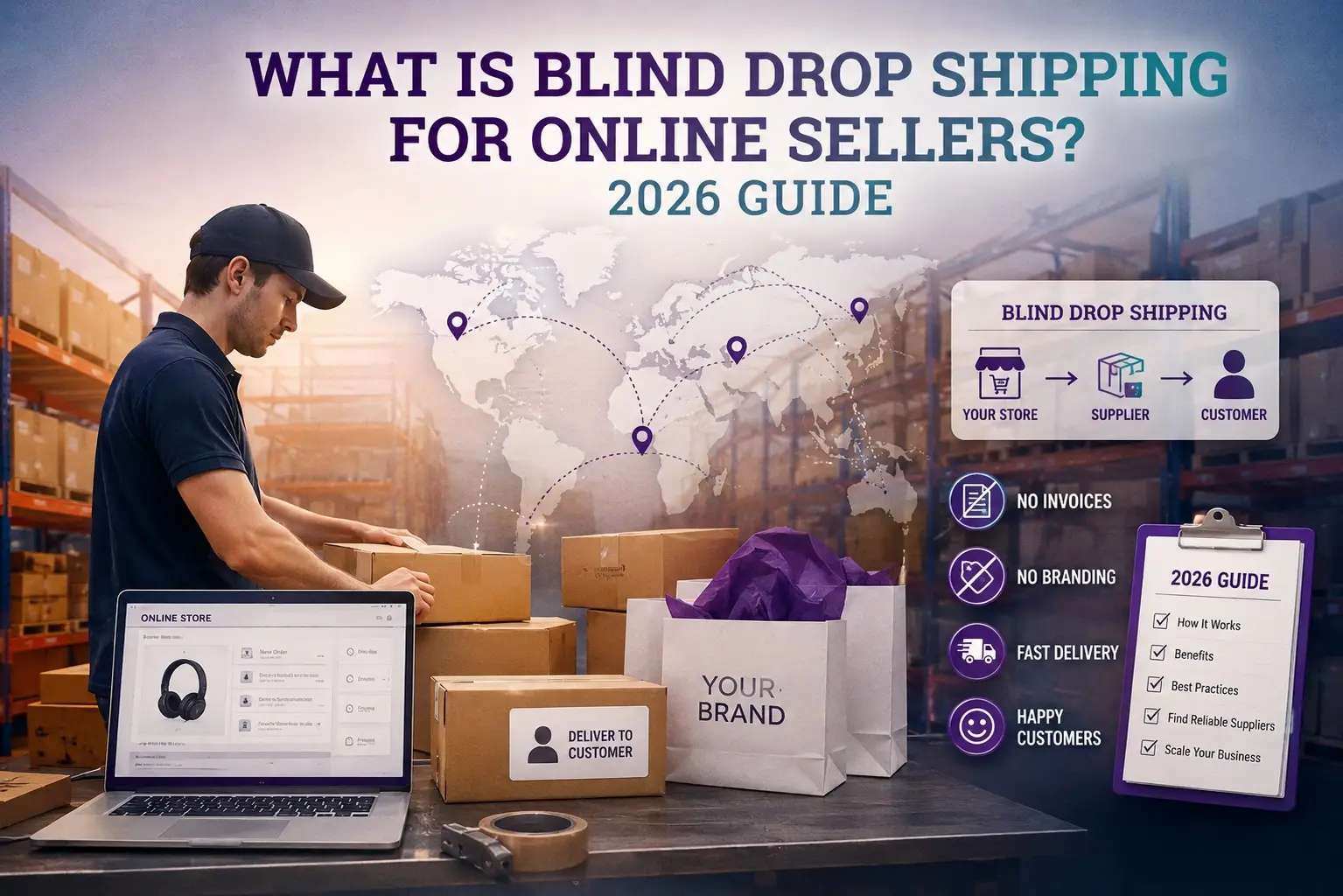
Blind drop shipping is a fulfillment method where your supplier ships directly to your customer but removes all traces of their own identity from the package. The customer receives the order believing it came straight from your store. Your supplier's name, invoice, and branding never appear anywhere in the box.
You just made your first sale. The order goes straight to your supplier in China. A few days later, your customer gets the package — and inside is the supplier’s invoice showing they paid $2.80 for a product you sold for $29. They feel cheated. They go directly to the source next time. You lose the customer and the repeat business.
This is the exact problem that blind drop shipping solves. It’s a simple fulfillment method, but a lot of sellers don’t understand it fully until after something goes wrong.
This guide explains everything: what blind drop shipping is, how it works, the difference between single and double blind shipping, and how to actually set it up with your suppliers using ready-to-use message templates.
What is Blind Drop Shipping?
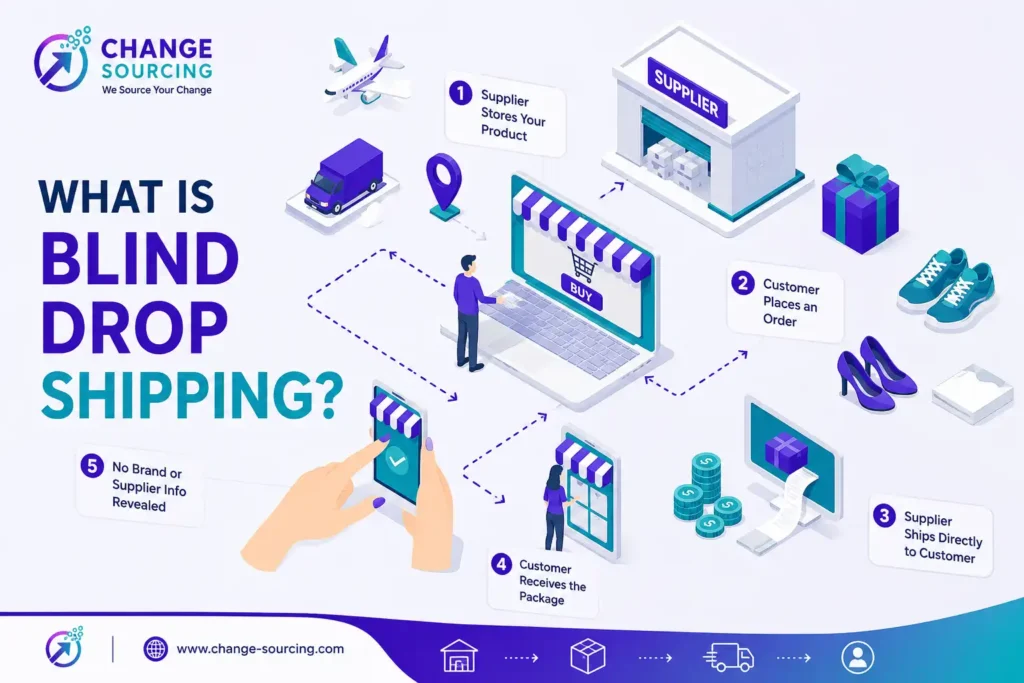
Blind drop shipping is a version of the regular dropshipping model with one key addition: your supplier hides their identity before the package reaches your customer.
The product still ships directly from the supplier's warehouse. But the customer only ever sees your business name on the label.
Think of it like a restaurant that buys ingredients from a local food supplier. The restaurant doesn’t want the delivery truck parked out front with a big logo on the side telling diners exactly who grew the lettuce and what they paid for it. The food still arrives the same way. The supplier just parks around the back.
That’s blind drop shipping in a nutshell. The supply chain stays the same. The customer’s experience stays clean and focused on your brand.
What Gets Removed from the Package
When a supplier ships blind, several things are stripped from the package before it goes out the door.
Here is what you can expect to be removed:
- The supplier’s name and logo from the outer packaging
- Any packing slip or invoice that shows the wholesale price
- Promotional inserts, catalogs, or branded materials
- The supplier’s return address (replaced with yours)
- Supplier details from the shipping label and Bill of Lading
What remains is a neutral package with your business name as the sender. The customer has no way of knowing who actually fulfilled the order.
What is a Bill of Lading and Why Does It Matter?
A Bill of Lading (often shortened to BOL) is a legal shipping document that travels with every freight shipment. It identifies who shipped the goods, where they came from, and where they are going.
For most consumer packages, this is handled automatically by the courier. But in B2B freight, LTL (less-than-truckload) shipments, and larger commercial orders, the BOL is a physical document. Anyone who handles the shipment can read it.
In blind drop shipping, the supplier’s name is removed from the BOL before the shipment leaves. A blank or modified BOL replaces it.
This is critical for sellers who import larger volumes, because competitors can legally request BOL records to identify who you buy from. Blind shipping closes that door.
Why Do Retailers Use Blind Drop Shipping?

There are three main reasons retailers request blind shipping from their suppliers. Each one protects a different part of the business.
Protecting Your Brand Identity
Customers build loyalty based on what they see and feel. If someone orders a skincare product from your Shopify store and the package arrives from “Shenzhen Cosmetics Factory No. 7,” that experience falls apart instantly.
Your website, your packaging copy, your social media — all of it creates a brand. Blind shipping makes sure the final delivery matches everything else you’ve built. The customer stays inside your brand world from the moment they order to the moment they open the box.
This matters more than ever. According to PwC's Global Consumer Insights Survey, 65% of consumers say a positive brand experience is more influential than great advertising. Your delivery is part of that experience.
Preventing Customers from Bypassing You
Here is the financial risk. A customer receives a package with the supplier’s name on it. They search for that name, find the supplier’s website, and realize they can buy the same product for $3 instead of paying you $30.
You lose them not just for that order — permanently. And if one customer figures it out, others will too. Blind shipping removes the breadcrumb trail entirely. There is no supplier name to search, no invoice to check, nothing to follow.
Keeping Your Suppliers Secret from Competitors
If you’ve spent months finding a great supplier in China with strong quality and competitive pricing, that is a business asset. Competitors actively look for that information.
In larger freight shipments, BOLs are semi-public records. A competitor who intercepts your shipment paperwork could identify your supplier and go directly to them. Blind shipping prevents this.
The documents show your name, not the factory’s.
Single Blind vs. Double Blind Drop Shipping: What’s the Difference?
Here is a proper breakdown:
| Feature | Single Blind | Double Blind |
|---|---|---|
| Customer sees supplier? | No | No |
| Supplier sees customer? | Yes (needs address to ship) | No (3PL handles this) |
| Who manages it? | eCommerce sellers, small to medium volumes | Third-party logistics (3PL) or freight forwarder |
| Cost | Usually free | Additional 3PL fee ($1–$3/unit typically) |
| Best for | eCommerce sellers, small-medium volumes | High-volume importers, B2B intermediaries |
| Protection level | Strong | Maximum |
Single Blind Shipping Explained
In single blind shipping, the customer never learns who the supplier is. But the supplier does know the customer's address, because they need it to ship the order.
This is the standard setup for most eCommerce dropshippers. You instruct your supplier to strip their branding and invoice from the package.
The supplier fulfills the order as normal, just without any identifying materials inside.
It’s the simplest form and usually costs nothing extra. Most suppliers who work with dropshippers are used to this request. For the vast majority of online sellers, single blind is all you need.
Double Blind Shipping Explained
Double blind shipping goes one step further. Neither the customer nor the supplier knows anything about the other party. A third-party logistics (3PL) provider or freight forwarder sits in the middle and replaces both names with their own on all paperwork.
Here is how it flows: you send the 3PL the order details. The 3PL purchases from your supplier under its own name, receives the goods, repackages them, and ships them to the customer using your brand name as the sender.
The supplier never sees the customer’s address. The customer never sees the supplier’s name.
This level of protection is mainly used by high-volume importers and B2B middlemen who have significant supply chain value to protect. It is more expensive and logistically more complex.
How Does Blind Drop Shipping Work? Step by Step
The process is simpler than it sounds. Here is exactly what happens from the moment a customer orders to the moment the package arrives at their door.
Step 1: Customer Places an Order on Your Store
Your customer visits your Shopify store, your Amazon listing, or whichever platform you sell on. They pay your retail price. From their perspective, it is a completely normal purchase from your brand.
Step 2: You Forward the Order to Your Supplier
You place the order with your supplier at the wholesale price. This is where you make your margin. Along with the shipping address, you include a clear instruction to ship blind.
More on exactly what to say is discussed below in the blog.
Step 3: The Supplier Strips Their Identity
The supplier prepares the order as normal, but removes everything that identifies them. No invoice with wholesale pricing and no branded packaging inserts. Also, there will be no packing slip in their name.
The return address is changed to yours (or left blank, depending on what you specify).
Step 4: The Carrier Picks Up and Delivers
The shipment leaves the supplier’s warehouse and is handed to the carrier. The package looks like it came from you. The customer receives it, opens it, and has no indication of where it actually originated.
The entire supply chain ran invisibly. Your brand is the only thing the customer ever sees.
Blind Drop Shipping vs. Regular Dropshipping: Key Difference
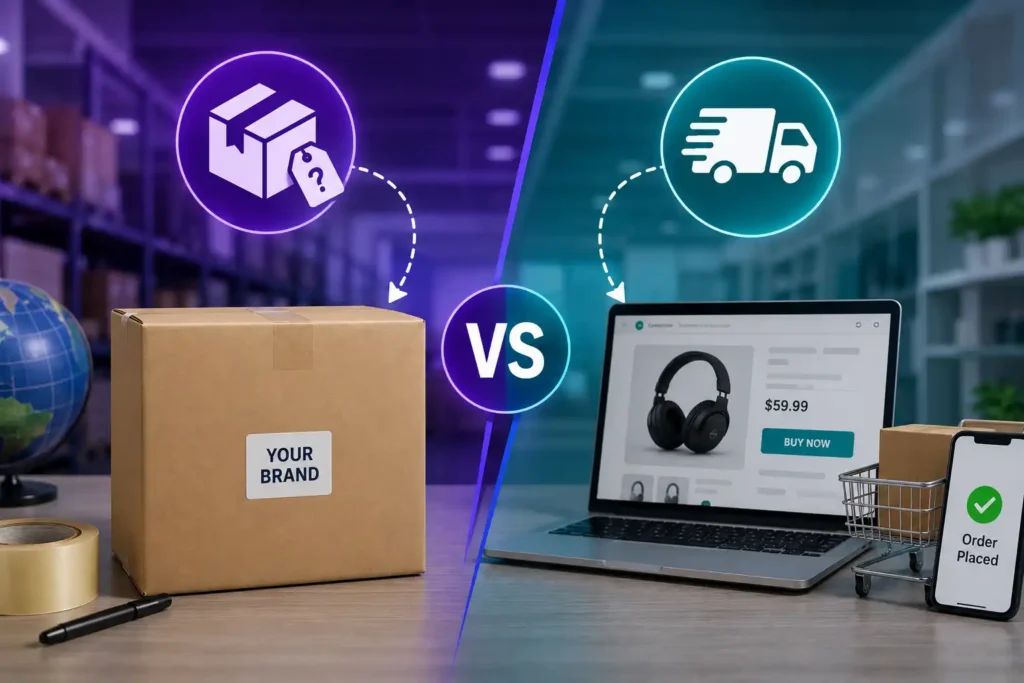
These two terms get mixed up constantly. The distinction is important.
Regular dropshipping is a fulfillment model. It means products ship directly from the supplier to the customer without passing through you. You never hold inventory. That is the model.
Blind drop shipping is a privacy layer added on top of that model. It does not change how the goods move. It changes what information travels with them.
Every blind drop shipment is a drop shipment. But not every drop shipment is blind.
Think of it this way: regular dropshipping is like being a travel agent who books flights through an airline. Blind dropshipping is like being a travel agent who books flights through an airline and makes sure the ticket never shows the airline’s name — only yours.
Suggested Read: Blind Shipping vs Drop Shipping: Key Differences Explained (2026)
| – | Regular Dropshipping | Blind Drop Shipping |
|---|---|---|
| Supplier ships direct? | Yes | Yes |
| Supplier identity hidden? | No | Yes |
| Invoice included? | Sometimes yes | Never |
| Customer sees wholesale price? | Risk: yes | No |
| Brand experience? | Inconsistent | Consistent |
How to Request Blind Shipping from Your Supplier: Message Templates
Knowing what blind shipping is does not help you if you don’t know how to actually ask for it. Below are three ready-to-use templates for different situations.
Template 1: General Supplier Request by Email
Use this when you are emailing a supplier for the first time or setting up a new product line.
Subject: Blind Shipping Requirement for All Orders
Hi [Supplier Name],
Thank you for working with us on this product line. I wanted to confirm a packaging requirement for all orders we place with you going forward. We kindly ask that you ship all orders blind. This means: – Please do NOT include any invoice, receipt, or pricing information in the package. – Please do NOT include your company name, logo, or any promotional materials. – Please use our company name and return address as the sender on all shipments. – Our return address is: [Your Company Name], [Your Address] We are a dropshipping business and our customers order directly from our branded store. Your cooperation with this request is greatly appreciated and will help us maintain a long-term relationship with high order volumes.
Please confirm you can fulfill orders under these conditions.
Thank you, [Your Name] [Your Company]
Template 2: AliExpress Checkout Note (Copy-Paste Ready)
When you order on AliExpress, there is a message field at checkout where you can leave instructions for the seller. Paste this note into that field with every order.
I am a dropshipper. Please DO NOT include any invoice, receipt, QR code, promotional materials, or your brand name/logo in the package or on the label. Please ship blind. Ship as soon as possible. Thank you for your cooperation — I will place regular repeat orders.
A quick note on supplier selection: when sourcing on AliExpress, look for suppliers with a feedback score between 2,000 and 2,000,000. Below 2,000 means they are too new to be reliable.
Above 2,000,000 means they are doing very high volume and may not pay attention to individual order notes. The sweet spot gets you an experienced, attentive supplier who understands dropshipping.
Template 3: Chinese-Language Note for Factory-Direct Suppliers
If you work directly with Chinese factories through Alibaba or factory contacts, including a note in Chinese significantly improves compliance. Warehouse staff may not read English instructions well, but they will read Chinese ones.
请务必盲发 (Blind Shipping Required): - 包装内不要放任何发票或收据 (No invoice or receipt inside the package) - 不要放任何工厂的宣传单或广告 (No factory promotional materials) - 面单上请不要出现中文字符 (No Chinese characters on the shipping label) - 发件人信息请使用以下地址 (Use the following as the sender address): [Your Company Name], [Your Address] - 不要显示工厂名称或联系方式 (Do not show factory name or contact details) 感谢合作,我们会长期下单。(Thank you for your cooperation. We will place long-term orders.)
What to Do If a Supplier Refuses
Most established suppliers who work with eCommerce sellers will agree without hesitation. This is a standard request in the dropshipping industry.
If a supplier refuses, treat it as a red flag. Professional wholesale suppliers understand that their buyers have branding needs. A supplier who won’t accommodate a simple blind shipping request is either inexperienced with international eCommerce or not aligned with how your business works.
In that case, look for a different supplier. Platforms like Alibaba and AliExpress both have thousands of suppliers who offer blind shipping as a default for dropshipping buyers.
Suggested Reading: Best Ways to Verify China Suppliers in 2026 (Complete Checklist)
Blind Drop Shipping from China: AliExpress, Alibaba, and Factory Suppliers
The majority of dropshipping businesses source their products from China. The process of requesting blind shipping differs slightly depending on which channel you use.
Does AliExpress Blind Ship by Default?
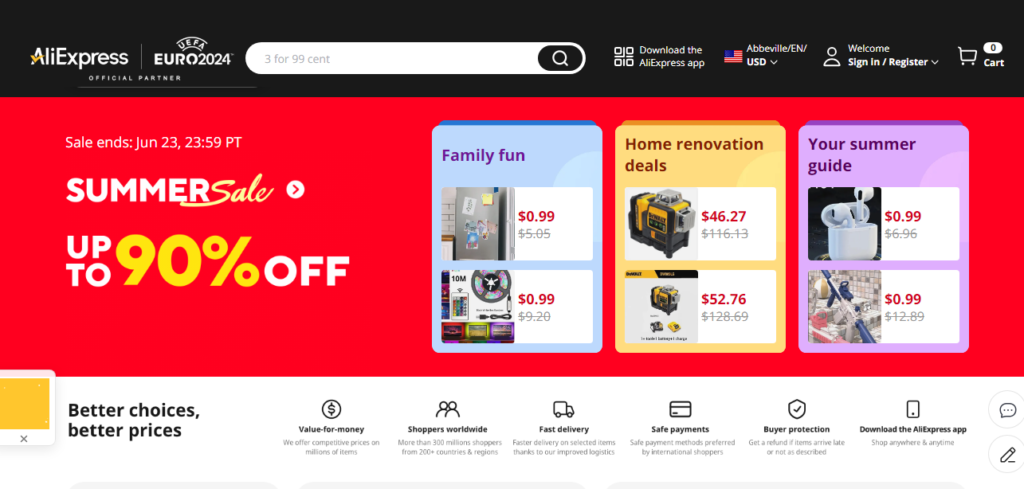
In most cases, yes. Established AliExpress sellers have been working with dropshippers for years. Most packages already arrive without invoices or promotional materials. But “most of the time” is not good enough when your brand reputation is on the line.
Always include the checkout note from Template 2 above with every single order.
It takes five seconds and eliminates any ambiguity. A supplier who sees that note and still includes branded materials is not a supplier worth keeping.
How to Set Up Blind Shipping with Alibaba Suppliers
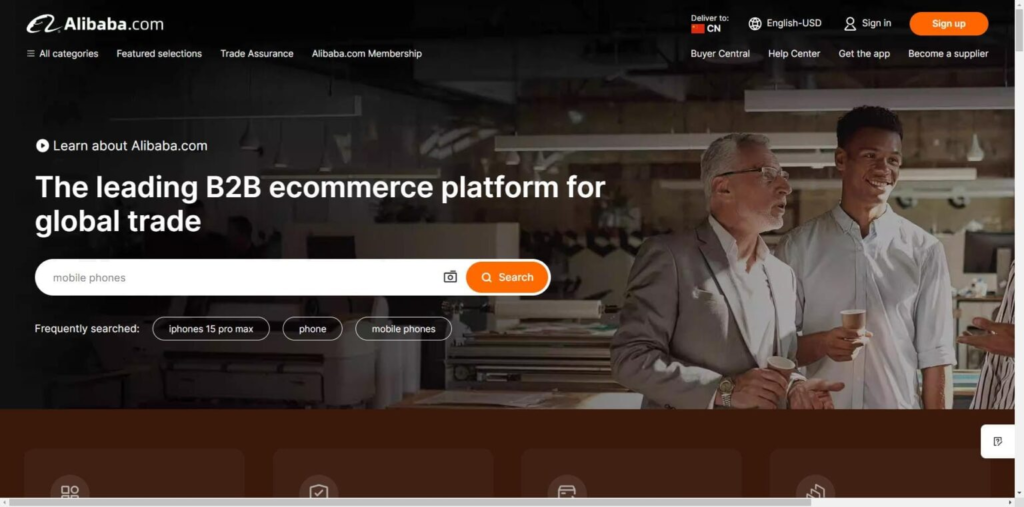
Alibaba is a B2B platform built for bulk orders. The process is more formal. You are negotiating with factory representatives, not individual sellers.
When you first contact a factory, include your blind shipping requirement in the initial inquiry. Do not wait until the purchase order stage.
Use the Chinese-language template above alongside your English instructions. Before placing a bulk order, request a sample and check the packaging to confirm they are following your instructions correctly.
Include your blind shipping requirement as a line item in your formal purchase order. This makes it a contractual obligation, not just a polite request. If they miss it after that, you have grounds to reship at their cost.
Suggested Reading: How to Contact China Manufacturers: 4-Step Guide for Beginners
Working with Freight Forwarders for Double-Blind Shipments
For high-volume or high-value shipments where you need maximum supply chain protection, a freight forwarder or 3PL can manage a double-blind arrangement. They receive goods from your supplier under their name, then reship them to your customers under your brand name.
This adds cost. But it completely severs the documentary link between your factory and your customers. If you are in a competitive niche where supply chain exposure is a real risk, double-blind through a freight forwarder is worth considering.
Suggested Reading: China Shipping Cost Guide for US Sellers (2025–2026)
CHANGE Sourcing Insights: How We Handle Blind Drop Shipping for Our Clients
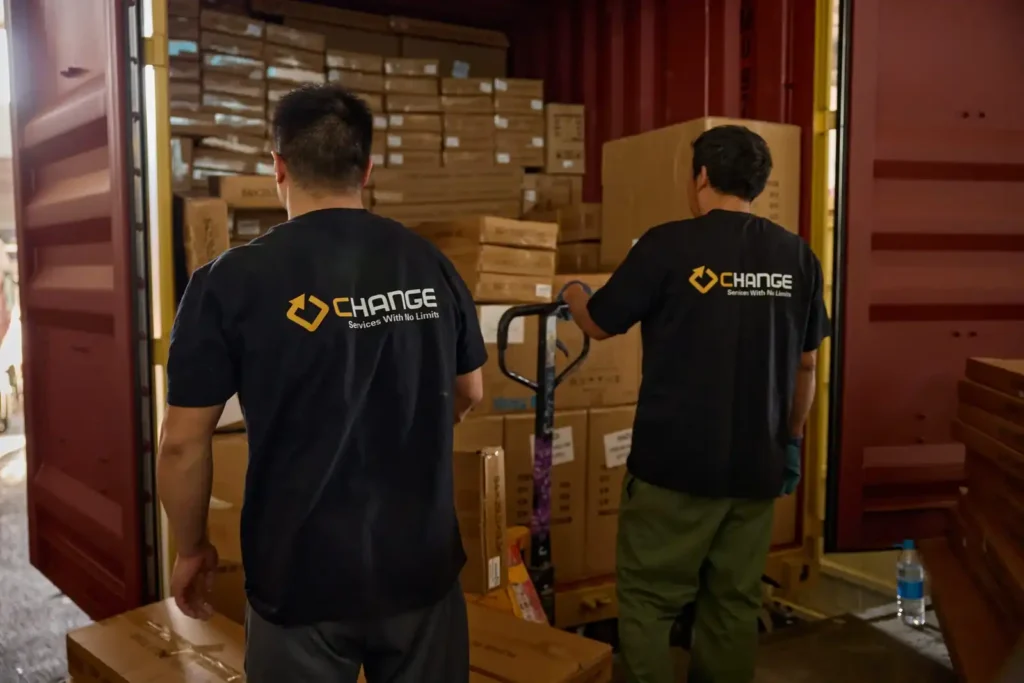
At CHANGE Sourcing, we work directly with factories in Yiwu and Guangzhou every day. Blind shipping compliance is one of the most common requests we handle for eCommerce clients, and it is also one of the easiest things to get wrong when you are doing it yourself for the first time.
Here is what typically goes wrong without proper oversight: the factory confirms blind shipping verbally, you pay for the bulk order, the goods ship, and three weeks later, your customer receives a box with the factory’s invoice and WeChat contact details stuffed inside.
Now you have a customer who knows your entire margin and a supplier who “forgot” your instructions.
We prevent this by building blind shipping requirements directly into the purchase order from day one. No informal notes, no assuming the factory will remember. It is written in English and Chinese in the PO, confirmed before production, and checked physically during the pre-shipment inspection.
What We Check During Pre-Shipment Inspection
Our quality inspectors physically open a representative sample of units before they are packed for shipping. They verify that no invoices are inside, no supplier promotional materials are present, no supplier logos appear on the outer box, and the return address matches the client’s specified details.
If anything is wrong at that stage, it costs almost nothing to fix. If you catch it after the goods have shipped, you are looking at a re-shipment, a refund request, and a damaged customer relationship.
For Double-Blind Arrangements
For clients who need full double-blind protection, CHANGE can act as the neutral intermediary. Your supplier ships to us. We verify the goods, repack them under your brand, and ship them to your customers.
The factory never sees your customer list. Your customers never see the factory name. The entire supply chain runs clean and protected.
If you are setting up blind shipping with Chinese suppliers and want to make sure it is done correctly the first time, our team is available for a free consultation. Contact CHANGE Sourcing here.
How Much Does Blind Drop Shipping Cost?
This is a question most sellers have. The honest answer depends on which type of blind shipping you are using.
Single Blind: Usually No Extra Cost
Asking your supplier not to include an invoice and to remove their branding costs you nothing extra in most cases. You are essentially asking them to do less, not more.
Suppliers who regularly work with dropshippers have this built into their fulfillment process already.
There may be a small cost if you ask the supplier to replace their return address label with a custom one carrying your branding. Depending on the supplier, this could be free or may involve a small per-unit fee of $0.10 to $0.50.
Double Blind: 3PL Fees Apply
Double blind shipping through a 3PL or freight forwarder involves real additional costs. These typically include a receiving fee, a repackaging or relabeling fee, and a re-shipment fee.
Rough cost ranges to budget for:
- 3PL receiving and inspection: $0.50–$1.50 per unit
- Repackaging or relabeling: $1.00–$3.00 per unit
- Custom branded inserts: $0.10–$0.50 per unit (if sourced separately)
- Branded outer packaging: Usually requires a minimum order of 500–1,000 units
At higher volumes, these costs become a small percentage of your overall margin. On a low-margin product selling for $12, the math is harder to justify. On a $60 product with 50% margins, double-blind protection makes strong business sense.
Suggested Reading: How to Source Products from China Cheaply in 2026
How Returns Work Under Blind Drop Shipping
This is the part that catches most sellers off guard. When a customer wants to return a product, and the supplier’s address is hidden, where does the return actually go?
The Return Address Is Yours
In a correctly set up blind shipment, the return address on the label is your business address (or a 3PL address). If a customer sends a return, it comes to you — not the supplier.
This is important to plan for before you start. You need a plan for what happens when a return lands. Your options are:
- Your own address or warehouse: You receive the return, inspect it, and either restock or dispose. Works if you have physical storage.
- A 3PL return centre: Your 3PL partner receives and processes returns on your behalf. Most professional 3PLs offer this service.
- Customer keeps the item, you refund: For low-cost goods sourced from China, international return shipping is often more expensive than the product itself. Many sellers simply refund or reship without requiring the return.
Avoid Sending Returns to the Supplier Directly
Do not instruct customers to return items to your supplier’s address. This instantly breaks the blind shipping arrangement. The customer now has the supplier’s contact details.
Everything you set up to protect your supply chain is undone in one return label.
If your supplier wants to examine defective goods, arrange a separate return shipment yourself after the customer returns them to your address. Keep those two processes completely separate.
Suggested Reading: How to Import Samples from China in 2026
When Should You NOT Use Blind Drop Shipping?
Blind shipping is not always the right move. There are situations where the extra steps add friction without adding meaningful value.
When You Sell Your Own Private Label Products
If you have negotiated exclusive branding with your manufacturer and the packaging already carries your logo and product name, blind shipping is redundant. The factory is already shipping under your brand. There is nothing to hide.
Suggested Reading: Buying Private Label Products from China: Complete Guide
When Your Margins Are Too Thin for 3PL Fees
For products where you are making $3 to $5 per unit, adding a $2 to $3 double-blind 3PL fee wipes out your profit. In these cases, single blind (free) is the better choice. Or reconsider whether the product margin works at all.
When Your Supplier is Already Your Manufacturer, and You Have Exclusivity
If you have a direct factory relationship, an exclusive manufacturing agreement, and the factory is not selling to anyone else in your market, the risk of supply chain exposure is much lower. Single blind is probably sufficient without needing to spend on double-blind arrangements.
When Extremely Fast Shipping is the Priority
Double blind shipping adds processing time. Goods go from the factory to 3PL to the customer, not straight to the customer. If your customers expect 2-day delivery and you are competing on speed, the additional step may hurt your competitive position.
FAQs about “What is blind Drop Shipping”
Yes, completely. Blind drop shipping is a legitimate and widely used business practice. You are not deceiving the customer about what they bought or the quality of the product. You are simply choosing not to reveal your supply chain. There is no law in the US, EU, UK, or Australia that requires you to disclose who fulfilled your order.
A blind Bill of Lading is a shipping document where the shipper’s name and contact details have been removed or replaced. In standard shipping, the BOL identifies the seller and the buyer. In blind shipping, the supplier’s information is stripped before the document leaves with the shipment. This is particularly important for freight and LTL shipments where the BOL is a formal document accessible to multiple parties.
Most established AliExpress sellers do ship blind by default, especially those with strong feedback scores and experience working with dropshippers. However, you should always request it explicitly using the checkout note template provided in this guide. Never assume it will happen without asking.
They are related but different. White label means you are selling a generic product under your own brand name. The product carries your logo and packaging. Blind shipping is about hiding the supplier’s identity during delivery, regardless of whether the product is white-label or not. You can use blind shipping with white-label products or with non-branded products. They serve different purposes.
Yes. In fact, this is the ideal setup. Instead of just removing the supplier’s branding, you ask the supplier to use your branded packaging, your custom packing slips, and your return address label. This turns a neutral blind shipment into a fully branded unboxing experience. Some suppliers offer custom insert printing for a small fee. Others require you to supply branded materials separately.
No. Private label dropshipping means you have your own branded product that a manufacturer produces for you. Blind drop shipping means you are hiding a third-party supplier’s identity during fulfillment. You can use both strategies together — private label products shipped blind — but they are separate concepts. A private label seller may not need blind shipping if their packaging already carries only their brand. A generic reseller absolutely does.
Final Takeaway
Blind drop shipping is one of those business fundamentals that sounds complicated but is actually very simple once you understand what it is. You are just asking your supplier to remove their identity from the package. That’s the whole thing.
The most important step is making the request clearly and in writing with every single order. The templates in this guide make it a copy-paste process.
The returns process and cost structure are worth planning before you scale. Single blind costs nothing and covers most e-commerce use cases. Double blind is worth the fee at higher volumes or in competitive niches where your supply chain is a genuine business asset.
If you source products from China and want every shipment to leave the factory with proper blind shipping compliance already verified, CHANGE Sourcing’s team handles exactly this.
From purchase order specification to pre-shipment inspection to full double-blind arrangements, we make sure the process runs cleanly every time. Get a free consultation here.
You might also like to read: