

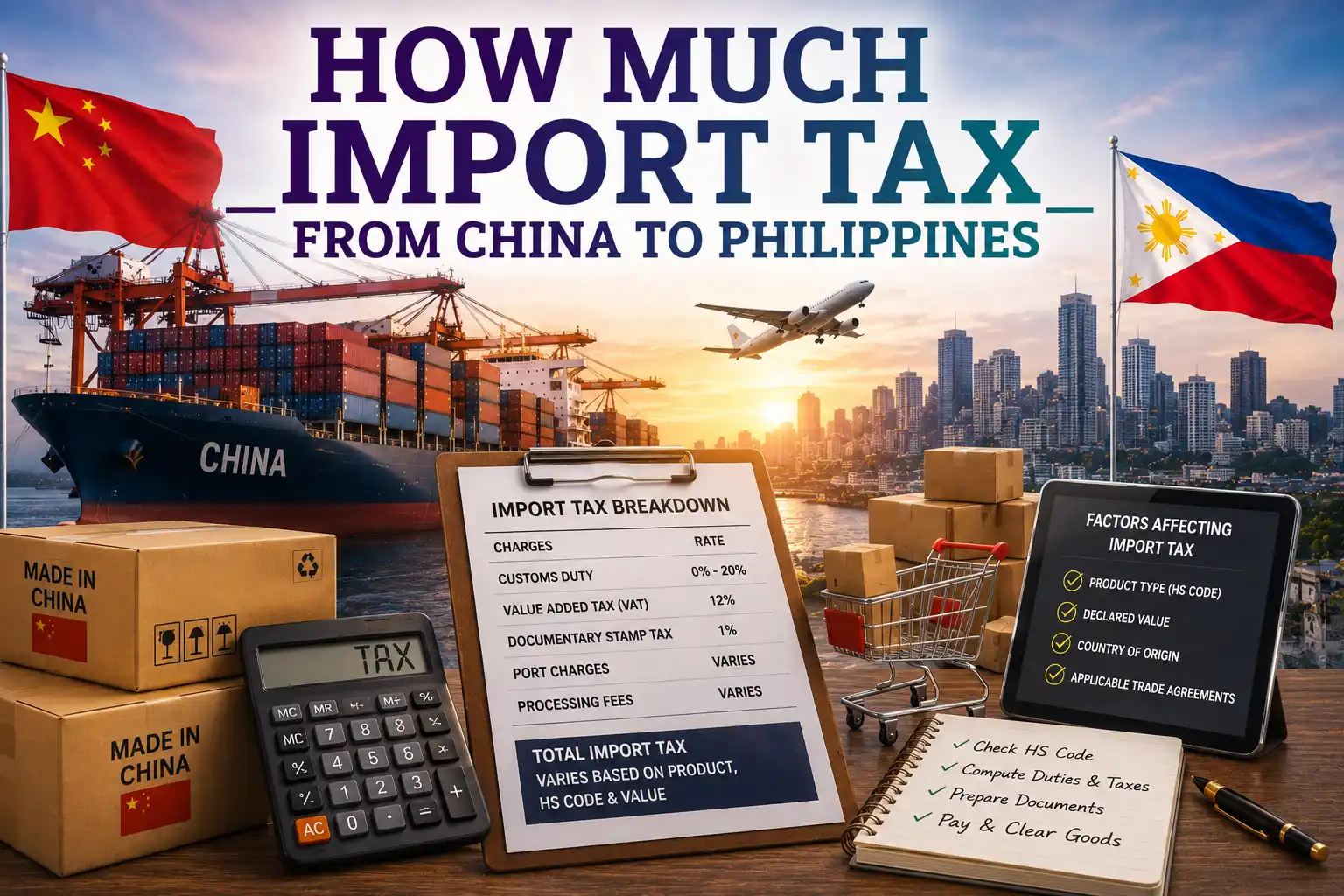
Most importers from China to the Philippines end up paying more than they should. Not because the tax rate is unfair, but because they ship first and calculate later. Knowing the numbers before your goods leave China is what separates a smooth import from a costly surprise at customs.
This guide covers the exact formula, real PHP worked examples, product-specific duty rates, and the most common mistakes that inflate your tax bill.
How Much Import Tax Do You Pay from China to the Philippines?
Importing from China to the Philippines typically costs 3% to 30% in customs duty plus a flat 12% VAT, both calculated on the CIF value of your shipment. Some China-origin goods qualify for 0% duty under the ASEAN-China Free Trade Agreement (ACFTA), depending on your product and paperwork.
According to the Philippine Tariff Commission, most manufactured goods from China fall in the 3% to 15% duty range. Electronics, laptops, and mobile phones often carry 0% customs duty. Agricultural goods and processed food can go as high as 65%.
The 12% VAT applies to virtually every shipment, even when customs duty is 0%. That is often the number people forget to factor in.
What Taxes Apply When Importing from China to the Philippines?
Three charges apply to most commercial imports: customs duty, VAT, and, in some cases, excise tax. Each is calculated on the CIF value using the Bureau of Customs (BOC) standard formula.
Customs Duty
Customs duty is assessed based on the 8-digit AHTN/HS code of your product. The rate ranges from 0% to 65%, with most Chinese-manufactured goods sitting between 3% and 15% under Most Favoured Nation (MFN) rates.
The Philippines follows the ASEAN Harmonised Tariff Nomenclature for classification.
Value Added Tax (VAT)
A flat 12% VAT is charged on the total VAT base, which includes your CIF value, customs duty, and brokerage fees. This applies to personal and commercial imports alike.
According to the Bureau of Internal Revenue (BIR), VAT cannot be avoided unless the goods fall under specific BIR-approved VAT-exempt categories.
Excise Tax
Excise tax applies only to specific products: alcohol, tobacco, petroleum, vehicles, cosmetics, jewelry, minerals, and sweetened beverages.
It is charged on top of customs duty and VAT. For example, imported vehicles face a separate excise tax schedule under the Tax Reform for Acceleration and Inclusion (TRAIN) Law.
Brokerage and Handling Fees
These are not government taxes, but they factor into your landed cost. A licensed customs broker typically charges PHP 1,500 to PHP 5,000 for standard shipments. These fees are added to the VAT base before the 12% VAT is applied.
What is CIF and Why Does It Matter?
CIF stands for Cost, Insurance, and Freight. It is the total declared value of your goods, including the purchase price, shipping cost, and insurance, which the BOC uses as the basis for all duty and tax calculations.
Here is a simple way to think about it. You buy a product for USD 500. Shipping costs USD 80, and insurance is USD 5. Your CIF value is USD 585, not USD 500. The BOC calculates duty and VAT on USD 585. If you only declared the product cost, the BOC will reassess the value and can impose penalties for undervaluation.
Undervaluing goods at the Philippine customs is treated as fraud under the Customs Modernization and Tariff Act (CMTA).
Penalties include surcharges up to 600% of the tax owed, seizure of goods, and criminal liability.
How is Import Tax Calculated from China to the Philippines?
Import tax is calculated in four steps: convert your CIF to PHP, apply the duty rate, build your VAT base, then apply 12% VAT. The total of all these charges is your landed cost.
The Formula:
Step 1: CIF Value (PHP) = (Product Cost + Freight + Insurance) × USD/PHP exchange rate

Step 2: Customs Duty = CIF Value (PHP) × Applicable Duty Rate

Step 3: VAT Base = CIF Value + Customs Duty + Brokerage Fees + Excise Tax (if any)

Step 4: VAT = VAT Base × 12%

Step 5: Total Landed Cost = CIF Value + Customs Duty + Brokerage + Excise + VAT
Worked Example: Import Tax Calculation in PHP
Here is a complete calculation for importing electronics from China. Electronics (HS Code 8471) carry a 0% MFN duty rate in the Philippines.
| Item | Value |
|---|---|
| Product cost | PHP 50,000 |
| Shipping (freight) | PHP 7,000 |
| Insurance | PHP 1,000 |
| CIF Value | PHP 58,000 |
| Customs duty (0%) | PHP 0 |
| Brokerage fee | PHP 2,500 |
| VAT Base | PHP 60,500 |
| VAT (12%) | PHP 7,260 |
| Total Tax + Fees | PHP 9,760 |
Now compare that to importing garments (HS Chapter 61), which carry a 15% MFN duty rate.
| Item | Value |
|---|---|
| CIF Value | PHP 58,000 |
| Customs duty (15%) | PHP 8,700 |
| Brokerage fee | PHP 2,500 |
| VAT Base | PHP 69,200 |
| VAT (12%) | PHP 8,304 |
| Total Tax + Fees | PHP 19,504 |
The difference is PHP 9,744 on the same shipment value. Your product category, not just the CIF value, determines your total cost.
Duty Rates for Common Products from China
The table below shows common import categories with their typical duty rates. Always verify using the official Philippine Tariff Commission Finder before shipping, as rates can change under executive orders.
| Product Category | HS Code Example | MFN Duty Rate | ACFTA Rate |
|---|---|---|---|
| Laptops/Electronics | 8471.30 | 0% | 0% |
| Mobile phones | 8517.12 | 0% | 0% |
| Clothing/garments | 6109.10 | 10–15% | Reduced |
| Footwear | 6403.99 | 3–10% | Reduced |
| Toys | 9503.00 | 0–5% | 0% |
| Furniture | 9403.60 | 10% | Reduced |
| Cosmetics | 3304.99 | 5–10% | Reduced + excise |
| Food items | Varies | 5–65% | Varies |
| Vehicles | 8703 | 10–30% | Not exempt |
Not sure which HS code applies to your product? Read our full breakdown: HTS Code vs HS Code: What Every Importer and Exporter Needs to Know (2026)
Does ACFTA Reduce Your Import Tax from China?
Yes. Under the ASEAN-China Free Trade Agreement, many goods manufactured in China qualify for 0% or reduced customs duty when imported into the Philippines. To claim this rate, your Chinese supplier must provide a valid Certificate of Origin Form E with every shipment.
Without Form E, the BOC defaults to the standard MFN duty rate. Form E cannot be obtained after the goods have already been shipped. Your supplier applies for it at their local commerce bureau in China before the goods leave.
Since June 2023, the Philippines has also been active under the Regional Comprehensive Economic Partnership (RCEP). RCEP uses a separate Form RCEP and sometimes produces a better rate than ACFTA for specific product categories. Ask your customs broker which agreement gives you the lower rate for your specific HS code.
Are Any Shipments Exempt from Import Tax?
Goods with an FOB value below PHP 10,000 are exempt from both customs duty and VAT under the Philippine de minimis rule. This is based on FOB value, not CIF.
One trap many small importers miss: if multiple parcels ship to the same recipient on the same day, the BOC can consolidate them and treat them as a single shipment.
If the combined FOB value exceeds PHP 10,000, full taxes apply on everything. This is particularly relevant for those buying from Alibaba or 1688.com and splitting orders across multiple parcels.
What Documents are Required for Customs Clearance from China to the Philippines?
Every commercial import requires a Commercial Invoice, Packing List, and Bill of Lading or Airway Bill at a minimum. These shipping documents must match your cargo markings exactly, or the BOC may hold your shipment for inspection.
Depending on the product, you may also need a Certificate of Origin (Form E for ACFTA), an FDA certificate, an import permit, and a Customs Import Declaration. Additional product-specific permits include:
- FDA License to Operate (food, cosmetics, drugs, medical devices)
- DENR permit (chemical products, wildlife)
- NTC Type Approval (electronics and telecom devices)
- SPS import permit (agricultural products and processed food)
Before your goods leave China, make sure your supplier has completed a pre-shipment inspection so that quantity, quality, and labeling all match your commercial invoice. Discrepancies at this stage are far cheaper to fix than problems at Philippine customs.
How Can You Legally Reduce Import Tax from China to the Philippines?
The most effective legal way to reduce import tax from China to the Philippines is to ensure your Chinese supplier provides a valid Certificate of Origin on every shipment, unlocking preferential 0% or reduced duty rates. You can also verify your product is classified under the most accurate HS code, since misclassification often results in a higher duty rate than necessary.
Use ACFTA Form E
Most China-manufactured goods qualify. Your supplier applies for Form E at their local commerce bureau before shipping. Without it, you pay the standard MFN rate even if the product qualifies for 0%.
Use RCEP Form RCEP
Also covers China and sometimes produces a better rate than ACFTA for specific categories. The Philippines has been under RCEP since June 2023.
Verify Your HS Code Classification
Misclassification at a higher heading means unnecessary overpayment on every shipment. A licensed sourcing agent or customs broker can audit your classifications and help you recover historical overpayment by filing a BOC protest within the allowable window.
Keep Individual Shipments Under PHP 10,000 FOB (for Small Orders)
Applicable to e-commerce or sample shipments only. Not suitable for commercial bulk imports. Beware the BOC consolidation rule explained above.
How to Import from China to the Philippines with CHANGE Sourcing

Simplifying Your Import Tax and Sourcing Process from China
CHANGE Sourcing is based in Yiwu and Guangzhou, two of China’s largest export hubs, and works directly with Philippine importers, resellers, and online sellers.
The team helps clients source products, consolidate shipments, and coordinate shipping documentation, including Certificate of Origin (Form E) from Chinese suppliers.
This matters because many importers overpay customs duty simply because their supplier did not include Form E. Getting this paperwork right before the goods leave China directly reduces what you pay at the Philippine BOC.
CHANGE Sourcing also coordinates third-party product inspections before shipment, so your goods arrive in the condition described on the commercial invoice.
If you are importing from China to Manila, Cebu, or other Philippine ports, contact CHANGE Sourcing for a freight quote or FREE sourcing consultation.
Frequently Asked Questions
Packages with an FOB value below PHP 10,000 are generally exempt from customs duty and VAT. Above this threshold, full taxes apply even on small parcels from Lazada or Shopee sellers shipping directly from China.
Most electronics including laptops, phones, and tablets carry a 0% customs duty rate in the Philippines. However, 12% VAT still applies on the CIF value of the shipment.
The de minimis threshold is PHP 10,000 based on FOB value. Below this amount, no customs duty or VAT is charged on imports.
Yes. The 12% VAT applies to virtually all taxable imports regardless of duty rate. Even goods with 0% customs duty are subject to the 12% VAT on the CIF value, as outlined by the BIR.
At minimum you need a Commercial Invoice, Packing List, and Bill of Lading or Airway Bill. For ACFTA preferential rates, you also need Certificate of Origin Form E. Product-specific permits from the FDA, DENR, or NTC may apply depending on your goods.
Final Words
Understanding your tax obligations before shipping is the most effective way to protect your margins. Customs duty ranges from 0% to 30% for most goods, VAT is always 12% on CIF, and ACFTA can bring your duty to zero with the right paperwork.
Use the Philippine Tariff Commission Finder to check your specific HS code and rate before your next order leaves China.
You Might Also Like to Read:
- HTS Code vs HS Code: What Every Importer and Exporter Needs to Know (2026)
- Shipping Marks Explained: Types, Rules, Examples for Importers
- How to Find a Sourcing Agent in China: Complete Step-by-Step Guide (2026)
- Top 10 Third-Party Inspection Companies in China in 2026
- What is the Purpose of Pre-Shipment Inspection in Shipping?