

You met a great supplier at the booth. The samples looked perfect, the price was low, and the sales rep was friendly. Now they ask for a deposit. Before you send a single dollar, you need to know how to verify suppliers in Canton Fair the right way.
A booth tells you very little. A real factory, a trading company, and a small team with a laptop can all rent the same stand. This guide gives you a 3-stage process: before the fair, at the booth, and before you pay.
The 140th session is running now, and Phase 3 takes place from October 31 to November 4, 2026. Use these steps whether you are still in Guangzhou or already back home.
Quick answer: To verify suppliers in Canton Fair, shortlist exhibitors on the official site, ask the right questions at the booth, get the Chinese company name and business licence, check the company on the official register, and match the names on the licence, invoice and bank account before you pay.
Why You Need to Verify Suppliers in Canton Fair?
The Canton Fair is huge. The 139th session welcomed 314,000 overseas buyers from 220 countries and regions. The 140th session fills 1.55 million square meters of exhibition area. With that many booths, picking the wrong supplier is easy.
A booth only shows that a company paid for space. It does not show that the company owns a factory, holds the right licence, or can ship on time. Think of the fair as an introduction, not a background check.
Money is the real risk. Once a deposit leaves your account, getting it back from another country is slow and often impossible. That is why every check in this guide happens before you pay.
Common Problems Buyers Face
Most losses follow a few repeat patterns. Watch for these:
- A trader posing as a factory. You pay factory prices but cannot get technical answers.
- A borrowed licence. The paperwork is real, but it belongs to another company.
- A moving quote. The price rises after the deposit is paid.
- The wrong bank account. Your money goes to a company or person you never checked.
Stage 1: Before the Fair
Good verification starts weeks before you land in Guangzhou. So you need to keep in mind the following important points!
Shortlist Exhibitors on the Official Website
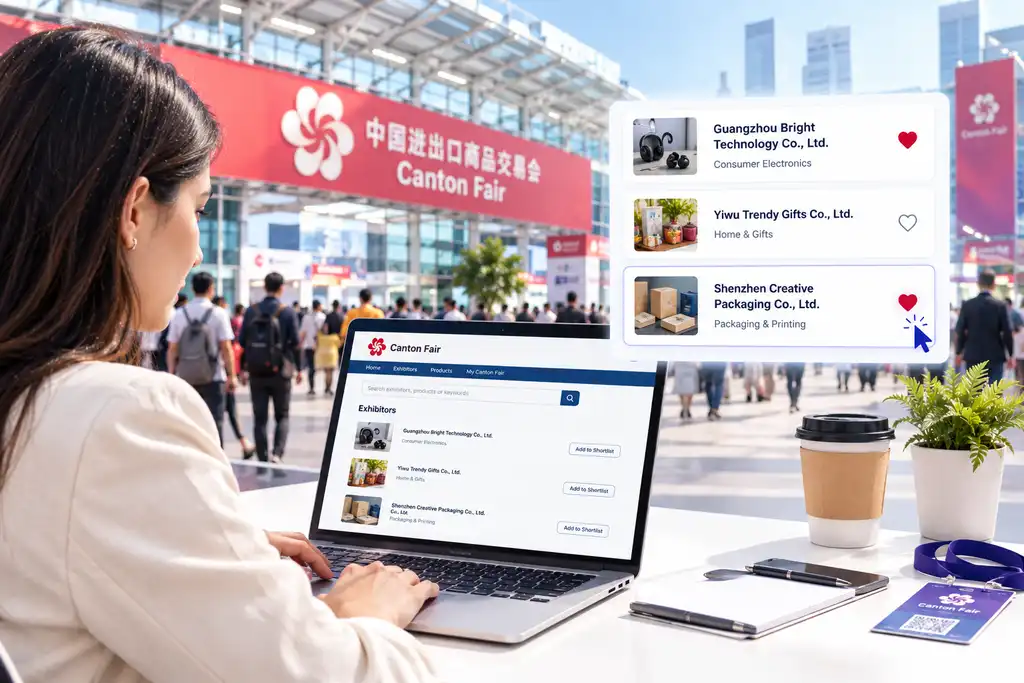
Use the official Canton Fair website to search exhibitors by product, company name, or booth number. Each phase has different exhibitors, so check which phase fits your product. Then build a simple sheet with the company name, booth number, and phase.
You can also look at a company’s profile on Alibaba or Made-in-China. A profile is a hint, not proof. Use it to compare details, such as names and addresses, with what the supplier tells you later.
Request Documents by Email
Email your shortlist before you travel. Ask for the business license, the full Chinese company name, and the factory address. Real companies usually reply fast. A slow or vague reply is your first warning sign.
Sample Request Email
“Hello, I plan to visit your booth at the 140th Canton Fair. Please send a copy of your business licence, your full Chinese company name, and your factory address. Thank you.”
Stage 2: At the Booth
You only have a few minutes at each stand, so bring a short list of questions.
Ask These Questions
- Do you own the factory? Ask them to name the city and district where it sits.
- Which products do you make yourself? Listen for clear, specific answers.
- What are your MOQ and lead time? Makers usually answer quickly. Vague answers suggest another factory makes the goods.
- Can we do a live video call from the workshop this week? A real factory can say yes.
- Which countries do you export to? Export experience helps with packing, papers, and shipping.
- Who is the legal representative on your licence? The person you speak with should know.
Spot a Factory or a Trading Company
Factories tend to focus on one product family. Their staff can explain materials, tooling, and defect rates without checking a phone. A booth that shows electronics, toys, and garden tools side by side is more likely a trader.
Trading companies are not bad. They can be a smart choice for small or mixed orders. The problem starts when a trader claims to be a factory.
Record Everything
Take a photo of the booth sign, the sales rep’s business card, and the products you liked. Write down the booth number and the answers you got. Later, you can compare them with what the supplier sends.
Stage 3: Before You Pay a Deposit

This is the stage that protects your money. Most of it you can do yourself in a few hours.
Step 1: Get the Chinese Company Name and Licence
A Chinese company’s legal name is its Chinese name. The English name on the card is only a translation that the company chose. Ask for a clear scan of the business licence, not a blurry photo.
The licence lists the company name, an 18-character unified social credit code, the legal representative, the registered address, and the business scope. If a supplier delays or refuses, take that seriously.
Step 2: Check the Official Register
China runs a public database called the National Enterprise Credit Information Publicity System. It is free, but the site is in Chinese. Search by the Chinese name or the credit code, and use a translation tool carefully.
What to Check
Status: the company should be active, not cancelled or revoked.
Details: the name, code, and address should match the licence you received.
Age: a “20-year-old factory” registered last spring needs a good explanation.
Warnings: look for entries on abnormal operations or penalties.
Step 3: Read the Business Scope
The business scope lists what the company may legally do. A maker’s scope usually includes words like production, manufacturing, or processing. A trader’s scope leans toward sales, wholesale, and import and export.
Step 4: Match the Names on Every Document
Put three documents side by side: the licence, the proforma invoice, and the bank details. The company name on all three should be the same. If it is not, ask why and request papers that prove the link between the companies.
If the bank account belongs to a person, stop. A company-to-company order should not go to a personal account.
Step 5: Confirm the Address and Ask for a Live Video Call

Compare the licence address with the factory address the supplier gave you. Look both up on a map. A “factory” in the middle of an office tower is probably an office.
Then ask for a short live video call from the workshop. Ask them to show your product and the company sign at the gate. A real factory can do this the same day.
Step 6: Review the Quote Line by Line
A quote is more than a price. Make sure it states the exact model and specs, the price term (EXW, FOB, or CIF) and port, the packing type, the lead time and its start date, and how long the price stays valid.
Step 7: Check Payment Terms and Bank Changes
For a first order, a deposit of around 30% is common, with the balance paid before shipping. Be careful if a supplier demands full payment up front.
Watch out for emails that announce a “new bank account.” The FBI’s Internet Crime Complaint Center reported about US$3.05 billion in business email compromise losses in 2025. Always call the person you met at the fair, using a number you already have, before you pay into a changed account.
Red Flags That Should Make You Stop
If you see any sign below, pause the order and dig deeper. One may have an innocent reason. Several together are a clear signal to walk away.
| Red flag | What it may mean | What to do |
|---|---|---|
| Refuses to send a licence | No legal registration | Stop and look elsewhere |
| Licence name differs from invoice | Hidden middleman or borrowed licence | Ask for proof of the link |
| Bank account is personal | Higher fraud risk | Do not pay |
| No live video from the workshop | Not a real factory | Request a visit or inspection |
| Price far below all others | Missing costs or a bait-and-switch | Compare full quotes |
| Pushes for 100% payment up front | You carry all the risk | Negotiate a deposit and balance |
How Deep Should You Verify?
Match the depth of checking to the risk. A small test order needs less effort than a large, repeat one.
| Order size | Minimum checks |
|---|---|
| Small sample order | Licence, official register, name match, live video call |
| Mid-size order | All of the above, plus a sample test and a third-party factory audit |
| Large or repeat order | On-site visit, pre-shipment inspection, and a written contract reviewed by a lawyer |
A document check shows whether a company is real, not whether the goods are good. If you want a partner for this, our guide on how to choose the best sourcing agent in China shows what to look for.
How to Verify Suppliers in Canton Fair With Change Sourcing

Did you know? Phase 3 of the 140th Canton Fair runs from October 31 to November 4 and focuses on a better life, with categories such as fashion, food, and health products. If you are looking for new products or suppliers, there is still time to explore.
CHANGE Sourcing is a full sourcing service provider with more than 18 years of experience and 1,500+ clients. We help you find suppliers, check them, inspect the goods, and ship them.
Our team works through the fair and after it, so you do not have to handle every check alone.
What We Can Do for You
We find vetted suppliers that match your product needs. Also, we check licenses, company names, and factory details, and our inspection teams visit factories to check quality and compliance. We further handle freight, customs clearance, and delivery, with one team following your order.
Meet Us at the Canton Fair
Visiting the fair? Our team is available through all three phases to discuss your sourcing needs. See our 140th Canton Fair page to book a guide, or request a free consultation.
- Yiwu Head Office: 11th Floor, Building 4, Zhongfu Plaza, Financial District, Yiwu City, Zhejiang Province
- Guangzhou Branch Office: Room 2617-2618, South Tower, World Trade Center, #371-375 Huanshi East Road, Guangzhou
- WhatsApp: +86 177 5808 8106
- Email: contact@change-sourcing.com
- Website: change-sourcing.com
FAQs about “Verifying Suppliers in Canton Fair”

No. An exhibitor has registered and paid for a booth. Factories, traders, and agents all exhibit, so check every company yourself.
Yes. The official register is free to search. You need the Chinese company name or credit code, and you may need a translation tool to read the results.
Read the business scope on the licence. Makers list production or manufacturing, while traders list sales and trade. Then ask for a live video from the workshop to confirm.
Do it after you receive a written quote and before you send any money. For the 140th session, that means starting as soon as you leave the booth.
Conclusion
The Canton Fair is a great place to meet suppliers, but a booth is not proof. Prepare before the fair, ask sharp questions on the floor, and check the paperwork before you pay. Follow the three stages above, and you will avoid the most common and costly mistakes.
You might also like to read: