

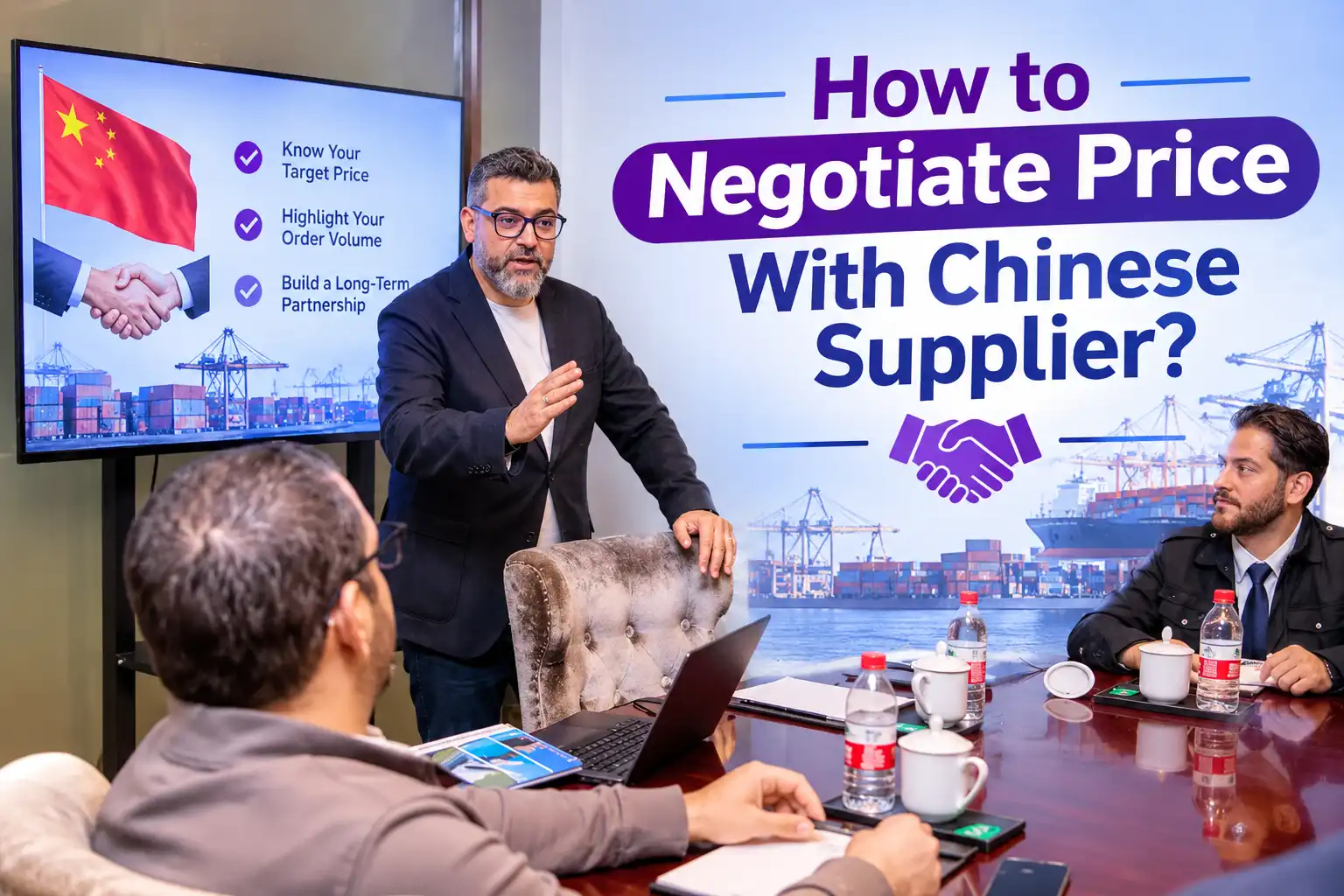
Yes, you can negotiate price with a Chinese supplier. Confirm you are talking to a factory, collect three quotes, and ask for a cost breakdown. Then trade levers like quantity, deposit, and packaging instead of only asking for a discount. Lock your specs in writing so quality does not drop. Know your walk-away price before the first message.
Most first-time buyers send one polite message: “Can you give me a better price?” The supplier cuts 2% and the talk ends.
That is not a failed negotiation. It is a missing plan. A vague ask gets a vague discount.
This guide shows how to negotiate price with Chinese supplier teams the right way. You get a clear process, word-for-word scripts, and a table of levers that really move the price.
Every step has a short example. The numbers are rounded and meant to show how the math works. Use them as a model for your own order.
The same logic applies whether you buy in Yiwu, Guangzhou, or online. You will also learn which mistakes end good deals.
Can You Negotiate Price With a Chinese Supplier?
Yes. Most Chinese suppliers expect a counter-offer, so the first quote is rarely the lowest price. How much you save depends on who you deal with, how much you order, and how well you prepare. A small, fair cut is normal. A huge cut often means lower quality.
Who you talk to matters. A factory controls its own costs. A trading company adds its own margin, so it has less room to move.
Example: A buyer asks two suppliers for 1,000 phone stands. The trader quotes $2.40 and the factory quotes $2.10.
The buyer pushes the trader for $2.10, but the trader says no because its own cost is almost the same. The buyer should have moved the order to the factory.
What Should You Do Before You Start Negotiating?

Do four things first. Confirm the supplier is a real factory, collect three quotes for the same spec, check market prices, and set a target price and a walk-away price. A buyer with numbers sounds serious. A buyer without numbers gets the first price.
Confirm Who You Are Talking To
Ask for the business license, factory photos, and a live video call from the workshop. Our guide on how to verify suppliers in Canton Fair gives the full checklist.
Compare Prices on Alibaba, 1688, and the Canton Fair
Alibaba shows export prices. 1688 shows domestic Chinese prices, which help you spot an inflated quote.
The Canton Fair in Guangzhou lets you compare many factories in one visit.
Set a Target and a Walk-Away Price
Your target is the price you want. Your walk-away price is the highest price that still leaves you a profit. Write both down before you send the first message.
Example: A US seller plans to sell a lamp for $11. After shipping, duty, and a 35% margin, the most they can pay the factory is $5.20.
Their target is $4.80. They now know exactly when to say yes and when to walk away.
How Do You Read a Chinese Supplier’s Quote?

Ask for the quote in parts: materials, labor, packaging, tooling, freight terms, and margin. One unit price hides where the money goes. A breakdown shows which part you can change without hurting quality.
Use a simple message: “Thank you for the $4.00 quote. Could you share a cost breakdown so we can see where to adjust the spec?”
Do not accuse the supplier of padding the price. You are asking to understand the cost, not to attack it.
Example: A silicone phone case is quoted at $4.00. The breakdown shows $0.60 for a custom box and insert.
The buyer switches to the standard box at $0.35. The price drops by $0.25, or about 6%, and the case itself does not change.
Which Levers Work Better Than Asking for a Discount?
Quantity, deposit size, packaging, delivery terms, bundled orders, and timing all move the price. Offer something the factory values and ask for a lower price in return. Factories like bigger orders, faster cash, and simple production.
| Lever | What You Offer | What You Can Ask For | Example |
|---|---|---|---|
| Quantity ladder | A bigger order or a repeat order plan | A lower price at each tier | Ask for prices at 500, 1,000, and 2,000 units |
| Smaller MOQ | A slightly higher unit price | A lower minimum order | Pay $0.15 more per unit for a 300-piece test order |
| Deposit size | A larger deposit or a faster balance | A lower unit price | Offer 40% up front, with the balance after inspection |
| Packaging | Standard packaging | A lower unit price | Skip the custom gift box |
| Bundled products | Several products from one factory | A better price on the total | Add two similar items to one order |
| Timing | An order when the factory is less busy | More flexible price and lead time | Ask when the factory’s slow weeks are |
A bigger deposit raises your risk. Pay it only to a verified factory, and pay the balance after inspection.
Also ask every supplier to quote under the same Incoterms rule, such as FOB. Two quotes with the same unit price can hide very different freight costs.
What Should You Say? Word-for-Word Scripts
Be polite, specific, and give a reason. Name your target price and quantity, then explain why. Keep every message short. Use WeChat or WhatsApp for fast replies, then confirm the final deal in writing.
First Counter-Offer Script
“Thank you for the quote. We like your samples. For an order of 1,000 pieces, our target is $4.40. Other quotes are close to this level. Can you work with us on price?”
Deposit and Payment Script
“If we pay a 40% deposit today and the balance after inspection, can you offer $4.60 per piece?”
Example: From First Quote to Final Deal
A buyer receives a $5.00 quote for 1,000 pieces. In round one, the buyer counters at $4.40 with standard packaging. The supplier replies at $4.80.
In round two, the buyer asks for a ladder price at 2,000 pieces. The supplier offers $4.55. The buyer accepts after the supplier confirms the spec in writing.
The final saving is $0.45 per piece, or 9%.
How Do You Get a Lower Price Without Losing Quality?

Fix your specs, materials, and samples in writing before you talk price. Then negotiate cost against that fixed spec. Add a pre-shipment inspection. This stops the factory from using cheaper parts to protect its margin.
Put the material grade, size, color, and packaging in the purchase order. Keep the approved sample. Compare the bulk order to it before you pay the balance.
Example: A buyer wins 10% off a power bank order, but the spec only says “high-quality battery.” The factory fits a lower-grade cell.
The buyer rewrites the spec with the exact cell brand and adds an inspection. The next order arrives as approved.
What Mistakes Make Chinese Suppliers Walk Away?
These mistakes end good deals:
- Offering a very low price with no reason
- Comparing a factory with a trading company
- Changing the spec after the price is agreed
- Negotiating only by email
- Pushing for zero profit, which makes the factory cut corners
How to Negotiate Price With Chinese Supplier Through Change Sourcing

A sourcing agent negotiates for you on the ground. The agent checks the factory, asks for the cost breakdown, compares quotes, and handles the price talk in Chinese. At Change Sourcing, our team also inspects goods before your balance is paid, so price and quality stay linked.
Our head office is in Yiwu’s Central Business District. Our Guangzhou branch is in Yuexiu District.
Case Study: 2,000 LED Desk Lamps for a US Seller
The goal: An online seller in US wanted 2,000 LED desk lamps. The target was $5.10 per unit, and the maximum was $5.50.
The quotes: A trading company quoted $6.80. Two factories quoted $5.90 and $5.75. Our team checked both factories and chose the $5.90 one for its better samples and steady output.
The breakdown: The cost breakdown showed $0.55 for a custom gift box. A standard box cost $0.20. That one change cut the price to $5.55.
The ladder: The $5.90 quote was for 1,000 pieces. We asked for the 2,000-piece tier, which brought the price to $5.30.
The payment terms: The client paid a 40% deposit, with the balance due after our inspection. In return, the factory dropped the price to $5.15.
The spec: The purchase order named the LED chip brand and the base material. This kept the lamp the same as the approved sample.
The result: The final price was $5.15, about 13% below the first quote. On 2,000 lamps, the client saved about $1,500. Figures are rounded for illustration.
Want help with your own price talk? Message us on WhatsApp, email contact@change-sourcing.com, or visit www.change-sourcing.com.
FAQs

Is It Rude to Negotiate Price With a Chinese Supplier?
No. Suppliers expect a counter-offer. Be polite, give a reason, and avoid comments about their honesty or quality. A calm, specific request shows respect and often gets a better answer than a demand.
How Much Discount Can I Realistically Ask For?
There is no fixed number. Factories can move more than trading companies, and larger orders give more room. Ask for a cost breakdown first. It shows whether a small cut or a bigger cut is possible without hurting quality.
Can I Negotiate a Lower Deposit on a First Order?
Sometimes. A smaller deposit is easier after a few clean orders. For a first order, you can offer staged payments or pay the balance after inspection. This shares the risk between you and the factory.
Should I Negotiate on WeChat or Email?
Use both. WeChat or WhatsApp is faster and builds rapport. Email is better for final terms. After any chat, send a short written summary of the price, quantity, spec, and payment terms so nothing is lost.
Final Thoughts
Negotiating price with a Chinese supplier is a skill you can learn. Prepare your numbers, ask for the breakdown, trade levers, and lock the spec. Stay polite and know when to walk away. Send your first counter-offer today and see how much room your quote really has.
You Might Also Like to Read