

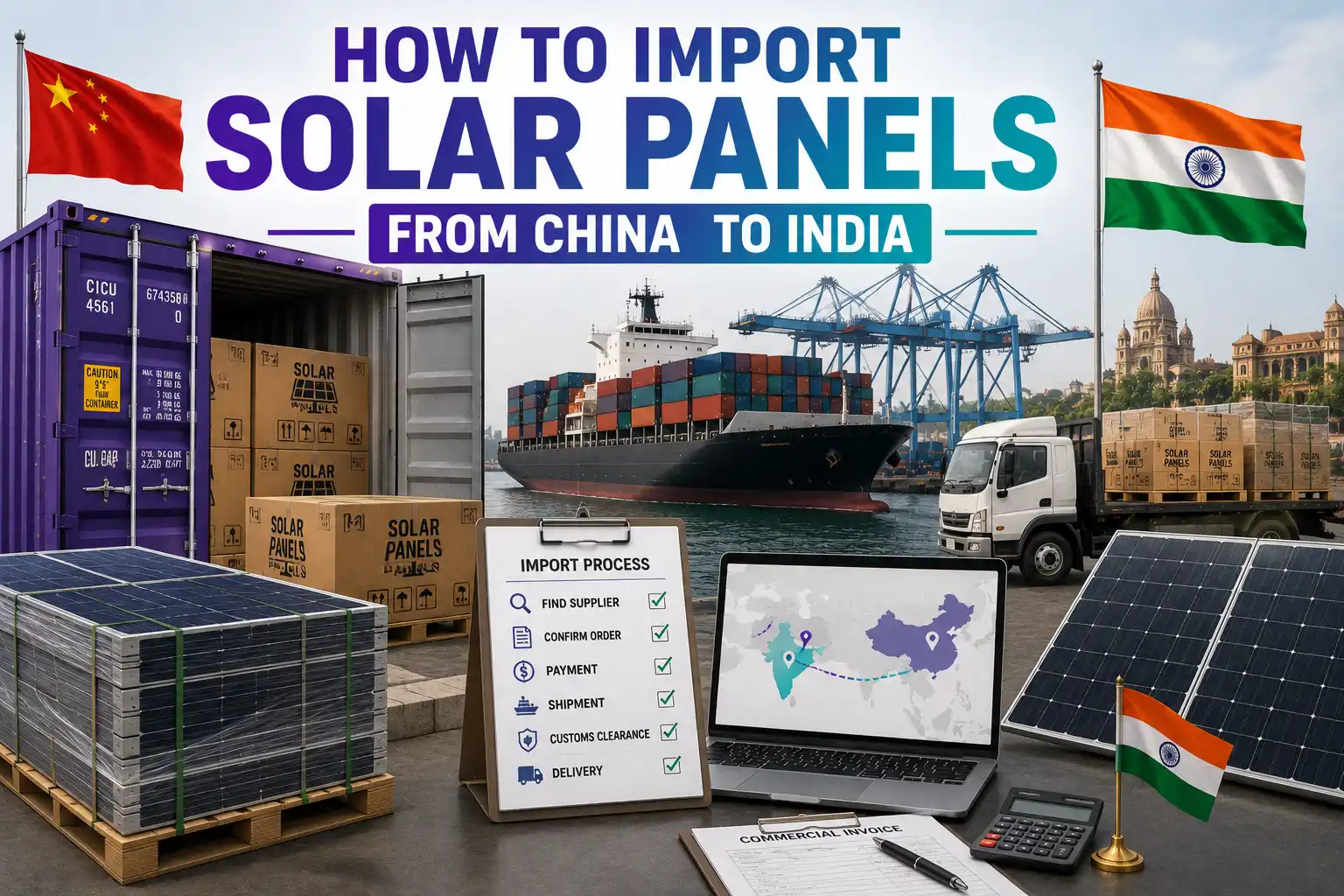
To import solar panels from China to India, you need to find a BIS-certified Chinese supplier, arrange sea freight to an Indian port, prepare all customs documents, including a Certificate of Origin, and clear your shipment through Indian Customs. Solar modules (HS code 8541.43) currently attract a 20% Basic Customs Duty plus a 20% Agriculture Infrastructure and Development Cess (AIDC). Additional anti-dumping duties of 23% to 30% apply to most Chinese manufacturers, making total duty exposure significant. BIS certification under IS 14286 is mandatory — panels without it cannot legally enter the Indian market.
India is now the world’s third-largest solar energy producer. Total solar installed capacity crossed 150 GW in March 2026, and the country added a record 44.6 GW in FY 2025-26 alone.
Demand is massive — and a growing share of that demand is still met by imports from China, particularly for solar cells and modules used in commercial and industrial projects. This guide walks you through every step of the process clearly.
| Quick Summary: Importing Solar Panels from China to India | |
|---|---|
| HS Code (Solar Modules) | 8541.43 |
| HS Code (Solar Cells) | 8541.42 |
| Basic Customs Duty (BCD) | 20% (modules and cells, effective Feb 2, 2025) |
| Agriculture Infrastructure & Development Cess (AIDC) | 20% on modules / 7.5% on cells |
| Social Welfare Surcharge (SWS) | 4% on modules / 2.5% on cells (applied on BCD) |
| IGST | 5% (reduced from 12% effective Sep 22, 2025) |
| Anti-Dumping Duty (Chinese origin) | 0%, 23%, or 30%, depending on the manufacturer |
| Mandatory Certification | BIS (IS 14286 + IS 61730) — required before import |
| ALMM Restriction | Applies to government-funded projects only |
| IEC from DGFT | Mandatory for all commercial imports |
| Best Shipping Route | Sea freight — Guangzhou/Shenzhen to JNPT (Mumbai) or Chennai Port |
Why is India Still Importing Solar Panels from China in 2026?
India’s domestic solar manufacturing has grown fast. Module production capacity reached approximately 172 GW by March 2026. But cell manufacturing capacity is only around 29 GW — far short of what the country needs.
Indian module makers still rely heavily on Chinese cells to keep their production lines running.
For commercial and industrial (C&I) rooftop solar projects, imported Chinese panels remain an option. These projects are not bound by the Approved List of Models and Manufacturers (ALMM) restriction the way government-backed utility projects are.
Chinese panels also tend to be significantly cheaper even after duties, with some market estimates suggesting a price gap of over 50% compared to domestically produced cells.
The GST reduction from 12% to 5% on solar equipment, which took effect on September 22, 2025, has also improved the economics.
The Indian solar market is growing at a 19.05% CAGR and is forecast to reach 348.57 GW by 2031. That trajectory makes it one of the most commercially attractive markets in the world for solar equipment suppliers and importers.
You might also find this useful: Top 8 Fast Selling Products to Import from China
Which Type of Solar Panel Should You Import from China for India?
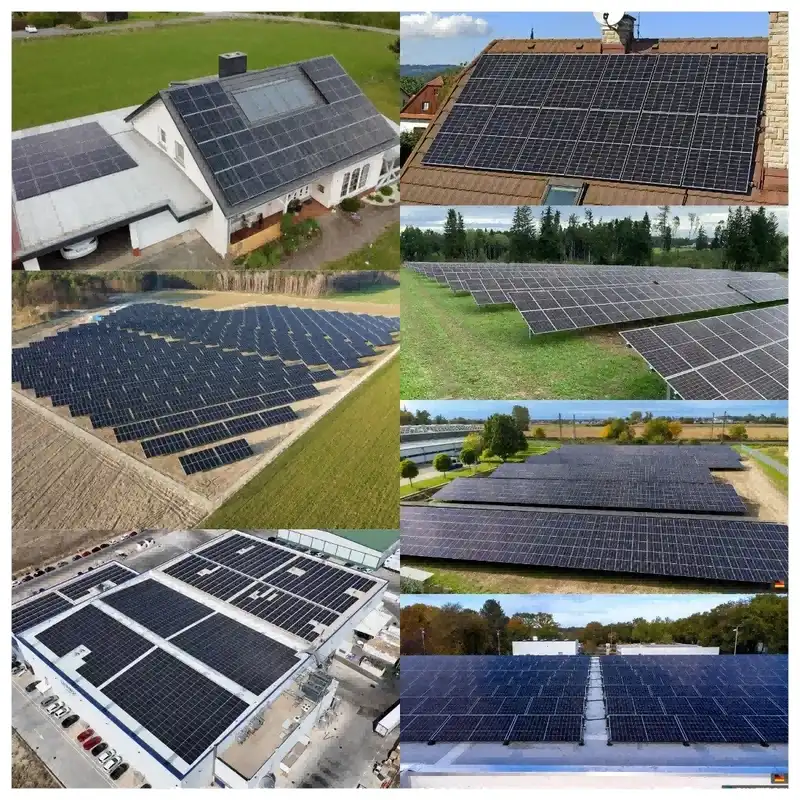
For Indian conditions — high ambient temperatures, intense UV exposure, and dust accumulation in northern and central regions — N-type TOPCon and bifacial panels perform best.
Standard polycrystalline panels degrade faster in heat and deliver lower output in Indian irradiance conditions.
Which Panel Technology Works Best in India’s Climate?
| Panel Type | Efficiency | Suitable for India? |
|---|---|---|
| Polycrystalline | 15–17% | Not recommended — poor heat tolerance, faster degradation |
| Monocrystalline PERC | 19–21% | Good — widely used, bankable, strong track record in India |
| TOPCon (N-Type) | 22–23% | Excellent — lower temperature coefficient, better desert output |
| HJT Bifacial | 23–25% | Best ROI for rooftop — bifacial gain in high-albedo Indian environments |
Also note the 2025 Quality Control Order (QCO): MNRE now mandates minimum efficiency thresholds of 18% for mono-crystalline panels and 17% for poly-crystalline panels.
This effectively rules out most low-grade polycrystalline options from entering the Indian market at all.
What Certifications Must Chinese Solar Panels Have for India?
This is where India differs most from other markets. Two layers of certification are required:
International certifications (from the Chinese supplier):
- IEC 61215 — photovoltaic module performance qualification (mandatory base standard)
- IEC 61730 — safety qualification for PV modules
- ISO 9001 — quality management system
- TUV Rheinland or Bureau Veritas — preferred for bankability
Indian BIS certification (mandatory for market entry):
- IS 14286 (Part 1): 2023 — crystalline silicon PV module design qualification
- IS/IEC 61730-1 & 2: 2016 — safety requirements under Indian standard
- Panels without BIS certification under the Compulsory Registration Scheme (CRS) cannot legally be imported or sold in India
Foreign manufacturers must appoint an Authorized Indian Representative (AIR) to manage the BIS application process. The AIR submits documentation, coordinates lab testing, and liaises with BIS on the manufacturer’s behalf.
Plan 3 to 6 months for this process if your chosen supplier does not yet have BIS certification.
How Do You Find the Right Solar Panel Supplier in China for India?

Start with the major B2B platforms: Alibaba, Made-in-China, and Global Sources. Filter specifically for manufacturers — not trading companies — and confirm that they hold both IEC 61215/61730 certifications and active BIS registration for the Indian market.
BIS certification is the single biggest filter. If a supplier cannot show you a valid BIS CRS license for IS 14286, they cannot legally sell to Indian buyers.
Once shortlisted, verify their anti-dumping duty status. Under the DGTR final ruling issued on September 29, 2025, Chinese manufacturers fall into three tiers — 0%, 23%, or 30% anti-dumping duty depending on which producer group they belong to.
Jinko Solar and Trina Solar were granted nil duty (0%) as cooperative producers. Most non-named manufacturers face 30% ADD. Therefore, choosing a Jinko or Trina product versus an unspecified factory is not just a quality decision. It is a direct 30% landed cost saving.
Before finalising any supplier, run a pre-shipment inspection through a licensed third-party agency. Read about the top third-party inspection companies in China to pick the right partner for this step.
Red Flags to Watch When Sourcing Chinese Solar Panels for India
- Supplier cannot provide a valid BIS CRS license number — do not proceed regardless of price
- Panel efficiency claimed above 26% for crystalline silicon — not commercially available at scale in 2026
- Pricing below $0.12/W for TOPCon modules — likely mislabeled specs or inferior cells
- Supplier refuses to share the datasheet with the temperature coefficient data
- Anti-dumping duty category not disclosed — this affects your total landed cost significantly
- 100% upfront payment demanded via wire transfer with no trade assurance protection
What are the Import Duties on Solar Panels from China to India?
India applies one of the most complex duty structures for solar panels in the world. As of 2026, importing solar modules from China involves Basic Customs Duty (BCD), Agriculture Infrastructure and Development Cess (AIDC), Social Welfare Surcharge (SWS), Integrated GST (IGST), and — for most Chinese manufacturers — an additional anti-dumping duty (ADD).
All of these stack on top of each other.
What is the Basic Customs Duty (BCD) on Solar Modules from China?
The BCD on solar modules was reduced from 40% to 20% in the Union Budget 2025, effective February 2, 2025. Solar cells also saw a reduction from 25% to 20%. This was the first significant relief since BCD was imposed in April 2022.
What is the AIDC on Imported Solar Panels?
The Agriculture Infrastructure and Development Cess (AIDC) was introduced alongside the BCD reduction. It is 20% on solar modules and 7.5% on solar cells.
The AIDC applies to the CIF value of goods and does not replace BCD — it is an additional charge layered on top.
What is the Social Welfare Surcharge (SWS)?

The SWS is 4% on modules and 2.5% on cells, calculated on the BCD amount. Think of it as a surcharge on a surcharge — it is relatively small, but it adds to the total.
What IGST Applies to Solar Panels Imported from China?
IGST on solar panels was reduced from 12% to 5% from September 22, 2025. It applies to the CIF value plus all customs duties combined.
The IGST you pay at import is fully reclaimable as Input Tax Credit (ITC) against your future GST liabilities, provided you are GST-registered — so the economic impact is lower than the headline number suggests.
What is the Anti-Dumping Duty (ADD) on Chinese Solar Panels?
This is the most important duty for importers of Chinese panels to understand. On September 29, 2025, India’s DGTR recommended three-year anti-dumping duties on solar cells and modules from China.
The recommended rates depend on the manufacturer:
| Manufacturer Group | Anti-Dumping Duty Rate |
|---|---|
| Jinko Solar group, Trina Solar group (cooperative producers) | 0% (nil duty) |
| Aiko Solar Group | 23% of CIF value |
| All other non-specified Chinese producers | 30% of CIF value |
The Ministry of Finance is responsible for officially notifying and enforcing these duties. Confirm the current notification status with your customs broker before signing any supply contract.
What Does the Total Landed Cost Look Like?
Here is a realistic cost breakdown for a bulk solar module import from a Jinko Solar factory (0% ADD) vs a non-named Chinese producer (30% ADD), on a CIF value of $100,000:
| Duty Component | Jinko/Trina (0% ADD) | Other Chinese Producer (30% ADD) |
|---|---|---|
| CIF Value | $100,000 | $100,000 |
| BCD (20%) | $20,000 | $20,000 |
| AIDC (20% on modules) | $20,000 | $20,000 |
| SWS (4% on BCD) | $800 | $800 |
| Anti-Dumping Duty | $0 | $30,000 |
| IGST (5% on all above) | ~$7,040 | ~$8,540 |
| Total Duty + Tax | ~$47,840 | ~$79,340 |
That is the real-world cost difference between choosing the right supplier and the wrong one. The ADD alone adds $30,000 per $100,000 of goods. Supplier selection in India is a financial decision, not just a quality one.
For a complete breakdown of how Chinese import taxes work across product categories, also read: Import Tax from China: Rate & Real Examples
What is the ALMM Requirement and Does It Affect You?
ALMM stands for Approved List of Models and Manufacturers. It is maintained by the Ministry of New and Renewable Energy (MNRE) and lists only domestically manufactured solar modules and cells that are approved for use in government-backed projects.
If you are supplying solar panels to a government project, a SECI tender, a DISCOM project, or any government-funded scheme, your panels must come from an ALMM-listed manufacturer.
Chinese panels are not on this list and cannot be used for these projects.
If you are supplying commercial and industrial (C&I) rooftop projects, private developers, or EPC contractors working outside government schemes, the ALMM restriction does not apply to you. Most private solar installers and distributors fall into this second category.
From June 2026, ALMM List II for solar cells also takes effect. This restricts which cells can be used to manufacture modules for government projects.
For importers supplying the private market, this does not change your situation — but it does tighten the regulatory environment overall and is worth tracking.
What Documents Do You Need to Import Solar Panels from India?

You need an Importer Exporter Code (IEC), a commercial invoice, a packing list, a Bill of Lading, a Certificate of Origin, and confirmation of your supplier’s BIS certification.
The IEC is mandatory for all commercial imports into India and must be obtained from the Directorate General of Foreign Trade (DGFT) before your first shipment.
| Document | Purpose |
|---|---|
| Importer Exporter Code (IEC) | Mandatory for all commercial importers — apply at DGFT before first shipment |
| Commercial Invoice | Declares value, HS code, buyer, seller, and goods description |
| Packing List | Details quantity, weight, and dimensions per carton |
| Bill of Lading / Airway Bill | Proof of shipment and carrier contract |
| Certificate of Origin (Form A or general CO) | Establishes the Chinese origin for the anti-dumping duty assessment |
| BIS CRS License (supplier’s) | Confirms panels meet IS 14286 and IS 61730 — must be verified before shipping |
| Bill of Entry | Filed with Indian Customs through your Customs House Agent (CHA) |
| Test Reports (BIS-approved lab) | May be required during customs inspection to verify BIS compliance |
| Insurance Certificate | Required for marine cargo insurance claims |
What is an IEC, and How Do You Get One?
An Importer Exporter Code (IEC) is a 10-digit business identification number issued by the Directorate General of Foreign Trade (DGFT). It is compulsory for any company or individual importing goods commercially into India.
The application is done online through the DGFT portal, and issuance typically takes 2 to 3 working days. You only need one IEC — it covers all future import and export transactions.
How Do You Ship Solar Panels from China to India?

Sea freight is the right choice for bulk solar panel shipments to India. A standard 40-foot container holds 1,000 to 1,200 panels.
Transit time from Guangzhou or Shenzhen to JNPT (Nhava Sheva, Mumbai) runs 12 to 18 days. Chennai Port is the alternative for South Indian delivery destinations, with similar transit times.
Sea Freight vs Air Freight for Solar Panels to India
| Factor | Sea Freight | Air Freight |
|---|---|---|
| Transit time (China to India) | 12–18 days to JNPT/Chennai | 4–6 days |
| Cost per unit | Low — suitable for bulk | 4–6x higher per kg |
| Best for | Bulk commercial orders (FCL) | Samples and urgent small shipments |
| Risk of damage | Medium — requires proper crating | Lower |
FCL vs LCL: Which Container Option Should You Use?
For orders above 400 panels, a Full Container Load (FCL) gives you better unit economics and reduced handling risk. Below 400 panels, use Less than Container Load (LCL) and pay for the cubic meters your shipment occupies.
LCL involves more cargo handling at consolidation, which increases the chance of minor panel damage — so proper crating matters even more for LCL shipments.
What Incoterms Should You Negotiate for Indian Solar Imports?
FOB (Free On Board) is the most practical starting point for most Indian importers. Your Chinese supplier loads the goods at the export port, and your freight forwarder takes over from there.
If you have an experienced logistics partner, FOB gives you full control over freight costs and carrier selection.
For first-time importers, DDP (Delivered Duty Paid) removes the logistics burden from your side — but it comes at a premium and means less visibility into shipping costs.
CIF (Cost, Insurance, Freight) is a middle ground: the supplier covers freight and insurance to the Indian port, and you handle customs from there.
Working with an experienced sourcing agent in China can help you negotiate the best Incoterm arrangement and coordinate logistics on your behalf.
Read our guide on how to find a sourcing agent in China if you want to understand this option better.
How Should Solar Panels Be Packaged for Sea Freight to India?
- Export-grade plywood crates with foam corner protection on each panel
- Anti-moisture desiccant packs inside each crate — Indian port humidity can damage unsealed panels in transit
- Each crate labeled clearly: consignee name, port (JNPT or Chennai), PO number, HS code
- Stacking ratio not to exceed manufacturer spec — document this on the packing list
- BIS CRS license number printed or attached to each crate for customs verification
How Do You Clear Solar Panels Through Indian Customs?
File a Bill of Entry with Indian Customs through a licensed Customs House Agent (CHA) before your vessel arrives at port. A CHA is not optional — it is a legal requirement for commercial imports in India.
Submit all documents (commercial invoice, packing list, Bill of Lading, Certificate of Origin, BIS certification proof), pay assessed duties, and coordinate delivery from JNPT, Navi Mumbai or Chennai Port.
Step-by-Step: Indian Customs Clearance for Solar Panels
- Appoint a licensed CHA registered with the Indian Customs authority — do this before goods depart China
- File your Bill of Entry through ICEGATE (Indian Customs EDI system) before vessel arrival
- Submit all required documents, including the supplier’s BIS CRS license number
- Customs officer assesses duty — BCD, AIDC, SWS, IGST, and ADD if applicable
- Pay assessed duties; claim IGST as ITC later in your GST filings
- Customs may physically examine the shipment to verify BIS marks on panels and match them with the declared specifications
- Receive release order and coordinate trucking from port to warehouse or project site
Expect 5 to 10 working days for clearance at JNPT on a well-prepared shipment. Physical examination for BIS compliance verification can add 2 to 3 days if triggered. Getting your documentation in perfect order upfront is the fastest way through the system.
How Change Sourcing Helps Indian Importers Source Solar Panels from China
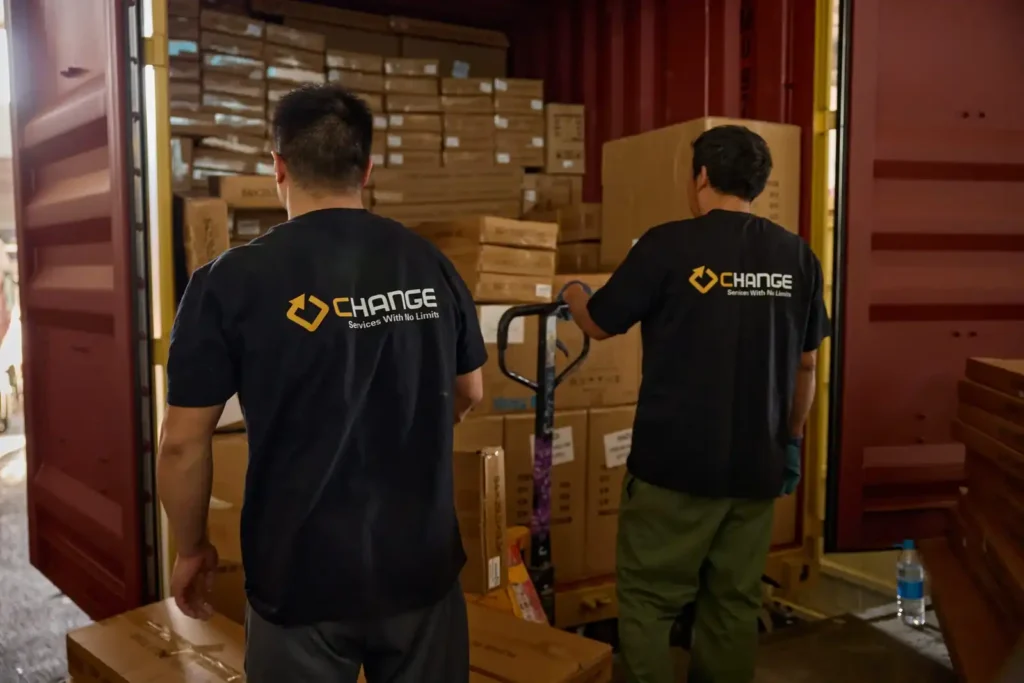
Sourcing solar panels from China for the Indian market is not the same as sourcing for any other country. The BIS certification requirement, the anti-dumping duty tiers, and the ALMM environment make supplier selection and compliance navigation genuinely complex for first-time importers.
Change Sourcing is a China-based sourcing and logistics company with offices in Yiwu and Guangzhou. The team specialises in supplier vetting, factory audits, pre-shipment inspection, and full-cycle export logistics from China.
For Indian buyers specifically, Change Sourcing can:
- Identify BIS-certified Chinese solar panel manufacturers with valid CRS registration
- Confirm anti-dumping duty tier (0%, 23%, or 30%) for each shortlisted supplier before you commit
- Arrange third-party factory audits and pre-shipment inspections in China
- Coordinate sea freight logistics from Guangzhou or Shenzhen to JNPT or Chennai
- Prepare all required export documentation, including Certificate of Origin
Getting the supplier and compliance details right before your first shipment saves significantly more money than you spend on professional sourcing support.
Request a free consultation and cost estimate here.
Frequently Asked Questions
No. BIS certification under IS 14286 and IS 61730 is mandatory under the Compulsory Registration Scheme (CRS). Panels without a valid BIS CRS license cannot be legally imported, sold, or installed in India. Shipments may be held or confiscated at customs.
For most Chinese manufacturers, the effective duty stack is: 20% BCD + 20% AIDC + 4% SWS (on BCD) + 5% IGST + 23% to 30% anti-dumping duty. For nil-duty producers like Jinko and Trina, the anti-dumping component is 0%.
Based on the DGTR final findings of September 2025, Jinko Solar and Trina Solar groups were classified as cooperative producers and recommended for nil (0%) anti-dumping duty. Aiko Solar faces 23%, and all other unspecified manufacturers face 30% of CIF value.
Assembled solar photovoltaic modules use HS code 8541.43 under India’s customs tariff. Unassembled solar cells use HS code 8541.42. Using the wrong sub-code can lead to incorrect duty assessment and customs delays.
Sea transit from Guangzhou or Shenzhen to JNPT (Mumbai) or Chennai Port takes 12 to 18 days. Add 5 to 10 working days for customs clearance. Total door-to-door time is typically 3 to 5 weeks from order confirmation.
Final Thoughts
Importing solar panels from China to India in 2026 is commercially viable — but it requires more preparation than most other import markets.
The duty structure is layered, BIS certification is a hard stop, and your choice of Chinese supplier directly determines how much anti-dumping duty you pay.
Get those three things right — BIS-certified supplier, correct HS code, ADD tier confirmed — and the process follows a clear path from there. The market opportunity is real: India is adding solar capacity faster than any year in its history and private sector demand for cost-effective panels is stronger than ever.
If you need sourcing, inspection, or logistics support from the China side, reach out to Change Sourcing for a free consultation before your first shipment.