

The purpose of pre-shipment inspection in shipping is to verify that goods meet your quality standards, contain the right quantity, and comply with labeling and packaging requirements before they leave the factory. It is conducted when production is 80 to 100% complete by an independent third-party inspector. If problems are found, you still have time to fix them. Once goods ship, that window closes.
Imagine ordering 2,000 units of a product from a factory in China. Production finishes, the factory signs off, and the shipment leaves. Three weeks later, the goods arrive at your warehouse, and a third of them have defects you never agreed to accept.
At that point, you have three bad options: return the goods at your own cost, sell defective products and damage your brand, or negotiate a discount with a supplier who now has your money and no urgency to help.
A pre-shipment inspection stops this from happening. It is the last point in the production process where you can see what you are actually receiving before it is too late to do anything about it.
What is Pre-Shipment Inspection?
Pre-shipment inspection, commonly referred to as PSI, is a formal quality control check conducted at the factory or warehouse when a production order is between 80% and 100% complete.
An independent inspector, usually from a third-party inspection company, visits the facility, pulls a random sample of finished goods, and checks them against the buyer’s specifications.
The result is a detailed inspection report delivered the same day, giving the buyer a clear accept or reject decision before authorizing shipment and releasing final payment.
The global pre-shipment inspection market is valued at $16.20 billion in 2030 and is projected to reach $21.32 billion by 2030, which reflects how central this step has become in modern international trade.
The Main Purposes of Pre-Shipment Inspection in Shipping
The purpose of pre-shipment inspection in shipping comes down to four things it protects against: defective goods, wrong quantities, non-compliant packaging, and the inability to act once goods are already in transit.
Verify Product Quality Before Payment
The primary purpose is to confirm that what was produced matches what was ordered. Inspectors check workmanship, appearance, functionality, dimensions, and materials against the approved sample and purchase order specifications.
This matters because factories can and do make substitutions. A supplier might use a cheaper fabric grade when material costs rise.
An electronics manufacturer might swap a component for a lower-cost alternative during a shortage. Without an independent check, these changes arrive with your shipment.
A real example: a UK buyer orders 1,500 units of a portable speaker. The approved sample used a specific type of speaker mesh. The production run uses a thinner, cheaper version that affects sound quality. A PSI catches this before shipment. Without one, all 1,500 units ship, and the first customer reviews mention the audio quality problem.
Confirm the Right Quantity Was Produced
Inspectors physically count finished and packed units and verify them against the purchase order and packing list.
Short shipments are more common than most buyers expect and are difficult to dispute once goods have left the factory.
Check Packaging, Labeling, and Compliance
This is the area buyers most often overlook until it causes a problem at customs or in a retail warehouse.
Inspectors verify that labels are correct, barcodes scan properly, packaging dimensions match what was agreed, and carton markings meet the destination market’s requirements.
A mislabeled product can be rejected at customs. A barcode that does not scan can be refused by a retailer. These are all preventable at the PSI stage and very difficult to fix once goods arrive in your country.
Give the Buyer a Final Decision Point
Once a shipment leaves the factory and clears export customs, the buyer’s leverage drops significantly. Understanding the purpose of pre-shipment inspection in shipping means understanding this timing.
It is the last practical moment where you can require rework, negotiate a price reduction, or reject the batch entirely, while the factory still holds the goods and has an incentive to resolve the issue.
How Pre-Shipment Inspection Works Step by Step?
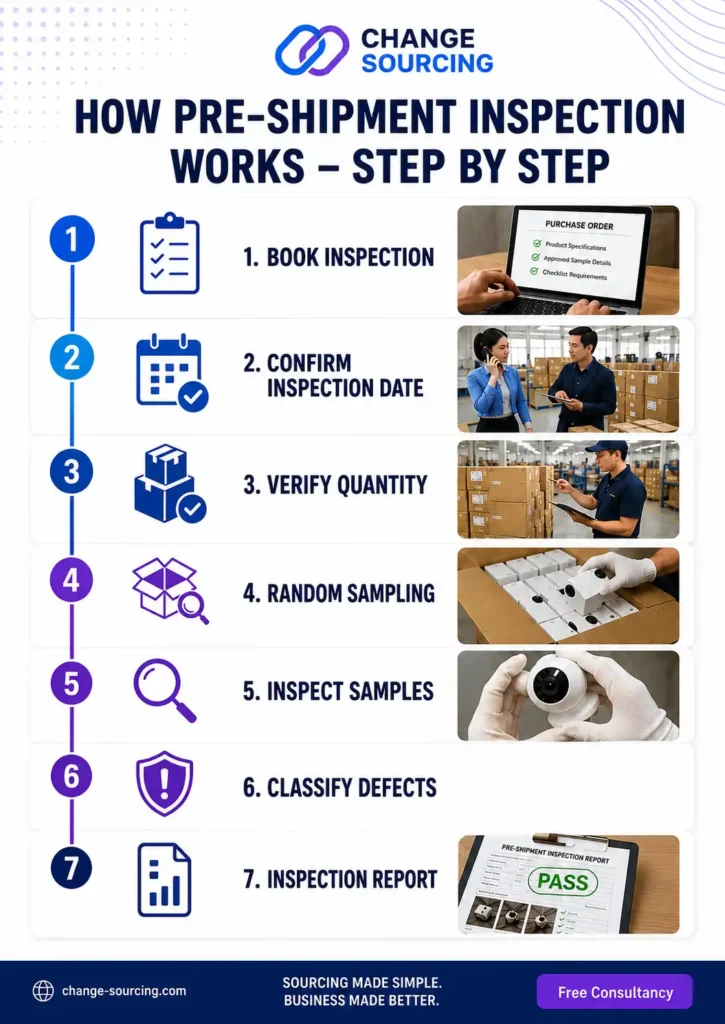
Pre-shipment inspection follows a structured process that checks quantity, quality, packaging, labeling, and product performance before goods leave the factory.
It gives buyers clear evidence, with photos and a pass/fail report, so they can fix problems before shipment.
- The buyer books an inspection through a third-party inspection company, providing the purchase order, product specifications, approved sample details, and any specific checklist requirements.
- The inspection company contacts the factory to confirm a date when at least 80% of the order is finished and packed.
- The inspector arrives at the factory and verifies the available quantity against the purchase order.
- Random samples are selected from packed cartons using standardized AQL sampling tables.
- Each sampled unit is inspected for appearance, workmanship, dimensions, labeling, packaging, and functionality.
- Defects are classified as critical, major, or minor and counted against pre-agreed acceptable thresholds.
- The inspector prepares a full report with photographs and a pass or fail conclusion, delivered the same day.
What Is AQL and What Does a “Pass” Actually Mean?
This is the most misunderstood part of pre-shipment inspection in shipping, and it is the reason buyers sometimes receive goods that passed inspection and still contain defects.
AQL stands for Acceptable Quality Limit. It is the maximum percentage of defective units considered tolerable in a shipment. A PSI does not check every unit. It checks a statistically representative sample and uses that sample to make a judgment about the whole batch.
Here is an example of how this works in practice:
You order 1,000 units. Under General Inspection Level II, the standard level used by most third-party agencies, approximately 80 units are selected for inspection. The default AQL for major defects is 2.5, meaning the lot passes if no more than 5 defective units are found among the 80 sampled.
If the inspector finds 4 major defects in the 80-unit sample, the result is a pass. But a 4-out-of-80 defect rate, if representative of the full batch, means roughly 50 defective units in your 1,000-unit order are still being shipped.
This is not a flaw in the system. It is how statistically valid sampling works in mass production. But it means a pass result does not mean zero defects. It means the defect rate is within the agreed acceptable limit.
The three standard AQL thresholds used globally are:
- Critical defects: AQL 0 (zero tolerance, any critical defect fails the batch)
- Major defects: AQL 2.5 (industry standard for most consumer goods)
- Minor defects: AQL 4.0 (cosmetic issues that do not affect function)
Buyers should agree on these thresholds with their inspection company before booking, not after receiving the report.
How Much Does Pre-Shipment Inspection Cost and Is It Worth It?
A standard pre-shipment inspection in shipping costs between $200 and $350 per man-day. Most orders of average complexity require one man-day, meaning a typical PSI costs around $250 to $300.
Whether it is worth it becomes a straightforward calculation when you compare it against what a defective shipment actually costs.
If you are importing $15,000 worth of goods and 15% of units are defective, that is $2,250 in unsellable inventory before you account for returns, customer complaints, or replacement stock. A $280 inspection that catches this before shipment is not an expense. It is a savings of nearly $2,000.
Research shows that the defect rate on shipments inspected by a third party drops from approximately 4.2% to 0.7%. That gap represents the measurable financial value of PSI.
For very small orders under $2,000 to $3,000, buyers sometimes make a judgment call based on their supplier’s track record and product risk. For any order going directly to retail, end consumers, or a market where regulatory compliance matters, PSI is the rational choice regardless of order value.
What Happens When Goods Fail Pre-Shipment Inspection?
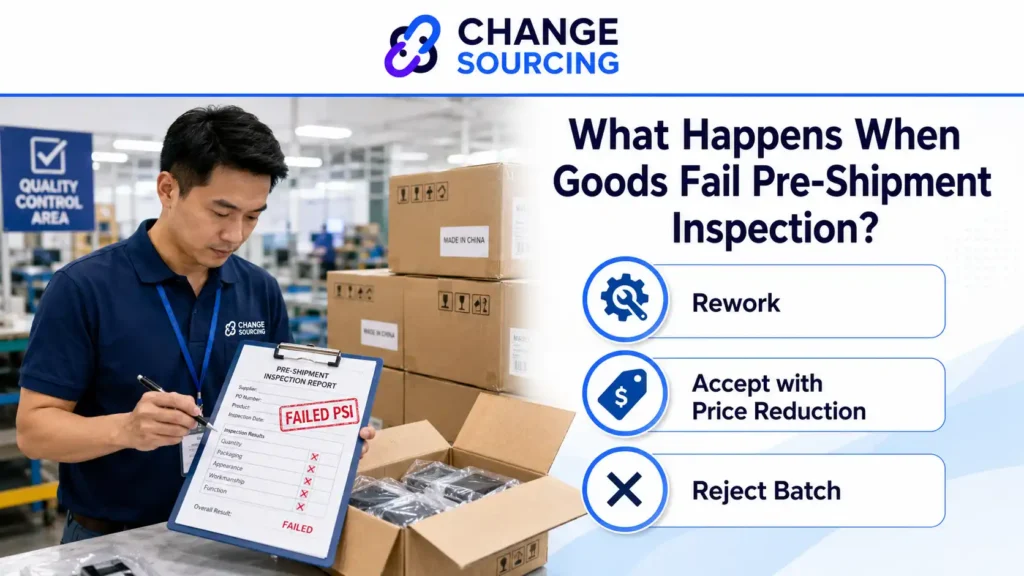
A failed PSI is not the end of the process. It is a decision point with three clear paths:
- Request rework: The factory sorts, repairs, or replaces defective units, and a re-inspection is booked. The buyer typically pays the re-inspection fee. The factory bears the cost of rework if the defects are its responsibility.
- Accept with a negotiated price reduction: If defects are minor and a rework is not practical within the shipping timeline, the buyer may accept the goods at a reduced price that accounts for the defect rate.
- Reject the batch: For serious or widespread quality failures, the buyer can reject the shipment entirely. This option is far simpler before goods leave the factory than after they have shipped internationally and cleared destination customs.
Which option is appropriate depends on what was defective, how many units are affected, and whether the purchase order included clear provisions for failed inspections. Buyers who define those terms before production begins have significantly more leverage.
PSI vs Other Quality Checks: Where It Fits in the Process
Pre-shipment inspection is one of several quality checkpoints in a complete production quality system. Understanding where it sits helps buyers decide what they actually need.
| Inspection Type | When It Happens | What It Checks |
| IQC (Incoming Quality Control) | Before production starts | Raw materials and components |
| IPQC (In-Process Quality Control) | During production | Process consistency and early defects |
| PSI (Pre-Shipment Inspection) | After production, before shipment | Finished goods quality, quantity, packaging |
| Container Loading Inspection | At the time of loading | Correct units loaded, no damage during loading |
The purpose of pre-shipment inspection in shipping specifically is to serve as the final verification of finished goods at the point where intervention is still practical and affordable.
IQC and IPQC require continuous on-site presence during the production cycle, which is not always feasible for buyers sourcing overseas. PSI achieves a one-time, end-of-production check that covers the most critical risk for most importers.
Change Sourcing Insight: When a Passed Inspection Still Results in Bad Goods
After 10+ years helping over 1,500 importers source from China, the question we hear most is this: the inspection passed, so how did defective goods still arrive?
The answer is almost always one of three things. The inspection was booked too early, before enough of the order was packed, meaning the sample was not representative of the full production run.
The AQL thresholds were never agreed in writing, so the inspector applied a default that did not reflect the buyer’s actual requirements. Or the supplier was allowed to select the samples rather than the inspector pulling them randomly from sealed cartons.
A buyer importing kitchen accessories from a Zhejiang factory came to us after receiving goods with a 12% defect rate on a shipment that had technically passed PSI.
When we reviewed the inspection report, the sample size had been 32 units from a 2,000-unit order, using Inspection Level I rather than the standard Level II.
At Level I, a 12% real defect rate in the batch can still produce a pass result if the sampled units happen to fall below the allowed defect count.
The inspection was valid at the level set. It just was not set up to protect the buyer.
This is why the setup of a PSI matters as much as whether you have one. Agreeing on AQL levels, inspection level, and sample selection method before booking is not an administrative detail.
It determines whether the inspection actually does what the purpose of pre-shipment inspection in shipping is meant to do: protect you from receiving goods that do not meet your standard.
If you are sourcing from China and want pre-shipment inspections set up and managed correctly by an experienced team, reach out to Change Sourcing before your next production run.
Frequently Asked Questions
The purpose of pre-shipment inspection in shipping is to verify that finished goods match the buyer’s specifications for quality, quantity, and compliance before they leave the factory. It is conducted when production is 80 to 100% complete, giving buyers a final opportunity to identify and resolve problems while the supplier can still act on them.
The buyer typically pays for pre-shipment inspection since it is arranged for their protection. Inspection companies charge the buyer directly, usually between $200 and $350 per man-day. If a re-inspection is needed because defects were caused by the factory, the rework cost is the factory’s responsibility, but the re-inspection fee is generally paid by the buyer.
Pre-shipment refers to the stage after production is complete but before goods leave the factory or country of origin. The pre-shipment activities include quality checks, packaging verification, document preparation, and export customs clearance. Pre-shipment inspection specifically refers to the quality control check conducted at this stage by an independent inspector.
AQL stands for Acceptable Quality Limit. It is the maximum percentage of defective units considered acceptable in a batch. Standard settings are AQL 0 for critical defects, AQL 2.5 for major defects, and AQL 4.0 for minor defects. A PSI uses AQL-based sampling to inspect a statistically representative portion of the batch and decide whether the full order meets the acceptable threshold.
When goods fail PSI, the buyer chooses from three options: request rework and a re-inspection at the factory’s cost, accept the goods at a negotiated lower price, or reject the batch entirely. Which option is appropriate depends on defect severity, timeline, and what terms were agreed upon in the purchase order.
For any order where the potential cost of defective goods exceeds the inspection fee of $200 to $350, pre-shipment inspection is worth it regardless of order size. For orders going directly to retail customers or requiring regulatory compliance, PSI is strongly recommended at any value.
A PSI certificate is a document issued by an accredited inspection body confirming that a shipment has passed inspection and meets the required standards. Some countries require a PSI certificate as a condition of customs clearance. In standard commercial trade, the equivalent is the detailed inspection report produced after a third-party PSI visit.
Pre-shipment inspection happens before goods leave the factory, when quality problems can still be corrected at the supplier’s cost. Post-shipment inspection happens after goods arrive at the destination, at which point practical recourse against the supplier is very limited. Pre-shipment inspection is always the preferred option because it preserves the buyer’s ability to act.
Final Takeaway
The purpose of pre-shipment inspection in shipping is simple: to make sure that what you ordered is what you receive, confirmed by someone independent, before your ability to act on any problems disappears.
The cost is modest relative to what it protects. The timing is specific: 80 to 100% production completion, not before, not after shipment. And the setup matters: AQL levels, inspection standard, and sampling method need to be agreed upon before the inspector walks into the factory.
Buyers who treat pre-shipment inspection as a procedural checkbox sometimes find that it does not fully protect them. Buyers who understand how to set it up correctly find that it consistently does.
Change Sourcing arranges pre-shipment inspections for importers sourcing from China, with on-the-ground teams in Shenzhen and Guangzhou who work independently of suppliers and report directly to you. Get in touch before your next production order is completed.