

To import from China to Ghana, get your TIN from the Ghana Revenue Authority, find suppliers on Alibaba.com, 1688.com, madeinchina.com, and Global Sources or via a sourcing agent like Change Sourcing. Ship your products via sea freight to Tema Port in 25 to 40 days or air freight to Kotoka Airport in 3 to 7 days. Your customs broker clears goods through Ghana's ICUMS portal, where duties range from 0% to 35% based on your HS code, plus VAT, NHIL, and GETFund levies. Total landed cost is typically 35 to 55% above your CIF value depending on product category.
In 2026, more Ghanaian businesses than ever are sourcing electronics, textiles, furniture, machinery, and consumer goods directly from Chinese factories. The reason is simple. Chinese manufacturers offer factory-direct pricing, enormous product variety, and flexible order sizes that local or regional suppliers simply cannot match.
But if you have never imported from China to Ghana before, the process can feel overwhelming. Customs, freight, documents, duties, supplier verification… it is a lot to navigate at once.
This guide breaks it all down into clear, manageable steps. Let’s get started!
How to Import from China to Ghana in 2026
China is Ghana’s single largest trading partner. In 2024, bilateral trade between the two nations hit an all-time high of $11.84 billion, up from $11 billion in 2023. That number keeps climbing every year.
But knowing how to import correctly is what makes the process smooth and manageable.
Step 1: Understand Ghana’s Import Regulations Before You Order
Before you even contact a supplier, you need to know what Ghana actually requires to bring goods into the country. Skipping this step is the single most common mistake new importers make.
It leads to shipments being held at the port, unexpected fines, and significant delays.
Ghana’s import framework is managed by the Ghana Revenue Authority (GRA) and its Customs Division. The Ghana Standards Authority (GSA) and the Food and Drugs Authority (FDA) also play a major role, depending on the type of goods you are importing.
Get Your Tax Identification Number (TIN) First
A TIN is mandatory for every importer in Ghana. Without it, you cannot clear goods at any port. You can apply for one through the Ghana Revenue Authority’s TIN registration portal. The process is straightforward and free for individuals and businesses.
Import Declaration Form (IDF)
For any shipment valued above $2,000, you need to file an Import Declaration Form through Ghana’s customs system. Your licensed customs broker handles this on your behalf, but you need to have all your documents ready before the shipment arrives.
Prohibited vs. Restricted Goods
Not everything can be imported freely. Ghana draws a clear line between prohibited goods and restricted goods, and it is important to know the difference.
Prohibited goods are banned entirely. These include:
- Narcotic drugs and psychotropic substances
- Counterfeit currency
- Pornographic materials
- Goods that violate intellectual property rights
Restricted goods can be imported, but only with the correct permits from the relevant regulatory authority. Common examples include:
| Product Category | Required Permit From |
|---|---|
| Food and beverages | Food and Drugs Authority (FDA) |
| Pharmaceuticals | FDA and Plant Protection Regulatory Services Directorate (PPRSD) |
| Electronics | Ghana Standards Authority (GSA) |
| Building materials | Ghana Standards Authority (GSA) |
| Agricultural inputs | PPRSD (phytosanitary certificate required) |
| Used vehicles | Ghana Revenue Authority and Driver and Vehicle Licensing Authority |
Important tip: Check the HS (Harmonized System) code for your product before you place any order. Your HS code determines your duty rate, which regulatory agency controls your goods, and whether you need a permit at all. You can check HS codes using the World Customs Organization HS Nomenclature database.
Step 2: Find and Verify Reliable Suppliers in China
Finding the right supplier is probably the most important decision in the entire import process. A reliable supplier means quality products, honest communication, and on-time delivery. An unreliable one can cost you thousands of cedis and months of stress.
You have several options for sourcing from China. Let’s look at each one in detail.
B2B Online Platforms
Alibaba.com
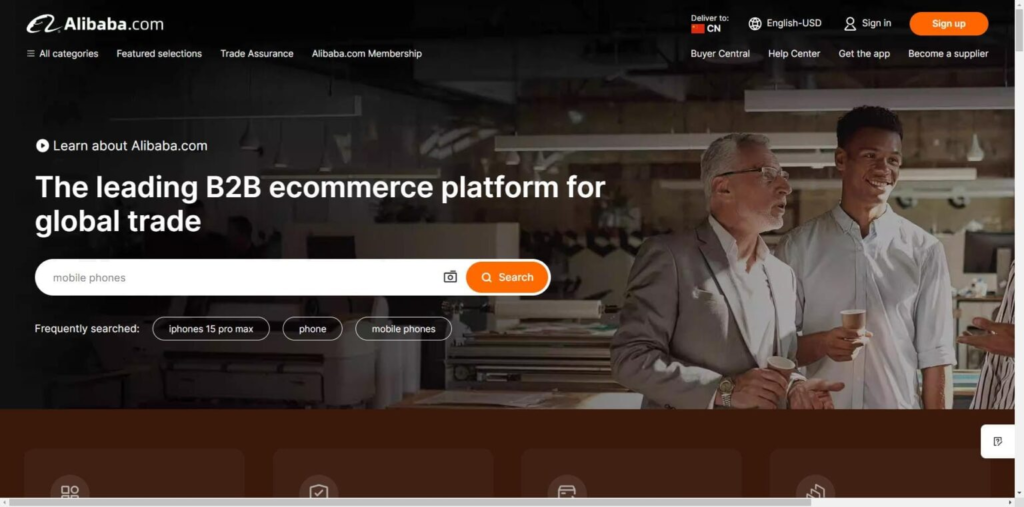
Alibaba.com is the world’s largest B2B sourcing platform and the most popular starting point for international buyers. It connects buyers with Chinese manufacturers and trading companies across virtually every product category imaginable.
What Alibaba is best for: Bulk orders, finding manufacturers for custom or branded products, OEM and ODM production, and buyers who prefer English-language communication.
Pros:
- Millions of product listings across all categories
- Trade Assurance payment protection for buyers
- Verified Supplier badges backed by independent third-party inspections (SGS, TUV Rheinland, Intertek)
- Built-in messaging, RFQ (Request for Quotation) system, and video calls
- English-language interface, making it accessible to Ghanaian buyers
Cons:
- Prices are higher than on domestic Chinese platforms like 1688.com
- Not all listed suppliers are manufacturers; many are trading companies reselling goods
- Minimum order quantities (MOQs) can be high for small importers
How to check reviews: You can find buyer reviews and ratings directly on supplier pages on Alibaba. For independent feedback, search for the supplier name on Trustpilot or check community discussions on trade forums.
Best practice on Alibaba: Always filter for “Verified Suppliers” and “Trade Assurance” when searching. Never work with a supplier who asks you to pay outside the Alibaba platform.
Made-in-China.com

Made-in-China.com is another major B2B platform operated by Focus Technology Co. It is especially strong for industrial products, machinery, hardware, and construction materials.
What it is best for: Industrial equipment, machinery parts, hardware, and buyers sourcing products that require technical specifications.
Pros:
- Strong focus on industrial and manufacturing sectors
- Good for finding factory-direct manufacturers rather than trading companies
- The buyer inquiry system is simple and straightforward
Cons:
- Smaller supplier database compared to Alibaba
- Fewer built-in buyer protection tools
- Communication can be slower
Global Sources
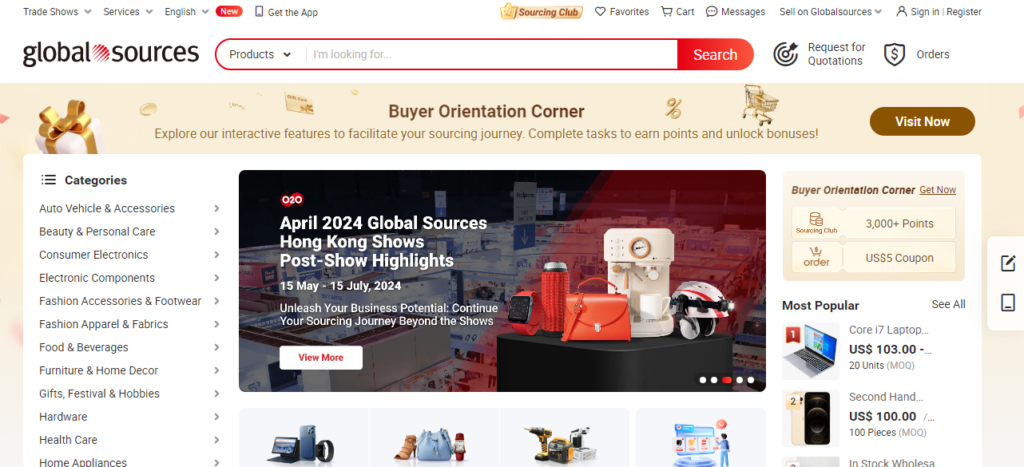
Global Sources is a Hong Kong-based platform that is well-regarded for electronics, fashion, and gifts. It is particularly popular among buyers attending trade shows in Hong Kong.
What it is best for: Electronics, mobile accessories, fashion and apparel, and buyers who prefer a more curated supplier database.
Pros:
- Strong verification standards for suppliers
- Known for connecting buyers with genuine manufacturers
- Useful for sourcing trending consumer electronics and gadgets
Cons:
- Fewer product categories compared to Alibaba
- Fewer suppliers overall
Reviews: Independent reviews of Global Sources are available on Trustpilot and SiteJabber.
1688.com
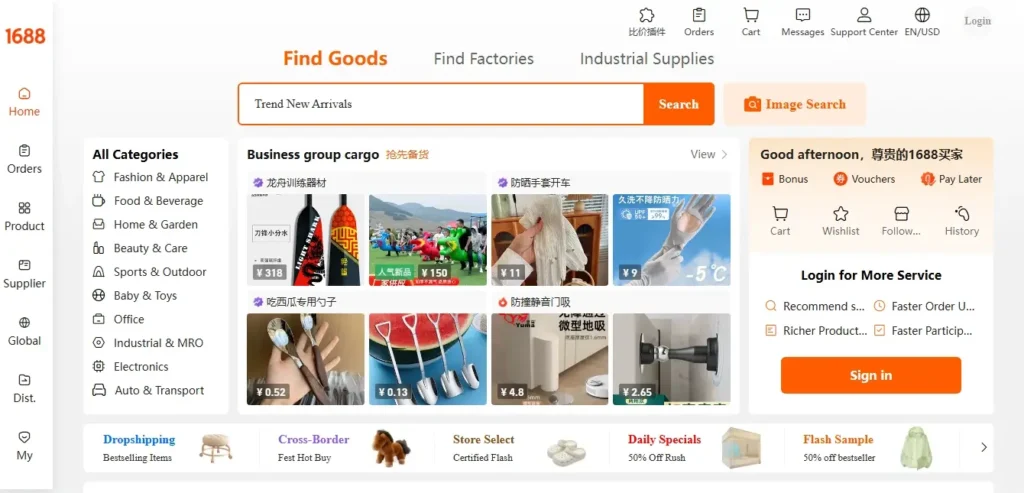
688.com is Alibaba’s domestic Chinese platform. Think of it as the “wholesale China” version that most international buyers never see. Prices on 1688 are significantly lower than on Alibaba because it is designed for Chinese buyers purchasing in bulk from factories.
What it is best for: Getting the absolute lowest factory prices, sourcing from the same factories that list on Alibaba, but at a fraction of the cost.
Pros:
- Prices are 20-40% lower than equivalent listings on Alibaba.com
- Direct factory access without intermediary markup
- Huge product variety
Cons:
- The entire platform is in Mandarin Chinese
- Payment requires a Chinese bank account or Alipay
- You will need a China-based sourcing agent to buy on your behalf
Bonus Tip: If you want access to 1688 pricing without the language barrier, working with a sourcing agent based in China is the most practical solution.
DHgate
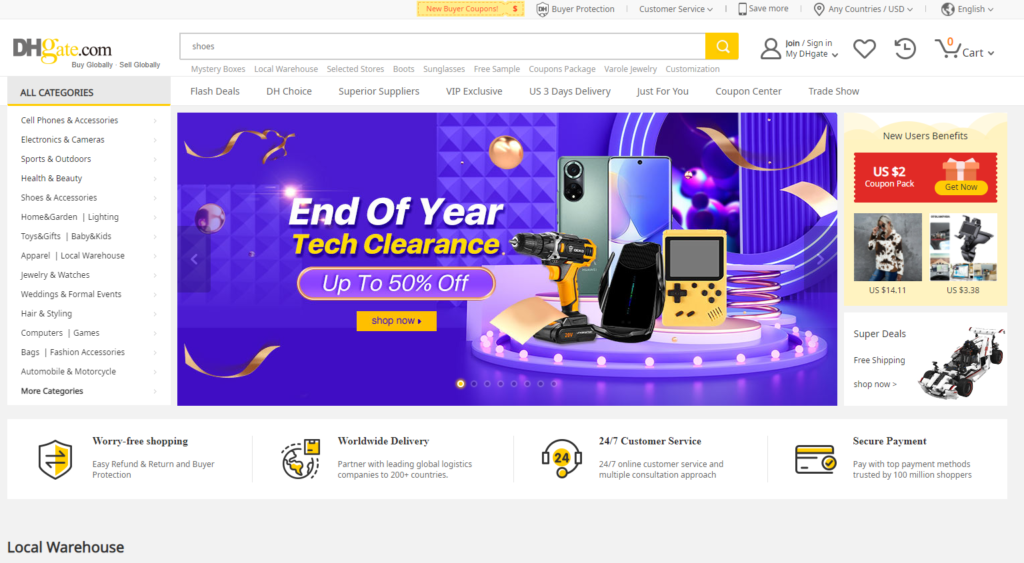
DHgate.com is a platform that sits between wholesale and retail. It is ideal for smaller orders and individual buyers who are not ready for large MOQs.
What it is best for: Small-quantity orders, product testing before committing to a large shipment, and individual entrepreneurs.
Pros:
- Low or no minimum order quantities
- Fast shipping options are available for many listings
- Buyer protection program
Cons:
- Higher per-unit cost compared to factory-direct sourcing
- Quality can be inconsistent across sellers
Canton Fair and Trade Shows
For serious importers, nothing beats visiting a trade show in person. You can see products, meet suppliers face to face, compare dozens of options in a single day, and negotiate better deals than you could ever get online.
The Canton Fair (China Import and Export Fair)
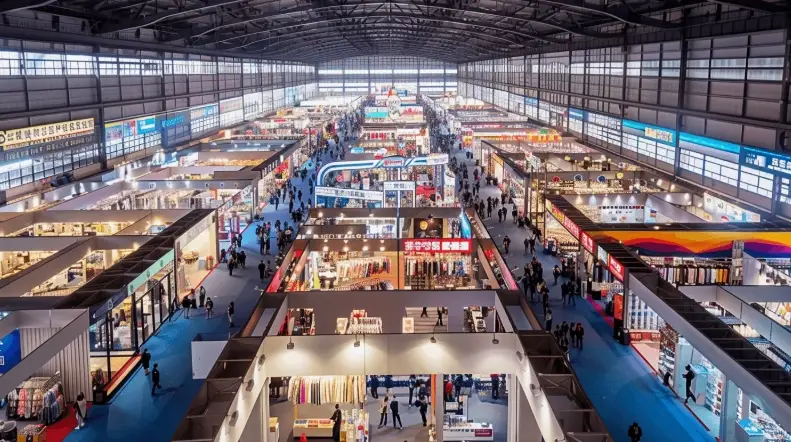
The Canton Fair is the largest trade fair in the world and the most important one for any importer sourcing from China. It is held twice a year in Guangzhou and attracts tens of thousands of exhibitors and hundreds of thousands of buyers from around the globe.
Location: China Import and Export Fair Complex (Pazhou Island), No. 380 Yuejiang Middle Road, Haizhu District, Guangzhou, China
2026 Spring Dates and Phases:
| Phase | Dates | Product Categories |
|---|---|---|
| Phase 1 | April 15-19, 2026 | Electronics, machinery, hardware, vehicles, new energy |
| Phase 2 | April 23-27, 2026 | Furniture, gifts, home decor, building materials, ceramics |
| Phase 3 | May 1-5, 2026 | Textiles, apparel, shoes, bags, food, toys, medical supplies |
2026 Autumn Dates and Phases:
| Phase | Dates | Product Categories |
|---|---|---|
| Phase 1 | October 15-19, 2026 | Electronics, industrial machinery, energy, vehicles |
| Phase 2 | October 23-27, 2026 | Furniture, gardening, houseware, gifts |
| Phase 3 | October 31 – November 4, 2026 | Textiles, office supplies, medical, bags, food |
Opening hours: 9:30 AM to 6:00 PM daily (local Guangzhou time, GMT+8)
How to attend: Register as a buyer through the official Canton Fair website. You will need a passport copy and basic business information. Most African buyers can obtain a business visa to China with a Canton Fair registration confirmation and an invitation letter from a Chinese supplier.
What to bring: Business cards, a notebook, your product specifications in clear simple language, and a budget range you are comfortable sharing with suppliers. Wear comfortable shoes. The complex is enormous, and you will cover several kilometers of floor space per day.
CHANGE Sourcing at the Canton Fair: If attending the Canton Fair sounds daunting, especially for first-timers, CHANGE Sourcing offers dedicated on-ground support at every session. Their team attends the fair each year and assists buyers with supplier communication, factory evaluation, deal coordination, and live interpretation. You can learn more about their Canton Fair 2026 guided service here.
Other Major Trade Fairs Worth Knowing
Beyond the Canton Fair, there are several other trade expos that Ghanaian importers should be aware of, depending on the product categories they are sourcing.
Global Sources Electronics Show
Location: AsiaWorld-Expo, Hong Kong International Airport, Lantau, Hong Kong
It is held twice a year (April and October), and this show is focused on electronics, mobile accessories, and tech products. Ideal for buyers sourcing gadgets, phone accessories, and consumer electronics.
Yiwu Commodity Fair (China Yiwu International Commodities Fair)
Location: Yiwu International Expo Center, Yiwu, Zhejiang, China
It is held annually in October, and this fair focuses on small commodities, gifts, hardware, and daily-use products. It is particularly relevant for Ghanaian importers because Yiwu itself is a major sourcing hub for West African buyers.
China Import Expo (CIIE)
Location: National Exhibition and Convention Center (NECC), Qingpu District, Shanghai, China
It is held each November, and the fair focuses on imports into China, but it is also an excellent networking event for African business delegations.
The Yiwu Market: A Special Mention for Ghanaian Importers
Yiwu International Trade Market in Zhejiang Province is the world’s largest small-commodity wholesale market. It spans over 5 districts and more than 75,000 booths covering everything from toys and tools to lighting, hardware, textiles, and home supplies.
What makes Yiwu especially relevant for Ghanaian buyers is that West African traders are among the most active buyers in the market. District 5 of the Yiwu market even has a dedicated African products exhibition center on the first floor.
Many established Ghanaian importers visit Yiwu regularly rather than relying solely on online sourcing because they can physically compare products, negotiate face to face, and consolidate orders from multiple suppliers in one trip.
Yiwu Market Location: No. 1 Chouzhou North Road, Yiwu, Zhejiang Province, China
CHANGE Sourcing is headquartered right in Yiwu. If you want someone with deep local market knowledge to source on your behalf in Yiwu, their team can navigate the market, negotiate prices, and consolidate your order for shipping, all without you needing to travel.
Supplier Verification Checklist
No matter which platform or market you use, always verify a supplier before sending any money. Here is a practical checklist:
- Request the supplier’s business license and export license (and verify them)
- Confirm the factory’s physical address and check it on Google Maps or Baidu Maps
- Request product samples before committing to a bulk order
- Check their export history and ask for references from other international buyers
- Ask how long they have been exporting and to which countries
- For significant orders, arrange a third-party factory audit
Step 3: Negotiate Your Order and Choose the Right Incoterm
Many importers accept the first price a supplier quotes them. That is usually a mistake. Chinese suppliers expect negotiation, especially for bulk orders. It is standard practice, not considered rude.
Practical Negotiation Tips
Start by getting quotes from at least three different suppliers for the same product. Use those competing quotes as leverage when negotiating.
A simple message like "Your price is 15% above what two other factories quoted for the same specifications" opens the conversation.
For a first order, target a counteroffer of 10 to 20% below the initial quoted price. You may not always get that full reduction, but you will almost always get something. On larger repeat orders, suppliers are often willing to reduce prices further because your business is a predictable volume for them.
Standard payment terms are typically 30% deposit before production and 70% balance before shipment. For very large orders or with suppliers you have worked with for a long time, you might negotiate 70% on sight of the Bill of Lading copy.
Understanding Incoterms

Incoterms (International Commercial Terms) determine who is responsible for freight, insurance, and customs at each stage of the shipment. Choosing the wrong Incoterm can lead to unexpected costs and complications.
| Your agent handles everything door-to-door | What It Means | Who Handles Ghana Customs | Best For |
|---|---|---|---|
| EXW (Ex Works) | You take responsibility from the factory gate | You | Experienced importers with a trusted freight agent already in China |
| FOB (Free on Board) | Supplier delivers goods to the Chinese port and loads them | You | Importers with a good freight forwarder who can handle the ocean leg |
| CIF (Cost, Insurance, Freight) | Supplier covers freight and insurance to Tema Port | You | Importers who want to simplify the China-side logistics |
| DDP (Delivered Duty Paid) | The supplier delivers goods to the Chinese port and loads them | Your agent | First-time importers who want the simplest possible experience |
For most Ghanaian importers, FOB or DDP is the most practical choice.
FOB gives you control over freight costs once the goods are on the ship. DDP offers complete peace of mind but comes at a higher total price because the agent charges for handling everything.
Step 4: Protect Your Payment and Avoid Supplier Scams
Losing money to a fraudulent supplier is more common than people admit. The good news is that it is entirely avoidable with the right precautions.
Safe Payment Methods
Alibaba Trade Assurance
It is the safest way to pay when using Alibaba.com. Your payment is held in escrow and only released to the supplier when you confirm that goods have been received and meet your specifications. Use it for every order.
T/T (Telegraphic Transfer / Bank Wire)
It is the most common payment method for international trade. The standard split is 30% upfront as a deposit to start production, and the remaining 70% before the goods are loaded onto the ship. Never pay 100% upfront to a new supplier.
Letter of Credit (LC)
LC is a bank-backed payment guarantee typically used for large orders above $50,000. Your bank guarantees payment to the supplier’s bank once the agreed shipping documents are presented. It adds cost but provides strong protection for high-value transactions.
PayPal
It is fine for small sample orders up to a few hundred dollars. It is not practical for bulk shipments.
Payments to Avoid
Never send money via Western Union or MoneyGram to a supplier. These services offer zero buyer protection and are commonly used in international trade scams. If a supplier insists on Western Union, walk away.
Avoid paying into a personal bank account rather than a company account. A legitimate manufacturer always receives payments in the company’s name.
Warning Signs of a Scam Supplier
Watch out for these red flags:
- Pressure to pay outside the Alibaba platform
- Price is dramatically lower than all other suppliers for the same product
- No verifiable factory address or refusal to do a video call from the factory floor
- Poor English combined with unusual urgency to close the deal quickly
- Request to move communication from Alibaba to WhatsApp or email before any order is confirmed
Step 5: Choose Your Shipping Method

The shipping method you choose affects your cost, your timeline, and the type of goods you can practically import. There is no single right answer; it depends on your shipment size, the urgency, and your budget.
Sea Freight: Best for Bulk Shipments
Sea freight is the most economical shipping option for large or heavy orders. Almost all bulk commercial imports from China to Ghana travel by sea.
There are two main options within sea freight:
FCL (Full Container Load): You rent an entire 20-foot or 40-foot container. This is cost-effective when you have enough goods to fill the space. A standard 20-foot container can hold roughly 25-28 cubic meters of cargo.
LCL (Less than Container Load): You share container space with other importers. You pay only for the cubic meters your goods occupy. This is the practical choice for smaller first orders or when you are testing a new product category.
Departure ports: Guangzhou (Nansha or Huangpu), Shenzhen (Yantian), Shanghai, and Ningbo are the main ports for goods heading to Ghana.
Route: Most vessels travel from China through the Indian Ocean, around the Cape of Good Hope or through the Suez Canal, then up into the Atlantic and down the West African coast to Tema Port in Ghana.
Transit times from Chinese ports to Tema:
| Route | Transit Time |
|---|---|
| Guangzhou/Shenzhen to Tema (Suez Canal) | 25-35 days |
| Shanghai/Ningbo to Tema (Suez Canal) | 30-38 days |
| Guangzhou to Tema (Cape of Good Hope) | 40-55 days |
Note: The Suez Canal route is faster but subject to surcharges and occasional transit disruptions. Your freight forwarder will advise on the best option at the time of booking.
Air Freight: Best for Urgent or High-Value Goods
Air freight is significantly faster but much more expensive per kilogram. It makes sense for high-value, low-weight goods like electronics, fashion items, or pharmaceuticals, or when you urgently need stock.
- Airport to airport: 3 to 7 days. Goods arrive at Kotoka International Airport (KIA) in Accra.
- Door-to-door (DDP air): 7 to 12 days. Your agent handles collection from the Chinese supplier and delivery to your location in Ghana.
- Typical air freight rates: $4 to $8 per kilogram, depending on weight, dimensions, and carrier.
Door-to-Door Agents
Some importers prefer working with a door-to-door shipping agent who handles the entire process for a single flat fee. The agent arranges collection from your supplier in China, handles sea freight booking, manages customs clearance at Tema, pays duties on your behalf, and delivers goods to your location in Ghana.
This is the simplest option for new importers who do not yet have their own freight forwarder relationships. The trade-off is that you have less visibility into individual cost components.
Shipping Cost Comparison
| Shipping Mode | Transit Time | Best For | Approximate Cost |
|---|---|---|---|
| Sea Freight LCL | 30-45 days | Small/mixed loads | $8-$15 per CBM |
| Sea Freight FCL (20ft) | 25-40 days | Large bulk orders | $1,200-$2,800 total |
| Air Freight | 3-12 days | Small, urgent, high-value | $4-$8 per kg |
| Door-to-Door Agent (sea) | 35-55 days total | First-time importers | Quoted per shipment |
Costs vary with season (Q4 holiday peak brings surcharges), fuel prices, and port congestion. Always get a firm quote from your freight forwarder before confirming your order with the supplier.
Step 6: Know Ghana’s Ports: Tema vs. Takoradi
Ghana has two commercial ports, and knowing the difference matters depending on where in Ghana your business is located.
Tema Port (Main Container Port)
Tema Port is Ghana’s primary container port. It is located about 25 kilometers east of Accra and handles the vast majority of containerized imports into the country.
If you are importing consumer goods, electronics, textiles, machinery, or any general cargo, your shipment will almost certainly arrive here.
The port is managed by Ghana Ports and Harbours Authority (GPHA) and has ongoing expansion projects to handle increased cargo volumes.
Port handling fees at Tema: Approximately $300 to $600 per container, depending on size and services used.
Inland delivery from Tema:
- Tema to Accra: approximately 30 minutes by road
- Tema to Kumasi: approximately 4 hours by road
- Tema to Tamale: approximately 8 hours by road
Takoradi Port
Takoradi Port is located in the Western Region of Ghana, about 220 kilometers west of Accra. It primarily handles bulk cargo such as minerals, timber, oil, and cocoa exports.
However, it also accepts general cargo and containers, making it a viable alternative for importers whose businesses are based in Western Ghana.
If your operations are in Takoradi, Sekondi, or surrounding areas, importing via Takoradi Port could save you significant inland transport costs compared to clearing goods at Tema and trucking them west.
Kotoka International Airport (KIA)
For air freight, all imports enter through Kotoka International Airport in Accra. Clearance procedures are the same as at Tema Port but typically faster due to the smaller volume of cargo.
Step 7: Prepare Your Shipping Documents
Missing or incorrect documents are the leading cause of shipment delays at Tema Port. Having everything in order before your goods arrive will save you from daily demurrage fees that can quickly add up.
Core Documents Required for All Imports
Bill of Lading (B/L): The primary shipping document for sea freight. It proves ownership of the cargo and is issued by the shipping line. For air freight, the equivalent is the Airway Bill (AWB).
Commercial Invoice: Must be issued by your Chinese supplier and must include the accurate CIF value (Cost + Insurance + Freight). The values on your commercial invoice must match your packing list exactly. Discrepancies trigger customs queries and delays.
Packing List: A detailed breakdown of every item in the shipment, including product descriptions, quantities, weights, and dimensions.
Certificate of Origin: Confirms that the goods were manufactured in China. Required for customs classification.
Import Declaration Form (IDF/CUSDEC): Submitted electronically through Ghana’s ICUMS portal by your licensed customs broker.
Insurance Certificate: Required because Ghana calculates import duties on the CIF value, which includes insurance.
Tax Identification Number (TIN): Your TIN, issued by the Ghana Revenue Authority, must be on all customs declarations.
Product-Specific Permits by Regulatory Body
Depending on what you are importing, you may need additional approvals from one or more of the following agencies. This is something many first-time importers overlook until it is too late.
| Product Category | Regulatory Body | Document Required | When to Apply |
|---|---|---|---|
| Food and beverages | FDA Ghana | Import permit | Before shipment |
| Pharmaceuticals | FDA + PPRSD | Registration and import permit | Before shipment |
| Electronics | Ghana Standards Authority (GSA) | GSA conformity assessment | Before shipment |
| Building materials | Ghana Standards Authority (GSA) | GSA certification | Before shipment |
| Agricultural seeds/inputs | PPRSD | Phytosanitary certificate | Before shipment |
| Cosmetics | FDA Ghana | Product registration | Before shipment |
| Textiles/clothing | Ghana Revenue Authority | Standard customs docs only | On arrival |
Key tip: Begin permit applications before your goods leave China. FDA and GSA approvals can take two to four weeks. If your goods arrive at Tema before the permits are approved, your shipment will be held at the port, and you will be charged demurrage fees every single day until clearance is granted.
Step 8: Clear Customs at Tema Port Using ICUMS
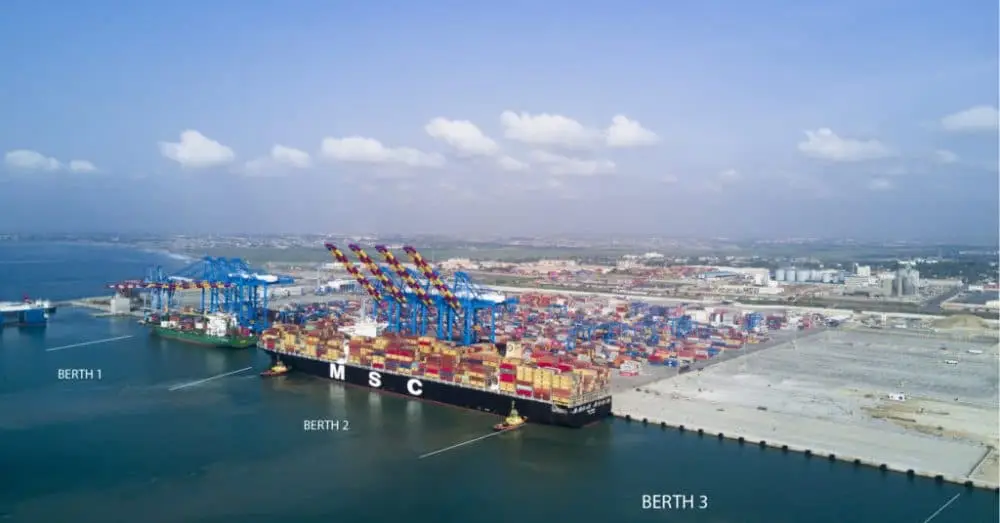
Ghana uses an integrated digital customs platform called ICUMS to process all import declarations. Understanding how it works will help you avoid surprises.
What is ICUMS?
ICUMS stands for Integrated Customs Management System. It is Ghana’s single-window customs platform, managed by the Ghana Revenue Authority Customs Division.
All import declarations, duty calculations, payment processing, and clearance approvals happen through this system. Every shipment entering Ghana is processed through ICUMS, regardless of port of entry.
The ICUMS Clearance Process Step by Step
Step 1: Obtain a Unique Consignment Number (UCN)
Once your shipment is registered in the system, it receives a UCN. This is your reference number for all subsequent steps. Get this number from your customs broker as early as possible, ideally before the vessel arrives at Tema.
Step 2: Submit Declaration Documents
Your licensed customs broker submits all required documents through the ICUMS portal. This includes the Commercial Invoice, Packing List, Bill of Lading, Certificate of Origin, Import Declaration Form, and any product-specific permits.
Step 3: Customs Risk Assessment
ICUMS automatically assigns your cargo to one of three clearance channels:
- Green channel: Cargo is automatically cleared without physical inspection. Fastest option.
- Yellow channel: Documents are reviewed in detail before clearance. Adds one to three days.
- Red channel: Physical inspection of the cargo at the port is required before clearance. Takes longer and may generate examination fees.
First-time importers and shipments with documentation discrepancies are more likely to be assigned to the yellow or red channels.
Step 4: Pay Duties and Levies
Once the assessment is complete, your customs broker receives a duty payment notice. Payment is made at an authorized bank or through the ICUMS online payment gateway.
Step 5: Present Tax Payment Certificate
After payment, the bank issues a tax payment certificate. This is submitted to Ghana Customs to confirm payment.
Step 6: Physical Examination (If Red Channel)
For red-channel cargo, a customs officer physically inspects the goods at the port to confirm that declared quantities and descriptions match what is in the container.
Step 7: Collect Delivery Order
Once clearance is complete, your customs broker obtains a Delivery Order from the shipping agent. You can then arrange inland transport to collect your goods from the port and deliver them to your warehouse or business location.
ICUMS Processing Fee: 0.75% of the FOB (Free on Board) value of your goods. This fee is in addition to customs duties and other levies.
Important: Working with a licensed clearing agent (customs broker) is legally required for most commercial imports in Ghana. Your freight forwarder can often recommend a reliable one, or you can contact the Ghana Institute of Freight Forwarders for referrals.
Step 9: Calculate Your Total Import Duties and Taxes
Ghana’s duty structure has multiple layers, and most importers underestimate the total tax burden until the bill arrives. Here is everything you need to know, including a real worked example.
Ghana’s Customs Duty Rates (ECOWAS Common External Tariff)
| Goods Category | Customs Duty Rate |
|---|---|
| Essential goods and raw materials | 0-5% |
| Semi-processed goods | 10% |
| Finished consumer goods | 20% |
| Special goods (vehicles, spirits, luxury items) | 35%+ |
All Additional Levies Applied on Top of Customs Duty
| Levy | Rate | Applied On |
|---|---|---|
| VAT (Value Added Tax) | 15% | CIF value + customs duty |
| NHIL (National Health Insurance Levy) | 2.5% | CIF value + customs duty |
| GETFund Levy | 2.5% | CIF value + customs duty |
| ECOWAS Levy | 0.5% | CIF value |
| AU (African Union) Levy | 0.2% | CIF value |
| ICUMS Processing Fee | 0.75% | FOB value |
| Customs Processing Fee | 1% (some goods) | CIF value + duty |
The World Bank’s WITS Ghana trade data shows Ghana’s effectively applied weighted average customs duty is approximately 13%, but the combined tax burden, including VAT and levies, is significantly higher once you run the full calculation.
Real Worked Example: Importing $10,000 of Electronics
Let’s say you are importing $10,000 worth of mobile phone accessories from Shenzhen (HS code: finished consumer goods = 20% duty) via sea freight.
| Cost Component | Calculation | Amount |
|---|---|---|
| Goods (FOB value) | $10,000 | |
| Sea freight (Shenzhen to Tema) | $1,500 | |
| Insurance (approximately 1.5% of goods) | $150 | |
| CIF Value (Customs Basis) | $11,650 | |
| Customs Duty (20%) | $11,650 x 20% | $2,330 |
| VAT (15%) | ($11,650 + $2,330) x 15% | $2,097 |
| NHIL (2.5%) | ($11,650 + $2,330) x 2.5% | $349.50 |
| GETFund (2.5%) | ($11,650 + $2,330) x 2.5% | $349.50 |
| ECOWAS Levy (0.5%) | $11,650 x 0.5% | $58.25 |
| AU Levy (0.2%) | $11,650 x 0.2% | $23.30 |
| ICUMS Fee (0.75%) | $10,000 x 0.75% | $75 |
| Total Tax and Duty | ~$5,282 | |
| Total Landed Cost | ~$16,932 |
Your actual total landed cost is approximately 69% above your original FOB price for electronics. Always do this calculation before confirming your product pricing with a Chinese supplier. If you do not factor in duties and levies, you can easily end up selling at a loss.
Step 10: Arrange Quality Inspection Before Goods Leave China

Once goods leave China, getting compensation for defective products from a foreign factory is extremely difficult and rarely worth pursuing.
A pre-shipment inspection typically costs $150 to $300 and can protect you from losses of thousands of dollars.
Types of Inspection
Pre-Production Inspection (PPI):
Conducted before manufacturing starts. The inspector checks that raw materials, components, and specifications match your order requirements. Best for first-time orders with a new supplier.
During Production Inspection (DUPRO):
Conducted when production is roughly 30-50% complete. Catches problems while there is still time to correct them without delaying the shipment. Ideal for large orders.
Pre-Shipment Inspection (PSI):
The most common type. Conducted on finished goods before they are packed for shipping. The inspector checks product quality, quantities, and packaging against your order specifications.
Container Loading Supervision (CLS):
An inspector is present at the factory when goods are loaded into the container. They verify that the correct products and quantities are packed and that the container is sealed properly.
What the Inspector Checks
A standard inspection follows the AQL 2.5 (Acceptable Quality Level) sampling standard, which is the international benchmark for most consumer goods.
Key things checked include:
- Product specifications match the approved sample (color, size, model, materials)
- Defect levels are within acceptable limits
- Packaging is intact and correctly labeled
- Compliance certificates are present and valid (CE marking, RoHS for electronics; FDA certification for food)
- Correct quantities are present
Step 11: Mini-Importation from China to Ghana
Not every importer is ready to fill a 20-foot container. Mini-importation is a popular and practical way to start importing from China with small quantities, lower risk, and faster delivery.
What is Mini-Importation?
Mini-importation refers to ordering small quantities (typically below $2,000 in value) and shipping them via international courier services rather than sea freight.
It is common among solo entrepreneurs, market traders, and individuals who want to test a product before committing to a large order.
How It Works
- Order products from platforms like Alibaba.com, DHgate, or Taobao in small quantities
- Use an international courier: DHL, FedEx, UPS, or EMS (China Post Express)
- Your package is delivered to your address in Ghana within 7 to 15 working days
- For shipments under a certain value threshold, reduced duty rates may apply. Confirm the current threshold with the Ghana Revenue Authority before ordering.
Pros and Cons of Mini-Importation
| Pros | Cons |
|---|---|
| Fast delivery (7-15 days) | Higher cost per unit than bulk sea freight |
| No freight forwarder needed | Not scalable for large businesses |
| Low minimum order quantities | Courier rates are expensive for heavy items |
| Great for testing new products | Limited to smaller, lighter goods |
Best Platforms for Mini-Importation
Alibaba.com: Many suppliers have small MOQs suitable for mini-importation. Use the “Ready to Ship” filter to find products that can be dispatched immediately.
DHgate.com: Designed for lower quantities. Useful for fashion accessories, phone cases, small electronics, and similar consumer items.
Taobao/1688.com: Lowest prices available, but the platform is in Chinese. Use a China-based agent or a forwarding address service to purchase on your behalf.
Step 12: How to Track Your Shipment from China to Ghana
Knowing where your goods are at any point during the journey gives you peace of mind and helps you plan inventory. Here is how to track depending on your shipping method.
Tracking Sea Freight Shipments
Once your goods are on a vessel, your freight forwarder will provide you with a Bill of Lading number and the name of the shipping line.
Use these to track your shipment on the shipping line’s official website. Major shipping lines serving the China-Ghana route include COSCO, MSC, Evergreen, and CMA CGM.
You can also check vessel arrival status at Tema Port through the Ghana Ports and Harbours Authority website.
Tracking Air Freight Shipments
For air freight, you receive an Airway Bill (AWB) number from your freight forwarder. Use this number on the airline’s website or on the DHL or FedEx tracking page if they are your carrier.
Tracking Door-to-Door Shipments
If you are using a door-to-door agent, they will provide you with a tracking number or milestone updates via WhatsApp or email. Ask your agent upfront how they communicate shipment status.
What to Do as Your Vessel Approaches Tema
Contact your customs broker about five to seven days before the expected arrival date. This gives them time to prepare documents and submit the ICUMS declaration before the vessel docks.
Early submission can speed up clearance significantly. Port congestion and vessel delays can add three to seven days beyond the scheduled arrival, so build a buffer into your inventory planning.
CHANGE Sourcing: Your On-the-Ground Partner for Importing from China to Ghana

Importing from China is manageable once you have done it a few times. But for most Ghanaian importers, the learning curve is steep. Working with an experienced sourcing partner in China removes the guesswork and significantly reduces the risk of costly mistakes.
CHANGE Sourcing is headquartered in Yiwu, China, with a branch office in Guangzhou. They have been operating for over 18 years and serve more than 1,500 clients globally, including businesses across Africa and the Middle East.
What CHANGE Sourcing Does for Ghanaian Importers
Product Sourcing: Their team sources products across multiple factories and compares prices, quality, and lead times on your behalf. Because they work in Chinese and have established relationships with manufacturers, they consistently get better pricing than buyers who approach factories directly in English.
1688 and Domestic Market Access: CHANGE Sourcing can purchase on your behalf from 1688.com and the Yiwu Market, giving you access to prices that international buyers never normally see.
The savings can be 20-40% compared to equivalent listings on Alibaba.
Factory Audits and Verification: Before recommending any supplier, their team verifies the factory’s business license, export history, and production capabilities. For significant orders, they conduct on-site audits.
Quality Inspection: CHANGE Sourcing’s inspection teams are embedded in factories across Guangdong and Zhejiang. They conduct pre-shipment inspections so you know exactly what is in your shipment before it leaves China.
Logistics and Freight Coordination: They coordinate shipping from the factory to Tema Port or Kotoka Airport, including customs documentation support on the China side.
Canton Fair Support: Their team attends every session of the Canton Fair in Guangzhou. If you plan to visit, they provide on-ground guidance, live interpretation, and supplier navigation to help you make the most of your trip.
Ready to start importing? Request a free consultation with CHANGE Sourcing here.
AfCFTA: Does it Help Ghanaian Importers from China?
The African Continental Free Trade Area (AfCFTA) is one of the most significant trade agreements in African history. Ghana was among the early signatories. But what does it actually mean for someone importing from China?
The Short Answer
AfCFTA primarily reduces tariffs on goods traded between African countries. It is designed to boost intra-African trade. It does not reduce the duties that Ghanaian importers pay on goods coming from China.
When you import from China, you still pay the full ECOWAS Common External Tariff schedule. AfCFTA does not change that.
Where AfCFTA Could Help Indirectly
If you source goods from China, add value to them or process them in Ghana, and then sell them to other AfCFTA member states, you could benefit from reduced tariffs on that re-export trade.
For example, a furniture manufacturer who imports Chinese timber and hardware, assembles products in Ghana, and exports finished furniture to the Ivory Coast or Nigeria could benefit from AfCFTA preferential rates on that finished product export.
For straightforward China-to-Ghana importing, though, AfCFTA is not a factor right now. Treat any rumored AfCFTA duty savings on Chinese goods as a future possibility, not a current reality. Always calculate your duties using the standard ECOWAS CET rates.
Frequently Asked Questions
How long does shipping from China to Ghana take?
Sea freight from Guangzhou or Shenzhen to Tema Port takes 25 to 40 days depending on the route. Air freight to Kotoka International Airport takes 3 to 7 days airport to airport, or 7 to 12 days for full door-to-door delivery.
What documents do I need to import from China to Ghana?
You need a Bill of Lading or Airway Bill, Commercial Invoice, Packing List, Certificate of Origin, Import Declaration Form (IDF), Insurance Certificate, and your TIN. Depending on your product, you may also need an FDA import permit, GSA conformity certificate, or PPRSD phytosanitary certificate.
How much are import duties in Ghana?
Customs duties range from 0% on essential goods to 35% or more on special goods like vehicles. On top of duty, you also pay VAT (15%), NHIL (2.5%), GETFund (2.5%), ECOWAS Levy (0.5%), and AU Levy (0.2%). For electronics imported at 20% duty, the total effective tax burden is typically 45 to 50% of CIF value.
What is ICUMS in Ghana customs?
ICUMS is Ghana’s Integrated Customs Management System, the digital platform used by the Ghana Revenue Authority to process all import declarations and duty payments. All commercial imports to Ghana, regardless of port of entry, are processed through ICUMS. The ICUMS processing fee is 0.75% of the FOB value of your goods.
Do I need a sourcing agent to import from China to Ghana?
You do not legally need one, but working with a sourcing agent makes the process faster, cheaper, and less risky. Agents give you access to Chinese-language platforms like 1688 at lower prices, can negotiate on your behalf, arrange inspections, and consolidate goods from multiple suppliers into one shipment.
What is the cheapest way to ship from China to Ghana?
LCL (Less than Container Load) sea freight is the most affordable option for smaller shipments, typically $8 to $15 per cubic meter. For large bulk orders, FCL (Full Container Load) in a 20-foot container becomes more cost-effective, typically $1,200 to $2,800 total.