

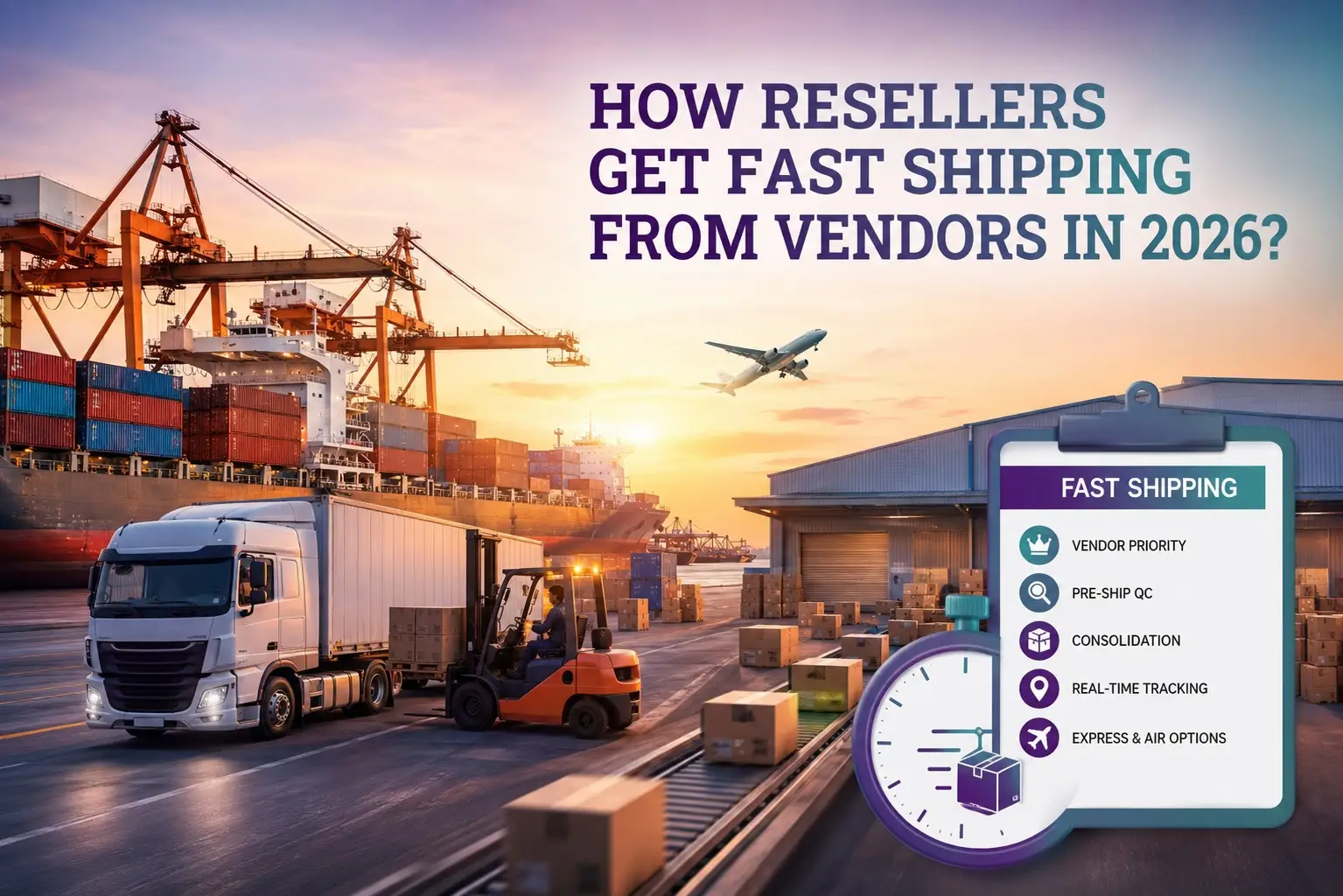
Resellers get fast shipping from vendors by choosing the right supplier model (private agent, fulfillment center, or factory direct), negotiating priority dispatch through MOQ commitments, pre-stocking inventory in domestic warehouses, picking the correct freight mode, and building genuine supplier relationships over time.
How do resellers get fast shipping from vendors? It is one of the most common questions in e-commerce, and it is almost always answered wrong.
According to Baymard Institute, slow or unclear delivery timelines contribute to a 70% average cart abandonment rate. Speed is not just a perk anymore. It is a business requirement.
In this guide, you will learn exactly how experienced resellers lock in faster vendor shipping at every stage of their business. From vetting new suppliers to negotiating priority dispatch, freight mode selection, customs clearance, and seasonal planning. No fluff. Just what actually works.
Why Vendor Shipping Speed is Your Real Competitive Edge?
Your biggest shipping bottleneck is almost never your outbound carrier. It is how fast your vendor processes, packs, and dispatches your order in the first place.
Most resellers focus all their energy on USPS, FedEx, and UPS rates. Those matters, but they only apply after the product is already in your hands. If your vendor takes 8 days to dispatch something that then ships in 2 days, your customer still waits 10 days total.
Marketplace algorithms feel this directly. Amazon’s seller performance standards penalize late shipments regardless of whose fault the delay is. eBay’s Fast ‘N Free badge and Top Rated Seller status both depend on consistent on-time delivery. Slow vendors quietly destroy your ranking.
The resellers who win are the ones who treat vendor speed as a supply chain problem, not a shipping problem.
Four levers control how fast a vendor moves your order:
- Your supplier relationship and standing as a buyer
- How you structure your orders (quantity, timing, payment)
- The freight mode you choose for inbound shipments
- Whether you pre-position inventory in a local warehouse
Understanding Your Supplier Model (Speed Varies More Than You Think)
The speed of your vendor shipments depends heavily on what kind of supplier you are working with. Fulfillment centers are the most beginner-friendly but offer less control. Private agents and factory-direct suppliers offer faster dispatch potential if you manage them well. Choosing the right model for your stage is the first decision to get right.
Not all suppliers operate the same way. A factory in Guangzhou, a trading company in Yiwu, and a fulfillment center in the US all have very different processing timelines.
Understanding this upfront saves you from blaming your carrier when the problem is actually upstream.
Here is how the main supplier models compare on speed:
| Supplier Model | Typical Dispatch Time | Negotiation Room | Best For | Risk Level |
|---|---|---|---|---|
| Fulfillment Center (CJ, Zendrop, Commer) | 2–5 days | Low | Beginners, 0–9 orders/day | Very Low |
| Trading Company | 5–10 days | Medium | Mixed product ranges | Low–Medium |
| Private Sourcing Agent | 3–8 days (with relationship) | Very High | 10+ orders/day, scaling stores | Low if vetted |
| Factory Direct | 7–20 days + production | High | High volume, custom products | Medium |
A private sourcing agent is someone based in China, often in manufacturing hubs like Yiwu or Shenzhen, who has direct relationships with multiple factories. They consolidate orders, negotiate rates, and handle logistics on your behalf. Think of them as a middleman who actually saves you time and money rather than costing you both.
The trade-off is that working with an agent requires some trust-building upfront. But once that relationship is established, your processing times often drop significantly compared to going through a generic fulfillment platform.
If you are just starting and doing fewer than 10 orders a day, do not overcomplicate this. A fulfillment center handles everything and lets you focus on growing sales.
The private agent model becomes worth the effort once you hit consistent daily order volume.
How to Vet Any Vendor for Shipping Speed Before You Commit

Before placing a real order, every reseller should run a simple vetting process to test how fast a vendor actually ships. Most suppliers will tell you what you want to hear during negotiations. A small test order with a firm deadline tells you the truth.
A vendor who promises 3-day dispatch but consistently takes 9 days will quietly kill your metrics on every marketplace you sell on.
Here is a five-step framework to test any new vendor before committing volume to them.
Step 1: Place a Small Test Order with a Hard Deadline
Order one or two units and state clearly when you expect them to be dispatched. Note how quickly they confirm the order, when they send tracking, and how accurate their estimated delivery turns out to be. This tells you more than any conversation ever will.
Step 2: Ask the Right Questions Before You Start
Some vendors are fast by default. Others are fast only when pushed. You need to know which one you are dealing with. Ask these questions directly via Alibaba chat, WhatsApp, or email:
- “What is your average processing time between payment and dispatch?”
- “Which courier or freight company do you use by default?”
- “Can I use my own freight account for better control?”
- “Do you have a dedicated team for accounts that order regularly?”
A vendor who gives vague or evasive answers to these questions is a red flag. A good supplier will be specific and transparent.
Step 3: Check Where Their Warehouse Is Located
Geography matters more than most resellers realize. A supplier located near a major port like Ningbo, Shanghai, or Shenzhen will have shorter inland transit to the container terminal. This can save two to four days before your order even leaves China.
A supplier based far inland means the goods have to travel overland to the port first, adding days to the timeline that are completely outside your control.
Step 4: Verify Their Carrier Partnerships
Suppliers who have established accounts with DHL Express, FedEx, or UPS can get your parcels picked up faster and tracked more reliably than those relying on economy postal services like ePacket or China Post.
Ask specifically which express carriers they use and confirm whether they offer tracking from the moment of pickup.
Step 5: Vet Multiple Suppliers at the Same Time
Do not commit to one vendor after a single successful test. Evaluate three to five suppliers simultaneously, compare their actual dispatch times side by side, and then choose your primary. Keep at least one backup.
This also gives you negotiating leverage. Vendors who know you are comparing options tend to be more responsive and competitive on price and speed.
The Stage-by-Stage Fast Shipping Playbook

The right strategy for getting fast vendor shipping depends entirely on how many orders you are currently processing per day. A beginner with 5 daily orders needs a completely different approach than a seller doing 50. Matching your strategy to your current stage is what separates profitable growth from expensive chaos.
There is no universal answer here. The resellers who get into trouble are the ones who try to implement an advanced private-agent setup when they are still at 3 orders a day, or who are still using a generic fulfillment center at 40 orders a day and wondering why their costs are killing their margins.
Stage 1: 0 to 10 Orders Per Day
At this stage, your job is to grow sales, not to optimize your supply chain. Use a fulfillment center. Platforms like CJ Dropshipping, Zendrop, or Commer let you paste an AliExpress product link, pay per order, and have everything else handled automatically.
These platforms typically ship in 5 to 15 days, depending on the product and destination. That is not ideal for long-term growth, but it is reliable, low-risk, and lets you focus on what actually matters at this stage: finding products that sell.
Do not stress about supplier negotiations, freight modes, or agents yet. Once you are consistently above 10 orders a day, that conversation becomes worth having.
Stage 2: 10 to 30 Orders Per Day
Now you have enough volume to justify a private sourcing agent. This is where shipping timelines start to improve significantly, often dropping from 10–15 days to 5–8 days for the same products.
Finding an agent is straightforward. You can contact suppliers directly through Alibaba or AliExpress using the built-in messaging tools and ask if they have a dedicated agent for international resellers.
You can also post in Facebook sourcing groups like "China Sourcing" with a simple message: "Doing 10+ daily orders in dropshipping. Looking for a reliable, fast agent. DM me."
Expect to receive a high volume of responses. Be skeptical. Start small with any new agent, limit your initial exposure to a few products, and only scale with them once they have proven themselves over several shipments.
Once you find a reliable agent, give them staff-level access to your Shopify store so they can view order details directly. This removes an entire communication step and speeds up processing.
Stage 3: 40 or More Orders Per Day
At this volume, the most powerful move is pre-stocking inventory in a US or European warehouse. Your agent in China ships a bulk container to a third-party logistics (3PL) provider near your main customer base. From there, orders ship domestically in 2 to 3 days.
This transforms your supply chain. Instead of every order triggering an international shipment, you are fulfilling domestically from local stock. Customers get their orders faster. You get better marketplace rankings and fewer complaints.
The trade-off is upfront capital for bulk inventory and warehouse fees. This only makes sense when you have enough sales data to forecast demand reliably. A good rule of thumb: only pre-stock SKUs that have sold consistently for at least 60 days.
Choosing the Right Freight Mode to Control Inbound Speed

How your inventory travels from your vendor to you or your warehouse is one of the biggest speed levers you control. Air freight is fast but expensive. Sea freight is cheap but slow. Knowing which mode to use for which situation directly affects your lead times and cash flow.
Here is a practical breakdown of your main options:
| Freight Mode | China to USA Transit Time | Estimated Cost per kg | Best Use Case |
|---|---|---|---|
| Express Courier (DHL/FedEx/UPS) | 3–7 days | $8–$18 | Small parcels, urgent restocks, high-value items |
| Air Freight | 7–14 days door-to-door | $4–$8 | Mid-size shipments, time-sensitive bulk orders |
| Sea Freight (LCL/FCL) | 25–40 days | $0.50–$2 | High-volume, low-urgency, pre-season inventory |
| China-Europe Rail | 18–30 days | $2–$4 | EU-based resellers, an alternative to slow sea freight |
A simple decision rule: if your product is worth more than $15 per kilogram, express air freight is usually justified. Below that threshold, sea freight often wins on total margin, even accounting for the longer wait.
When to Use Express Courier
Use it for urgent restocks, small high-value shipments, or when you are testing a new product and need inventory fast. Express courier from DHL or FedEx from China typically arrives in 3 to 7 business days. It is expensive per kilogram but eliminates almost all transit uncertainty.
When to Use Sea Freight
Use it for your core products that sell consistently and in high volume. Plan ahead with enough lead time (6 to 8 weeks minimum), and the savings per unit are substantial.
A container of goods that costs $1,500 to ship by sea might cost $15,000 by express courier.
The biggest mistake resellers make with sea freight is not planning far enough ahead. Order before you run out, not after.
Negotiating Priority Dispatch: Tactics Most Resellers Never Use

Getting your orders shipped faster does not always require a better supplier. Sometimes it just requires being a better buyer.
Vendors prioritize certain customers over others based on order volume, payment speed, relationship quality, and demand predictability. Understanding this gives you leverage most resellers never think to use.
Commit to Higher Order Quantities
Vendors run picking queues just like any business runs a to-do list. Larger orders tend to get assigned to experienced staff and processed first because they represent more revenue per unit of effort. When you commit to a minimum order quantity (MOQ), especially in writing, vendors take you more seriously.
Even a modest jump from 20 units to 50 units per order can bump you from the general queue to a priority queue at many smaller suppliers.
Ask your vendor directly: “Is there a minimum order that gets me faster processing or dedicated staff?”
Pay Early to Move Up the Queue
Vendors in China operate on tight cash flow. A buyer who pays immediately after placing an order, rather than waiting for confirmation, stands out. It signals reliability and reduces your vendor’s financial risk.
If cash flow is a concern, this is exactly where short-term e-commerce financing tools help. Paying your vendor a few days earlier than your competitors can earn you days of processing advantage over time.
Build a Real Relationship, Not Just a Transaction
This one sounds simple and gets ignored constantly. Send a brief check-in message between orders. Acknowledge your vendor’s Lunar New Year. Mention when a shipment arrived in great condition. These small actions signal that you are a long-term partner, not a one-time buyer.
Vendors who like working with you will pick your orders first when capacity is tight. That is especially true during peak seasons when their team is stretched.
Give Your Vendor Accurate Forecasts
If your vendor knows you are going to place an order in two weeks for 100 units of a specific SKU, they can pre-pick the stock and have it ready before you even pay. This shaves two to four days off your processing time with zero additional cost.
A simple weekly WhatsApp message works: “Heads up, I will be ordering 80 units of SKU-A and 40 of SKU-B next Tuesday.” That one habit compounds into massive time savings over months.
How Fast Vendor Shipping Worked in Practice: A Real Sourcing Story
Working with an experienced sourcing partner in China can cut vendor lead times dramatically, especially during periods of high demand or supply chain disruption. The key is having someone on the ground who has pre-built supplier relationships and understands local logistics.
A small home goods reseller selling across eBay and Amazon came to us after a difficult Q4. They were sourcing independently through a trading company and routinely seeing 14 to 18-day lead times from payment to their US doorstep.
During November, their supplier fell behind entirely, and they ran out of their best-selling SKU for 11 days straight. Estimated lost revenue: over $4,000.
The core problem was not the freight carrier. It was that their trading company had no priority relationship with the factory and was essentially placing orders in the general queue alongside dozens of other small buyers.
Our team at CHANGE Sourcing identified two alternative suppliers near Ningbo with established express freight accounts and an average dispatch time of 3 days.
We negotiated a small but consistent weekly order commitment on the client’s behalf, which earned the client priority handling status at both suppliers.
Within 60 days, their inbound lead time dropped from 16 days to 6 days on average using air freight for their core SKUs. They pre-stocked a buffer quantity through a US 3PL before Q4 of the following year. That November, they had zero stockouts.
The lesson is straightforward. Faster vendor shipping is rarely about finding a magic carrier. It is about who you know, how you order, and how you are perceived as a buyer.
Customs and Documentation: The Hidden Speed Killer
Customs delays are one of the most common and least-discussed causes of slow vendor shipping. A shipment that leaves China in 4 days can sit in customs for 2 weeks because of a wrong HS code or missing paperwork. Fixing this is entirely within your control.
According to U.S. Customs and Border Protection, improper documentation is one of the leading causes of import delays for small commercial shipments. Most resellers do not know this is happening because carriers often just list “in transit” without explaining the actual hold.
Getting Your HS Code Right
Every product you import needs a Harmonized System (HS) code. This is a standardized numerical code that tells customs what the product is and what duty rate applies.
Many suppliers default to a generic code that may not match your product precisely, which increases the chance of an inspection or hold.
Look up your product’s correct HS code using the U.S. International Trade Commission Tariff Database before your first shipment. Share it with your supplier and ask them to confirm it matches their documentation.
The Documents You Always Need
Make sure every shipment includes these four documents without exception:
- Commercial Invoice: Must list the correct value, product description, and HS code.
- Packing List: Detailed breakdown of items, quantities, and weights.
- Bill of Lading or Airway Bill: Issued by the carrier, needed for customs processing.
- Certificate of Origin: Confirms where the goods were manufactured.
Missing or inconsistent information across these documents is the number one cause of customs holds. Your supplier should provide all of these. Double-check them before shipment leaves China.
DDP vs. DDU: What You Should Specify
Delivered Duty Paid (DDP) means your supplier or freight forwarder handles import duties and taxes on your behalf. Delivered Duty Unpaid (DDU) means customs duty falls on you upon arrival, which can cause delays if you are not prepared.
For most resellers importing regularly, specifying DDP with a trusted freight forwarder avoids surprise holds at the border and keeps your lead time predictable.
Inventory Organization: The Operational Side of Fast Shipping
Once inventory arrives at your location, how organized you are determines how fast you can fulfill orders. A chaotic storage system causes delays, picking errors, and missed handling windows. The best resellers run their warehouse like a mini-operation, not a spare bedroom.
The Letter-Number Bin System
Assign every storage location in your space a code: A1, B1, C1… through Z1, then A2, B2, and so on. When you list a product on eBay or any marketplace, enter its bin code in the custom SKU field under item specifics. When the product sells, you know exactly where it is without searching.
This system scales indefinitely and takes about 30 minutes to set up from scratch. It eliminates the “I can’t find it” problem entirely, which is one of the most unprofessional things that can happen to an online seller.
The Morning Batch Workflow
Set a consistent daily window for order processing. Print all labels in the morning, pack during that window, and run one post office drop or schedule one carrier pickup per day. Batching is dramatically faster than processing orders as they come in throughout the day.
A thermal printer is non-negotiable at any real order volume. It prints labels in seconds without ink costs. Compare that to a standard inkjet printing one label at a time, and you will understand why every volume reseller upgrades quickly.
Your Handling Time is a Commitment
Whatever handling time you list on your marketplace profile (1 day, 2 days), treat it as a hard deadline. Customers evaluate their experience based on whether you met what you promised. If you ship in 1 day when you promised 2, they remember that. If you ship in 3 days when you promised 2, they also remember that, and they leave a review about it.
Set a handling time you can consistently meet and then beat it regularly.
Seasonal Planning to Avoid Vendor Slowdowns
Vendor shipping speed does not stay constant throughout the year. Chinese New Year, Golden Week, and Q4 holiday demand all cause major slowdowns that catch unprepared resellers off guard. Planning around these events is one of the highest-leverage habits a reseller can build.
According to Flexport’s annual shipping index, air and sea freight capacity tightens sharply between September and November each year as US holiday demand surges. Rates climb. Booking windows shrink. Resellers who did not pre-order stock pay a premium for whatever space is left.
The Chinese New Year Problem
Chinese factories and warehouses typically shut down for two to four weeks around Chinese New Year, which falls between late January and mid-February. Suppliers stop processing orders for weeks on either side of the holiday as workers travel home.
If you have not ordered your Q1 inventory before January, you will likely wait until March for stock. The solution is simple: place your post-holiday orders in December, not January.
Building a Vendor Calendar
Map out the key dates that affect your suppliers every year:
- Chinese New Year: Late January to mid-February
- Golden Week: First week of October
- Singles Day (11/11) surge: October through November
- US Q4 peak: September through December (freight capacity tightens)
For each of these windows, decide whether you need to order early, pre-stock, or switch temporarily to a domestic supplier. Making these decisions in advance rather than reactively is the difference between running out of stock and having a record month.
Your Safety Stock Formula
A simple way to calculate how much buffer inventory to keep on hand:
Safety Stock = (Average Daily Sales x Vendor Lead Time in Days) x 1.5
If you sell 20 units per day and your vendor takes 10 days to deliver, keep at least 300 units in reserve. The 1.5 multiplier is your buffer for delays and demand spikes.
FAQ: How Resellers Get Fast Shipping from Vendors
Resellers get fast shipping outside of FBA by working with private sourcing agents in China, using third-party logistics (3PL) providers for domestic warehousing, and choosing express freight modes for inbound shipments. The key is pre-positioning inventory locally so orders ship domestically rather than internationally each time.
The fastest method is express courier through DHL, FedEx, or UPS, which delivers from China to the US in 3 to 7 business days. This is the most expensive per kilogram but eliminates most transit uncertainty. For regular high-volume orders, pre-stocking in a US warehouse via sea freight is faster in practice because shipments are already local.
You can find private agents through Alibaba supplier messages, AliExpress vendor contacts, or by posting in Facebook groups focused on China sourcing. Always vet agents by starting with a small test order, verifying tracking quality, and evaluating their response time before committing real volume to them.
Commit to consistent order quantities, pay promptly, and give vendors advance notice of upcoming orders. Vendors prioritize buyers who are predictable and reliable. Asking directly whether a volume commitment earns priority processing is also a perfectly reasonable conversation to have.
Yes, significantly. Missing or incorrect documentation on international shipments can add 5 to 14 days to your lead time with no warning. Using the correct HS code, ensuring your commercial invoice matches your packing list, and working with a licensed customs broker for regular shipments removes most of this risk.
Conclusion
Fast vendor shipping is not one decision. It is a system built from the right supplier model, smart order habits, good freight planning, and a bit of relationship investment over time.
Start where you are. If you are under 10 orders a day, a good fulfillment center is enough. As you grow, bring in a private agent, then pre-stock domestically. Layer in the negotiation tactics, freight mode discipline, and seasonal planning as each becomes relevant to your scale.
The resellers who consistently get fast vendor shipping are not the ones with the best luck. They are the ones who treated their supply chain like a competitive advantage from day one.
If you want an experienced sourcing partner in China who already has the supplier relationships, freight accounts, and logistics infrastructure in place, reach out to CHANGE Sourcing for a free consultation. With 18 years of on-the-ground experience in Yiwu, the team handles everything from supplier vetting to freight coordination so your orders arrive faster and your margins stay protected.