

Sourcing smart home security products in China, specifically from Shenzhen and the wider Guangdong province, gives you access to the factories that manufacture the majority of the world's cameras, smart locks, alarm systems, and sensors. The opportunity is real, but this category has specific risks that generally nobody tells: certification traps, firmware ownership gaps, IP vulnerabilities, and data privacy concerns that can affect your customers.
The global smart home security market is projected to reach $94.59 billion by 2029, and the majority of those products are manufactured in one place: Shenzhen, China.
For importers and brand owners, sourcing smart home security products means accessing that manufacturing base directly. But this category is different from sourcing a water bottle or a tote bag.
Wrong certifications, firmware gaps, and IP mistakes do not just delay a shipment; they can get products pulled from shelves or hand your design to a competitor. This guide covers everything, with examples, so you know exactly what to check before placing an order.
Why China Dominates Smart Home Security Sourcing and Manufacturing?
China produces the majority of the world’s smart home security hardware, and Shenzhen is the center of it all.
The reason is not just low labor costs. It is supply chain density. A camera factory in Longhua district, Shenzhen, can receive image sensors from a supplier two streets away, PCB assembly from a facility five minutes by road, and injection-molded casings from a plastics manufacturer nearby.
A functional prototype can go from design file to physical product in 7 to 12 days.
No other manufacturing region in the world offers this combination of speed, component access, and engineering depth for electronics.
That is why brands from Germany, the US, Australia, and the UK all manufacture their security products here, even if the box says something else.
What Products Can You Source and What Do They Cost?
Smart home security covers a broader range of products than most buyers initially plan for. Here is a clear breakdown of the main categories with realistic factory pricing:
| Product | Factory Price Range | Typical MOQ | Key Certifications Needed |
| Indoor Wi-Fi camera | $8 to $25 per unit | 100 to 500 | CE, FCC, RoHS |
| Outdoor PTZ camera | $25 to $80 per unit | 100 to 300 | CE, FCC, RoHS, IP66 |
| Video doorbell | $15 to $45 per unit | 100 to 500 | CE, FCC, RoHS |
| Smart lock (fingerprint) | $30 to $90 per unit | 100 to 300 | CE, FCC, RoHS |
| GSM or Wi-Fi alarm kit | $20 to $60 per kit | 50 to 200 | CE, RoHS, FCC |
| Motion and door sensors | $3 to $12 per unit | 50 to 200 | CE, RoHS |
These are starting ranges based on factory-level pricing. Prices vary by specification, feature set, material quality, and order volume.
Smart Cameras
This is the highest-volume product category. Options range from basic 1080p indoor Wi-Fi cameras with night vision and motion alerts to advanced outdoor PTZ cameras with AI object recognition and PoE connectivity.
A practical example: a distributor sourcing a simple indoor baby monitor camera with two-way audio, night vision, and Tuya app integration would expect to pay around $10 to $14 per unit at 300 units.
The same factory can typically offer private label packaging, custom color, and app branding for a modest additional tooling fee.
Smart Locks
Smart locks have become one of the fastest-growing categories for OEM orders. Fingerprint, PIN code, Bluetooth, and Wi-Fi deadbolts are all widely produced in Guangdong.
A buyer sourcing branded smart locks for a property management company would typically start with a sample of 3 to 5 units, test them extensively, then place a first production order of 100 to 200 units.
Most factories support logo engraving, packaging design, and app integration for 100 units.
Security Alarm Systems
GSM and Wi-Fi alarm kits are especially popular for residential and small commercial security. Most are now built on the Tuya platform, which is explained in its own section below.
Sensors and Accessories
Door sensors, motion detectors, glass break sensors, and water leak detectors are often lower-MOQ additions that complement a main product line. They are also a good category for testing a factory relationship before committing to a larger camera or lock order.
Where to Find Suppliers?
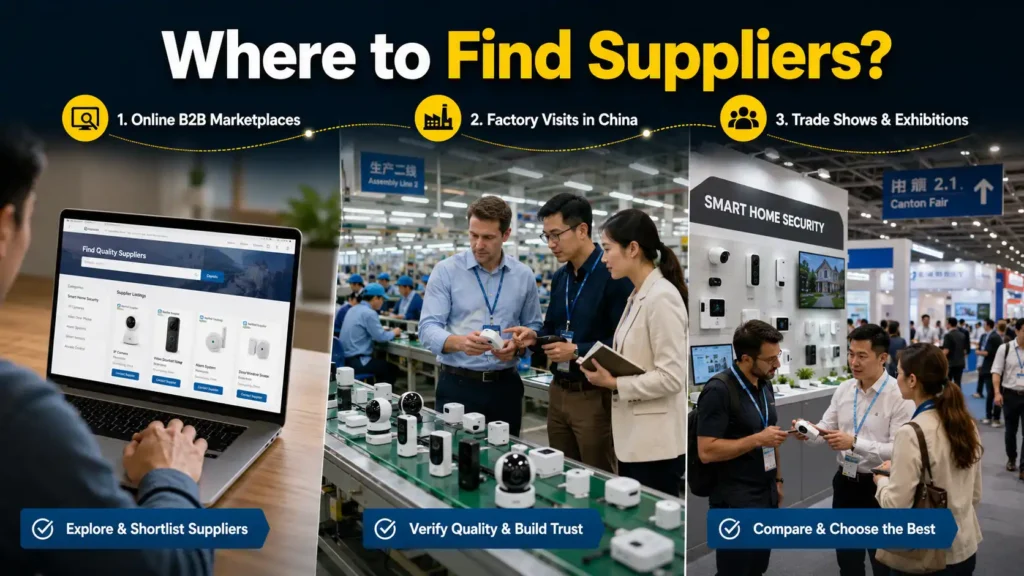
There are three main routes to finding suppliers for this category. Each one gives you access to a different level of the supply chain.
Sourcing smart home security products in China gives you three main access routes, each reaching a different level of the supply chain.
Online B2B Platforms
Alibaba, Made-in-China, and Global Sources all carry smart home security suppliers. Of the three, Made-in-China has a stronger representation of industrial and professional security manufacturers.
Global Sources is stronger for verified, export-ready electronics with compliance documentation. Alibaba has the widest selection but also the highest proportion of trading companies in this category.
A trading company will describe itself as a manufacturer. The difference matters because factories offer lower prices, direct quality control access, and the ability to modify specifications. A trading company adds a margin and has limited ability to make changes to the product.
To verify whether a supplier is a factory: ask for photos of their production line and assembly floor, request their business license showing manufacturing scope, and ask which specific factory their product is produced in. A genuine manufacturer answers these questions directly. A trading company deflects them.
Shenzhen and Guangdong in Person
For serious buyers, visiting Shenzhen directly is still one of the most efficient sourcing decisions you can make in this category.
The density of factories means you can visit three to five suppliers in a single day, see working production lines, and meet the actual engineers rather than just the export sales team.
The Hua Qiang Bei electronics market in Shenzhen is also worth visiting. It is one of the world’s largest electronics component markets and gives buyers a ground-level view of what components go into the products they are sourcing.
Canton Fair
Phase 1 of the Canton Fair in Guangzhou covers electronics and machinery and is the most relevant phase for smart home security sourcing.
Unlike browsing Alibaba, the Canton Fair lets you see working product demonstrations, compare twenty suppliers in one place, and negotiate face-to-face with factory representatives.
For buyers attending the Canton Fair, the security and smart home halls attract genuine manufacturers who exhibit because they are ready to support export volumes. It is a strong environment for finding OEM and ODM partners.
Suggested Reading: Which Canton Fair Phase Is Best in 2026? Complete Guide
OEM vs ODM: Which One Do You Actually Need?
This distinction confuses a lot of buyers when they start sourcing electronics, so here is a clear explanation with a real example for each.
ODM (Original Design Manufacturing) means you take the factory’s existing product, put your logo on it, and sell it as your own brand. The product design belongs to the factory. You are licensing their design.
Example: A UK security brand finds a factory in Shenzhen that already makes a well-built outdoor Wi-Fi camera. They ask the factory to add their logo, change the packaging to match their brand, and put their company name on the app. That is ODM. It is fast, affordable, and requires a relatively low MOQ.
OEM (Original Equipment Manufacturing) means you bring your own design specifications to the factory and they manufacture it to your requirements. You own the design.
Example: A US company designs a new smart lock with a specific fingerprint module, a custom housing shape, and its own proprietary app. They give the factory detailed technical drawings and specifications. The factory builds it. That is OEM. It requires more upfront investment in engineering, but gives the buyer full IP ownership over a product that competitors cannot directly copy.
Most buyers start with ODM because it is faster and lower cost. Most established brands move to OEM as they grow because they want products that belong to them. Neither is wrong. Understanding what you are doing sets the right expectations on price, timeline, and IP rights.
Certifications: The Trap Most Buyers Fall Into
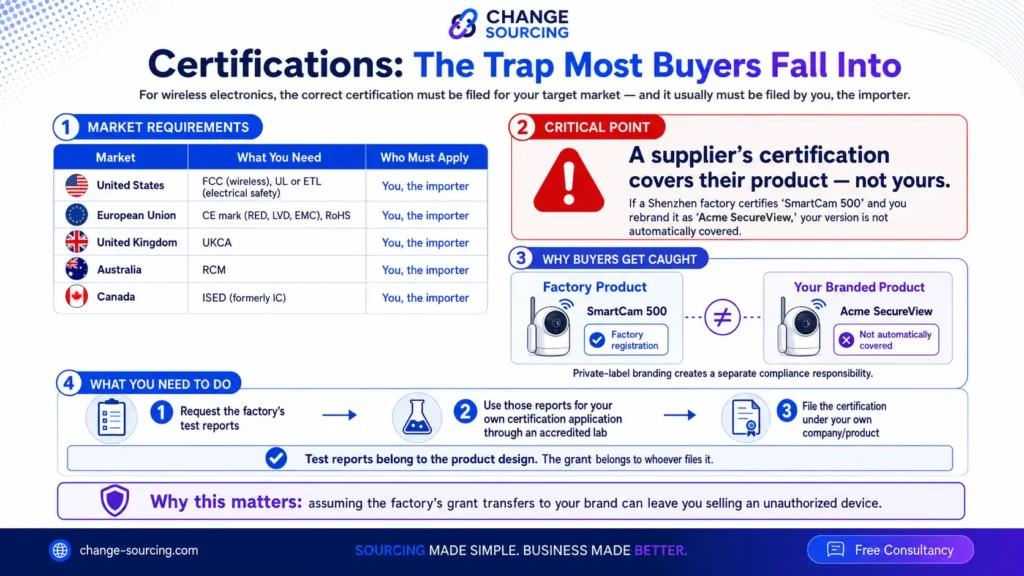
This is where the most expensive mistakes happen in this category.
Every market has its own certification requirements for wireless electronics. Before your product can legally be sold, it must carry the correct certification for that specific market.
| Market | What You Need | Who Must Apply |
| United States | FCC (wireless), UL or ETL (electrical safety) | You, the importer |
| European Union | CE mark (covers RED, LVD, EMC directives), RoHS | You, the importer |
| United Kingdom | UKCA (post-Brexit) | You, the importer |
| Australia | RCM | You, the importer |
| Canada | ISED (formerly IC) | You, the importer |
Here is the critical point that you should note: a supplier’s FCC certification covers their product, not yours.
Think of it this way. A Shenzhen factory produces a camera called the “SmartCam 500” and registers it with the FCC under its company name. You put your brand name on the same camera and call it the “Acme SecureView.” Your product is not covered by their FCC registration. Legally, you are selling an unauthorized device in the US.
In late 2025, millions of electronics listings were removed from major US retail platforms for exactly this reason. Sellers had assumed the factory’s certification transferred to them. It does not.
What you need to do: request the factory’s test reports and use them as the basis for your own certification application through an accredited lab. The test reports belong to the product design. The grant belongs to whoever files it.
What Is Tuya and Why Does Every Supplier Mention It?
If you have been searching for smart home security suppliers, you have probably seen the word Tuya everywhere without a clear explanation of what it actually is.
Tuya is a Chinese IoT platform that provides the cloud infrastructure and software layer behind a very large number of smart home products globally. Think of it as the operating system that runs in the background of many Chinese-made smart devices.
Here is a simple way to understand it: when you buy a smart plug from one brand and a motion sensor from a different brand, and they both work inside the same phone app, Tuya is often the reason. It is a shared platform that many manufacturers build on top of.
For buyers, this matters for three reasons.
First, Tuya-based products come pre-integrated with Amazon Alexa, Google Home, and Apple HomeKit. Your customers do not need any extra setup to connect the product to their existing smart home.
Second, Tuya supports white-label app branding. You can have your company name and logo on the app your customers download, without writing any code. The factory handles it.
Third, Tuya has its own compliance and certification documentation process that makes CE and FCC paperwork easier for qualified suppliers.
A practical example: a security alarm distributor in the Middle East sources a Tuya-based alarm kit. Their customers download an app with the distributor’s own branding. The alarm connects to their customers’ Alexa devices. Firmware updates come over the air automatically. The distributor did not write a single line of code.
The Firmware Ownership Problem Nobody Warns You About
When you source an ODM product with a custom app or custom firmware features, the factory’s engineers write the code.
If your contract does not include a clause transferring firmware ownership to you, the factory legally retains it. They can sell the same firmware, the same app interface, and the same features to another buyer tomorrow under a different brand name.
A buyer in the UK spent months specifying a custom alarm system with a branded app experience, specific notification logic, and a unique dashboard layout. Their contract said nothing about firmware ownership. Eight months after launch, a competitor appeared at a trade show with an identical product and app interface, produced by the same Shenzhen factory.
The fix is a single clause in your contract, drafted before you share any specifications: all firmware developed to your requirements transfers to you upon full payment, and the factory retains no right to license or reproduce it for any other party.
If you are using the Tuya platform, this issue is largely avoided because Tuya controls the underlying firmware. Your customizations sit on top of a platform that the factory cannot simply hand to someone else.
IP Protection: NNN Agreement vs NDA
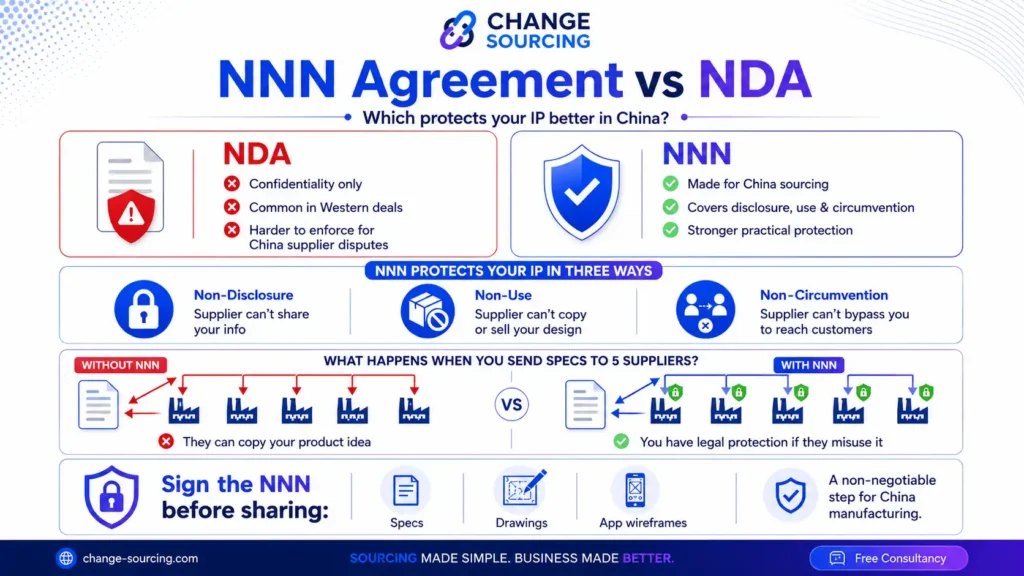
Most Western buyers know what an NDA is. An NDA protects the confidentiality of information you share. In China, a standard NDA is difficult to enforce because it is based on Western legal frameworks.
An NNN agreement is different. NNN stands for Non-Disclosure, Non-Use, and Non-Circumvention. It is specifically designed for the Chinese legal system and covers three things:
- The supplier cannot share your information.
- They cannot use it independently to make and sell a competing product.
- Your supplier cannot go around you to contact your customers or partners directly.
The practical difference: imagine you share your product specifications with five Shenzhen suppliers to get competitive quotes. Without an NNN, each of those five suppliers can use your specifications to make their own version of your product and sell it. With an NNN signed before you share anything, you have a legal remedy in a Chinese court if they do.
Always sign the NNN before sharing specs, drawings, app wireframes, or any proprietary information. This is a non-negotiable step in this product category.
One Thing US Buyers Must Know Before Selling to Commercial Clients
This section is specific to buyers who sell to government agencies, schools, hospitals, or any organization that receives US federal funding.
The US National Defense Authorization Act (NDAA) prohibits federal agencies and their contractors from purchasing telecommunications and surveillance equipment from several Chinese companies, including Hikvision, Dahua, Huawei, Hytera, and ZTE.
This does not ban the commercial sale of these products to general consumers. But if any of your customers are US government entities or contractors, or organizations that receive federal funding, supplying them with products manufactured by or using components from these companies can create compliance problems.
A practical example: a US security integrator sources cameras from a factory that uses Hikvision’s chip technology and component supply. They rebadge the product and sell it to a school district. If that school district receives federal funding, the purchase may violate NDAA compliance requirements.
If your customer base includes any public sector clients in the US, verify your product’s component supply chain before ordering.
How to Test Smart Home Security Products Before Placing a Volume Order?
Standard product inspection checks whether a product looks correct. For smart home security products, you need to know whether they work correctly. These are very different things.
Specific tests to run on samples before mass production:
- Wi-Fi range test: place the device at the maximum distance specified on the packaging, with two internal walls between the device and the router. Does the connection hold? Does the video stream without delay?
- App response time: trigger the motion sensor and count the seconds until you receive a push notification on your phone. Anything over 8 seconds is a consistent source of customer complaints.
- Night vision test: In a completely dark room at the specified range, does the image show what it should at the claimed resolution?
- False alarm rate: run the motion sensor in a real environment for 48 hours. Count how many times it triggers without an actual person moving through the zone.
- Battery life: for battery-powered wireless products, run them at the typical usage frequency for the full duration of the claimed battery life.
- Firmware update test: ask the factory to push an over-the-air update to your sample. Verify the device receives it without needing to be manually reset.
If a factory is reluctant to support extended sample testing, that is information worth having before you place a production order.
Change Sourcing Insight: What We See When Buyers Get This Category Wrong
After 10+ years helping over 1,500 importers source from China, smart home security is one of the categories where we see the most avoidable losses.
The most common pattern is a buyer who did everything right on the product side and nothing right on the legal and compliance side. Good factory. Good quality. No NNN agreement and no firmware clause. No certification verification. Six months after launch, the same product appears under three different brand names on Amazon, all from the same factory.
We also see buyers who accept a supplier’s certification documents at face value. A supplier sends a PDF with an FCC logo on it. The buyer assumes they are covered. The product goes live. Then, a retailer flags that the FCC ID on the unit does not match the product in the FCC database, because the supplier used an old certificate from a different model.
Verifying a certification is simple. Go to the FCC's public database at fcc.gov, search the FCC ID printed on the product, and check that the authorized equipment description matches what you are selling.
It takes five minutes, and it has saved clients from shipments worth tens of thousands of dollars being turned away at customs.
If you are sourcing smart home security products from China and want an experienced team to manage supplier verification, factory audits, sample testing, and compliance documentation, the Change Sourcing team works on the ground in Shenzhen and Guangzhou and can support your project from supplier selection through to shipment.
You can contact us for a FREE Consultation call!
Frequently Asked Questions

Shenzhen in Guangdong Province is the primary manufacturing hub for smart home security electronics globally. The area has the highest concentration of camera, smart lock, and alarm system factories, supported by a dense local component and PCB supply chain. Most of the world’s major security hardware brands manufacture in this region.
You need your own. A supplier’s FCC ID covers their branded version of the product. If you sell the product under your own brand name, you must apply for your own FCC grant using test data from an accredited laboratory. Selling under a supplier’s FCC ID without your own authorization is a federal violation in the US.
ODM means using the factory’s existing product design with your branding added. It is faster and lower cost. OEM means you provide your own design specifications, and the factory manufactures to your requirements. You own the design with OEM. Most buyers start with ODM and move to OEM as their brand grows, and they want proprietary products.
Tuya is an IoT platform that provides the cloud infrastructure and app framework for many smart home products. Products built on Tuya automatically work with Alexa, Google Home, and Apple HomeKit, and support white-label app branding. You do not have to use Tuya, but it significantly reduces development time and cost for buyers who want app-connected products without building their own software.
An NNN agreement covers Non-Disclosure, Non-Use, and Non-Circumvention. Unlike a standard NDA, which only covers confidentiality, an NNN prevents the supplier from using your information to make competing products or contacting your customers directly. It is specifically designed for the Chinese legal jurisdiction and should be signed before you share any specifications, drawings, or proprietary information with any supplier.
The cameras themselves function well and represent excellent value for quality. The key concern is data routing: many cheaper cameras send video data to servers in China by default. For buyers selling to residential consumers, this is a disclosure and configuration issue. For buyers selling to the US government or federally funded organizations, it is an NDAA compliance issue. Verify your supplier’s data routing and server infrastructure before finalizing a product.
Ask for photos of their production floor and assembly line. Request their business license showing the manufacturing scope. Ask which specific components they manufacture in-house versus purchase from suppliers. A genuine factory answers these questions directly and can provide facility photos and audit reports from third-party bodies like SGS or Bureau Veritas.
Products sold in the EU need the CE mark, which covers several directives: the Radio Equipment Directive (RED) for wireless devices, the Low Voltage Directive (LVD) for electrical safety, and the EMC Directive for electromagnetic compatibility. Products must also comply with RoHS for hazardous substances. You as the importer, are responsible for obtaining and holding the Declaration of Conformity documentation.
Final Takeaway
Sourcing smart home security products in China is a smart move in global electronics importing. The manufacturing infrastructure, engineering depth, and component supply chain in Shenzhen cannot be matched anywhere else for this category.
The buyers who succeed here are the ones who treat this category like the technical product category it is. That means verifying certifications rather than accepting supplier documents at face value, understanding the difference between ODM and OEM before discussing specifications, protecting firmware ownership and IP through the right legal agreements, and testing products properly before committing to volume.
Suggested Readings: