

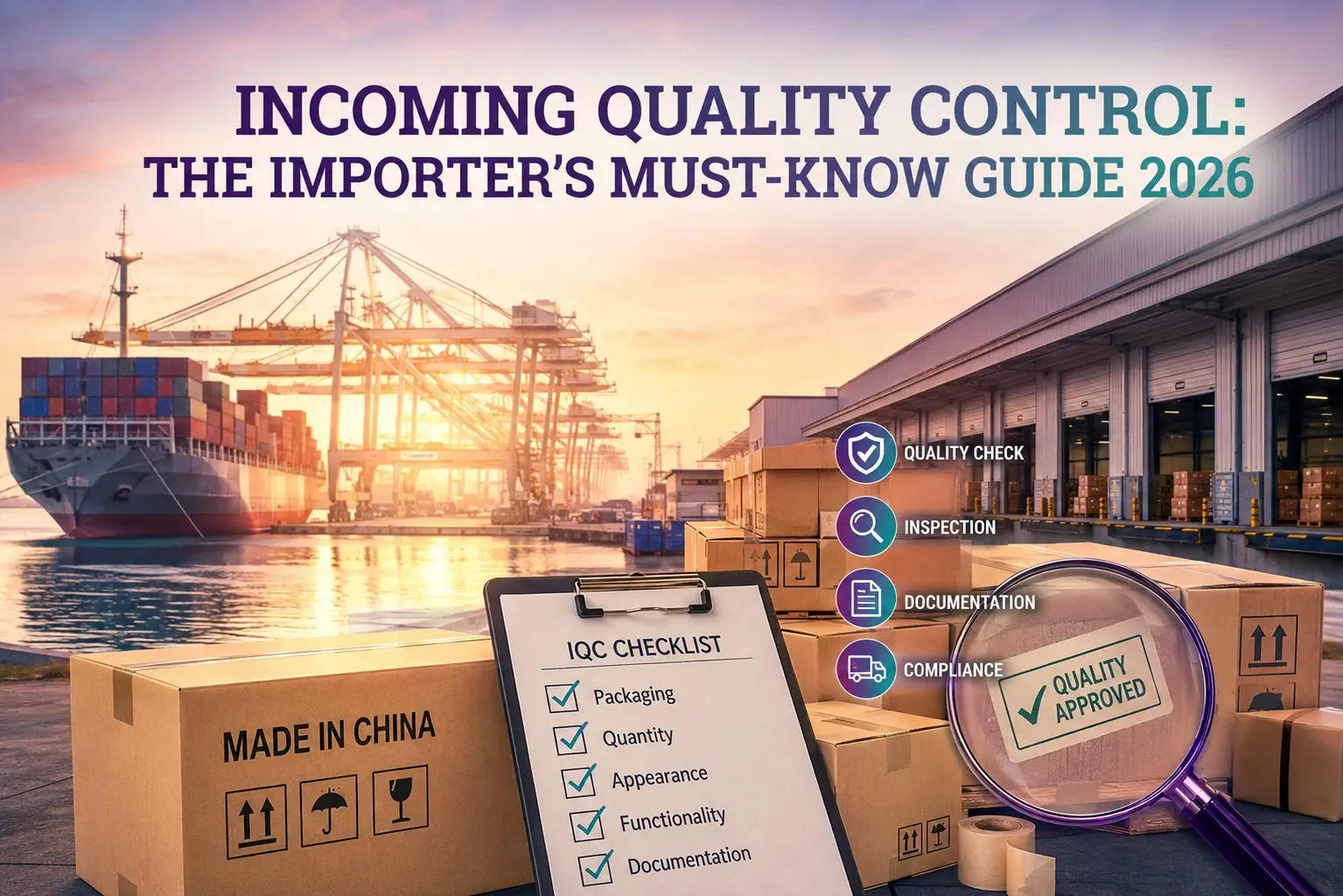
Incoming quality control (IQC) is the inspection of raw materials, components, and purchased parts before they enter production. IQC stands for Incoming Quality Control — it is the first quality gate in manufacturing and the most important one. Incoming materials directly influence up to 50% of final product quality. Skipping IQC, or worse, letting your supplier run it themselves, is where most product quality problems actually begin.
Most importers focus their quality attention on the finished product. They book a pre-shipment inspection, check the goods before they ship, and consider the job done.
But by that point, the damage is often already done.
If the raw materials going into production were substandard, no amount of final inspection will fix the finished goods. Incoming quality control is the step that stops the problem before it starts, and it is the step that most buyers either skip or leave entirely in the hands of their supplier.
This guide explains what incoming quality control is, how the process works, and what every importer sourcing from China needs to know about who should actually be running it.
What is Incoming Quality Control?
Incoming quality control (IQC) is the systematic inspection and verification of raw materials, components, and purchased parts before they are used in production.
Its purpose is simple: only materials that meet your quality specifications should be allowed onto the production floor.
IQC is the first checkpoint in a manufacturer’s quality system. If defective materials enter production, the problems compound at every stage after that. Catching issues at the incoming stage is always faster, cheaper, and less disruptive than catching them later.
Why Do Incoming Materials Account for 50% of Product Quality?
This is the statistic most buyers never hear. In manufacturing, four factors directly impact final product quality: design, incoming materials, the production process, and storage and transport.
Incoming materials account for approximately 50% of product quality outcomes. Design accounts for around 25%. The production process covers the remaining 20% to 25%. Storage and transport contribute just 1% to 5%.
That means the materials going into your product matter more than how the product is made.
The American Society for Quality (ASQ) estimates that quality-related costs consume 15%–20% of annual sales for many manufacturers, and external failure costs are 10–100× more expensive than catching defects during production, the core financial argument for upstream incoming quality control. That is not a factory floor problem. It is a supply chain problem, and it starts before a single unit is assembled.
How Does the IQC Process Work Step by Step?
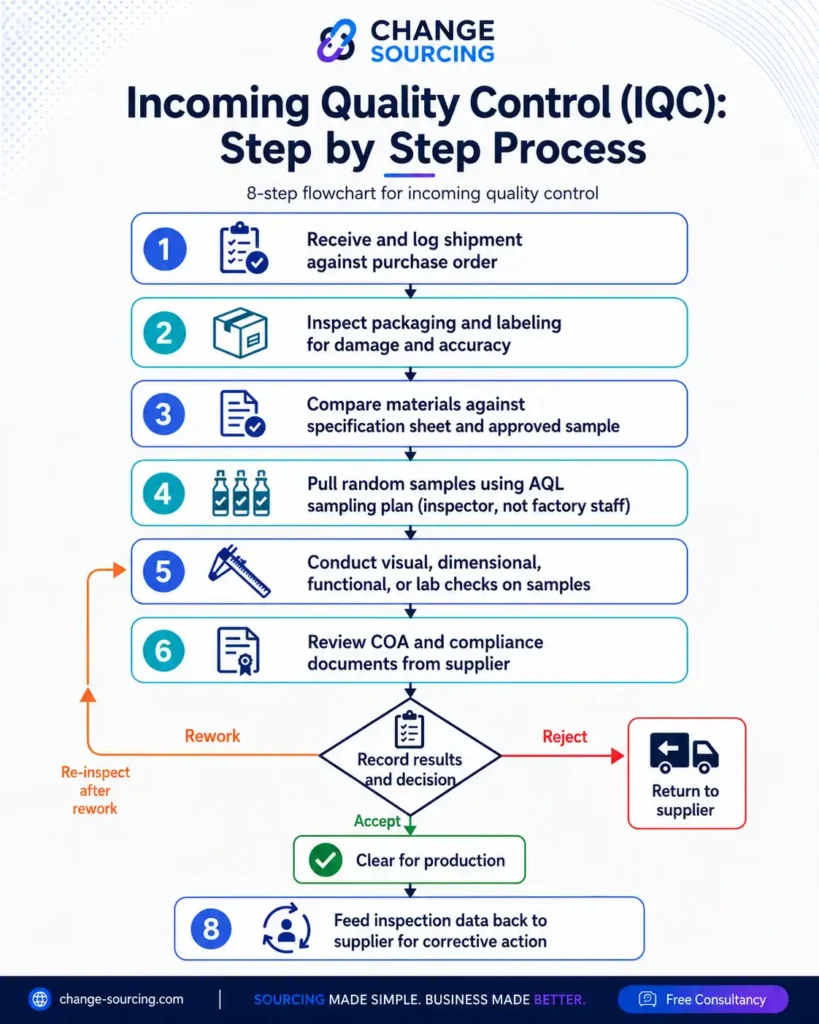
Incoming quality control follows a defined sequence from the moment materials arrive at the factory. Each step builds on the last, and skipping any one of them creates a gap that defective materials can pass through undetected.
Step 1: Receive and Log the Shipment
When goods arrive from the supplier, the first task is documenting what has actually been delivered. The quantity received is checked against the purchase order, the packing list, and the supplier’s delivery note.
Any discrepancy in quantity, labeling, or packaging condition is flagged immediately at this stage before anything moves further into the warehouse.
Step 2: Check Packaging and Labeling
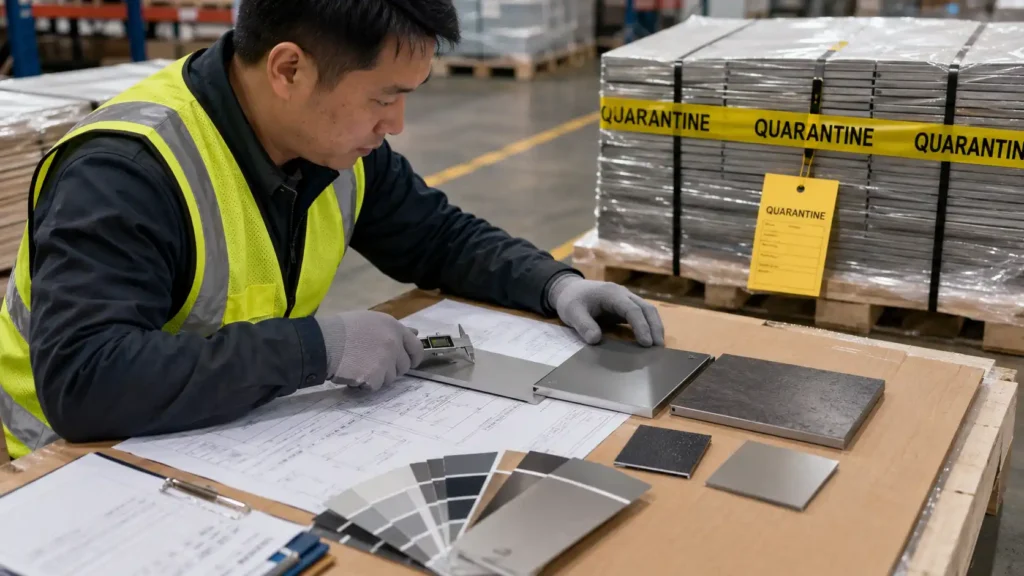
Before materials are even opened, the outer packaging is inspected for physical damage that may have occurred during transit. Labels are verified for accuracy, including part numbers, material grade, batch numbers, and country of origin. Incorrect labeling at this stage is a common signal of deeper inconsistencies in the batch.
Step 3: Verify Against Specification Sheet and Approved Sample
Received materials are compared against the agreed technical specification sheet and, where available, the approved pre-production sample. This includes checking material grade, dimensions, color, finish, and any other criteria defined at the time of ordering.
If the materials do not visibly match what was agreed, the batch is quarantined for further review before sampling begins.
Step 4: Pull Random Samples for Inspection
This is the most critical step in the entire process. Samples must be pulled randomly and independently, not selected by factory staff. When the factory chooses the samples, there is an inherent conflict of interest. Staff will naturally select units most likely to pass.
The sample size is determined using a defined sampling plan, most commonly the AQL (Acceptable Quality Limit) standard. AQL sets the number of units to inspect based on batch size and defines the maximum number of defects that can be found before the batch is rejected.
Step 5: Conduct Visual, Dimensional, and Functional Checks
Sampled units are inspected using the appropriate method for the material type:
- Visual inspection checks for surface defects, color inconsistencies, contamination, or workmanship issues visible to the eye
- Dimensional inspection uses calipers, micrometers, or gauges to verify that physical dimensions match technical drawings
- Functional testing checks whether parts perform as intended, including electrical testing, assembly fit, or mechanical resistance
- Lab testing is used for materials where composition matters, such as fabrics, metals, food-grade materials, or products with regulatory requirements
Step 6: Review Certificates and Compliance Documents
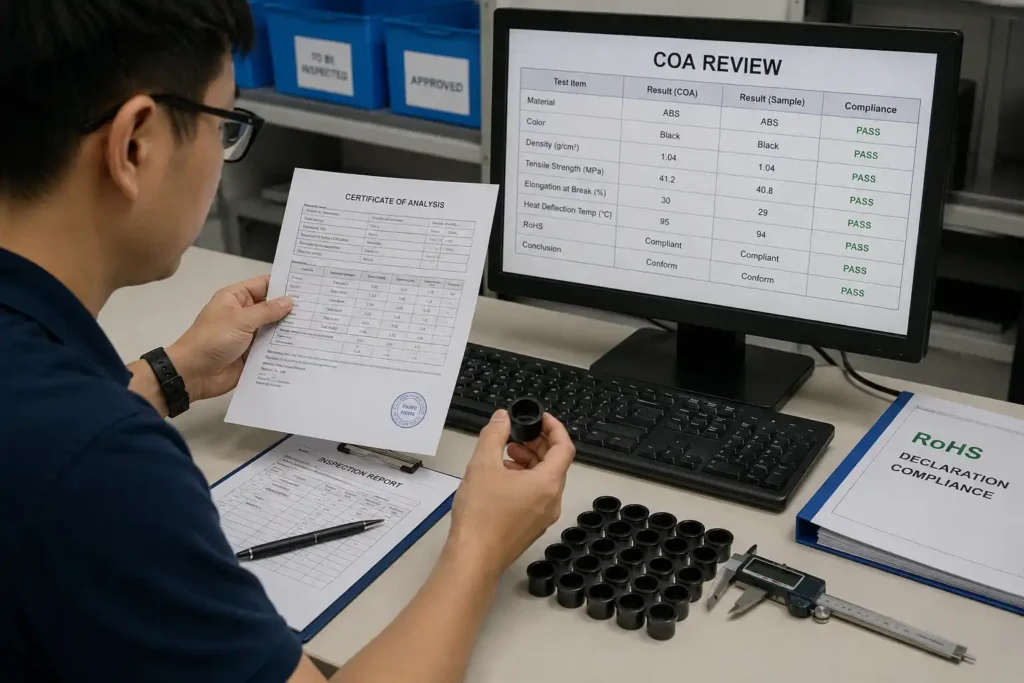
Most reputable suppliers provide documentation alongside their materials, including Certificates of Analysis (COA), RoHS declarations, material safety data sheets, or regulatory compliance certifications.
These documents are reviewed and cross-checked against the actual sampled units. A COA that contradicts what the inspection finds is a serious red flag.
Step 7: Record Results and Make the Accept or Reject Decision
All inspection findings are documented with photographs, measurements, and written notes. Based on the results, the batch receives one of three outcomes:
- Accepted: Materials meet specifications and are cleared for production
- Rework required: Materials have correctable defects and are sent back for remediation before re-inspection
- Rejected: Materials fail inspection and are returned to the supplier
Nothing should proceed to production without a documented decision at this stage.
Step 8: Feed Results Back to the Supplier
IQC data is not just an internal record. Sharing inspection findings with the supplier creates accountability and supports ongoing improvement.
Defect trends identified across multiple batches give buyers leverage to address root causes with the supplier rather than repeatedly catching the same problems at incoming inspection.
IQC, IPQC, and OQC: What Is the Difference?
Incoming quality control is one of three checkpoints in a complete manufacturing quality system. Most importers only know about the last one. That is exactly why quality problems are so common.
Each checkpoint serves a different purpose, catches different problems, and has a very different cost of failure.
| IQC | IPQC | OQC | |
| Full name | Incoming Quality Control | In-Process Quality Control | Outgoing Quality Control |
| When it happens | Before production starts | During production | After production, before shipment |
| What is inspected | Raw materials and components | Semi-finished products and process conditions | Finished, packaged goods |
| Who runs it | Independent inspector or QC team | Production floor QC staff | Third-party inspector or QC team |
| Purpose | Block defective inputs from entering production | Catch process errors before they affect the full batch | Make the final accept or reject decision on finished goods |
| Can defects still be fixed? | Yes, easily and cheaply | Yes, with some rework cost | Difficult and expensive |
| Cost of a failure at this stage | Low | Medium | High |
| Most common mistake | Letting the supplier run it themselves | Not running it at all | Treating it as the only QC step |
The relationship between the three is straightforward. IQC controls what goes in. IPQC controls what happens during. OQC controls what goes out.
The problem most importers have is that they only invest in OQC, meaning they inspect the finished goods and hope everything went right in between. When it has not, they are left negotiating rework or rejections on a completed production run, which is the most expensive and time-consuming position to be in.
IQC carries the most leverage because defects caught before production are far cheaper to fix. The same issue found after 10,000 units are made can cost significantly more. Without IQC, quality control becomes damage control.
The Conflict of Interest Problem: Why Your Supplier Should Not Run Their Own IQC
Understanding who runs your IQC matters just as much as whether it gets done at all.
Most suppliers do perform some form of incoming inspection on their raw materials. The problem is that factory staff have a direct conflict of interest when running it. They know which samples are most likely to pass. They will select those.
This is called cherry-picking, and it is one of the most common problems importers face when relying on supplier-run quality checks. The supplier has a financial incentive to pass the batch and keep production moving. That incentive works against you.
Independent data support this concern. Based on real factory data from one quality firm, 10 to 15% of incoming material batches fail inspection when checked by an independent party. Many of those same batches would have passed a supplier-run check.
The answer is third-party IQC. An independent inspector randomly pulls samples, has no relationship with the supplier, and has no reason to pass a batch that should fail.
IQC vs Pre-Shipment Inspection: Not the Same Thing
These two are regularly confused by importers, and confusing them is expensive. Here is how IQC and pre-shipment inspection compare across the key decision points:
| IQC | Pre-Shipment Inspection | |
| When | Before production starts | After production is complete |
| What is checked | Raw materials and components | Finished, packaged goods |
| Who benefits most | Prevents production defects | Approves or rejects the final shipment |
| Can it fix material problems? | Yes, before they enter the line | No, too late at this stage |
| Cost of failure | Low materials can be returned | Highly, the entire production may be affected |
IQC is pre-production. Pre-shipment inspection is post-production. You need both. Neither replaces the other.
IQC Checklist for Importers Sourcing from China
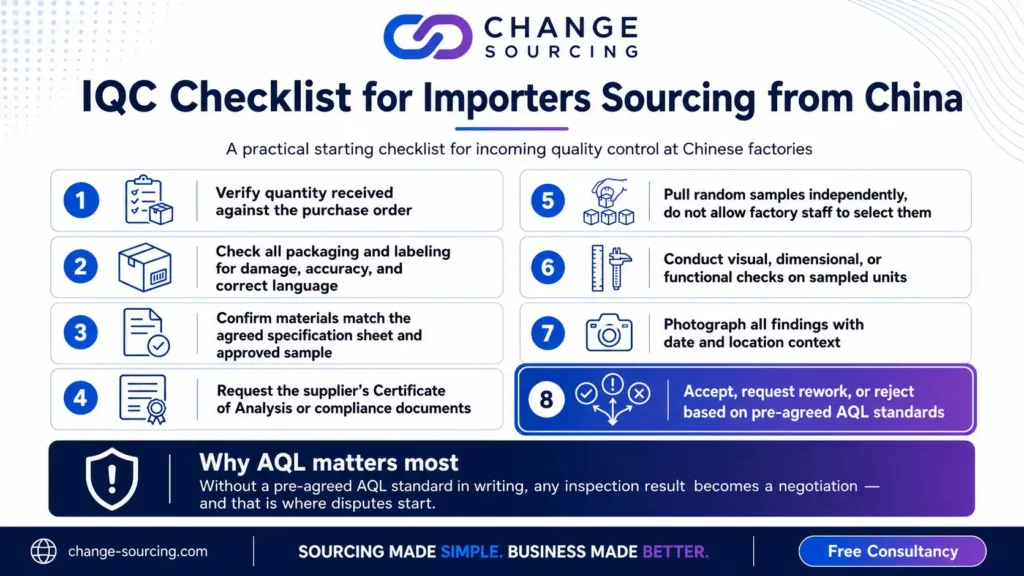
If you are sourcing from a Chinese factory and want to run or commission an incoming inspection, use this as your starting point:
- Verify quantity received against the purchase order
- Check all packaging and labeling for damage, accuracy, and correct language
- Confirm materials match the agreed specification sheet and approved sample
- Request the supplier’s Certificate of Analysis or compliance documents
- Pull random samples independently, do not allow factory staff to select them
- Conduct visual, dimensional, or functional checks on sampled units
- Photograph all findings with date and location context
- Accept, request rework, or reject based on pre-agreed AQL standards
The last point matters more than the rest. Without a pre-agreed AQL standard in writing, any inspection result becomes a negotiation, and that is where disputes start.
What Happens When Incoming Materials Fail Inspection?
When a batch fails incoming quality control, there are three paths forward:
- Reject and return to the supplier: The cleanest outcome if the defect affects the whole batch and cannot be corrected. The supplier bears the cost.
- Rework at the factory: If the defect affects a portion of the batch and is correctable, factory staff or inspectors sort the good units from the bad. Reworked units are re-inspected before approval.
- Accept with documented deviation: In rare cases where the defect is minor, and production cannot be delayed, a formal Material Review Board (MRB) decision accepts the batch with written justification. This is not a routine option and should never become one.
What should never happen is letting a failed batch enter production without a documented decision. That silence is how one quality problem becomes an entire shipment problem.
How quickly you act on a failed batch determines how expensive the problem becomes. A supplier notified within 24 hours of a failed inspection can often source replacement materials before the production schedule is disrupted. A supplier notified after production has already begun faces a much harder conversation, and so do you.
This is why having your AQL standard and your rejection protocol agreed in writing before the order is placed matters so much. When a failed batch is caught early, and the response protocol is already documented, the outcome is a manageable delay. When it is caught late, and there is no protocol, it becomes a dispute.
Change Sourcing Insight: What We See When IQC Gets Skipped

After 10+ years helping over 1,500 clients source from China, we have seen the same pattern more times than we can count.
A buyer places an order. The supplier assures them that quality is under control. No independent incoming inspection is arranged. Production begins, goods are made, and a pre-shipment inspection is booked on the finished product.
Then the inspector flags that the fabric weight is lower than specified. Or the electronic component does not match the approved sample. Or the packaging material is a cheaper substitute than what was agreed upon.
By that point, the entire order has been produced using the wrong inputs. Rework is expensive. Delays cost clients. And the supplier, in most cases, claims the materials passed their own internal check.
We worked with a buyer importing home textile products from a factory in Zhejiang. They skipped the incoming inspection to save time and cost. The cotton thread used in production was of a lower grade than specified. The finished goods looked fine on the surface, but started pilling after minimal use. The returns came in two months after delivery. The cost of the complaints, replacements, and reputational damage was many times more than an incoming inspection would have cost.
That is the pattern. The saving is small. The loss is large.
If you are sourcing from China and are unsure whether your incoming materials are being properly inspected, speak with the Change Sourcing team before your next production run. We can arrange an independent IQC on your behalf, with full documentation and photo reports.
Frequently Asked Questions
What does IQC stand for?
IQC stands for Incoming Quality Control. It refers to the systematic inspection of raw materials, components, and purchased parts before they are used in production. The term is used across manufacturing industries worldwide and is a standard part of any quality management system.
Incoming quality control (IQC) is the inspection and verification of raw materials, components, and purchased parts before they enter the production process. Its purpose is to ensure only materials meeting your specifications are used in manufacturing, preventing defects from entering the production line.
IQC happens before production starts and checks raw materials. Pre-shipment inspection happens after production and checks the finished goods. They serve different purposes, and neither replaces the other. IQC is the more cost-effective checkpoint because defects caught before production are far cheaper to correct.
IQC is incoming quality control, checking materials before production. IPQC is in-process quality control, monitoring quality during manufacturing. OQC is outgoing quality control, inspecting finished goods before shipment. Together, they form a complete three-stage quality management system.
Not without independent verification. Factory staff have a conflict of interest when inspecting their own incoming materials. They may cherry-pick samples known to pass. Hiring a third-party inspector to randomly pull and test samples gives you unbiased results and protects your order.
AQL (Acceptable Quality Limit) is a sampling standard that defines how many samples to inspect from a batch and how many defects are acceptable before rejecting the lot. It is widely used in IQC to make consistent, defensible accept or reject decisions without inspecting every single unit.
Final Takeaway
Incoming quality control is not a procedural formality. It is the single most important quality checkpoint in your supply chain, because materials account for half of your final product quality, and problems caught before production cost a fraction of what they cost to fix later.
Do not rely on your supplier’s own incoming inspection. Arrange an independent IQC, document your AQL standards in writing, and treat every new supplier as unverified until their materials pass a third-party check.
Change Sourcing provides independent incoming quality control for importers sourcing from China. With over 10 years of experience and 1,500+ clients, our team ensures your production starts with the right materials every time. Get in touch today.
Suggested Readings: