

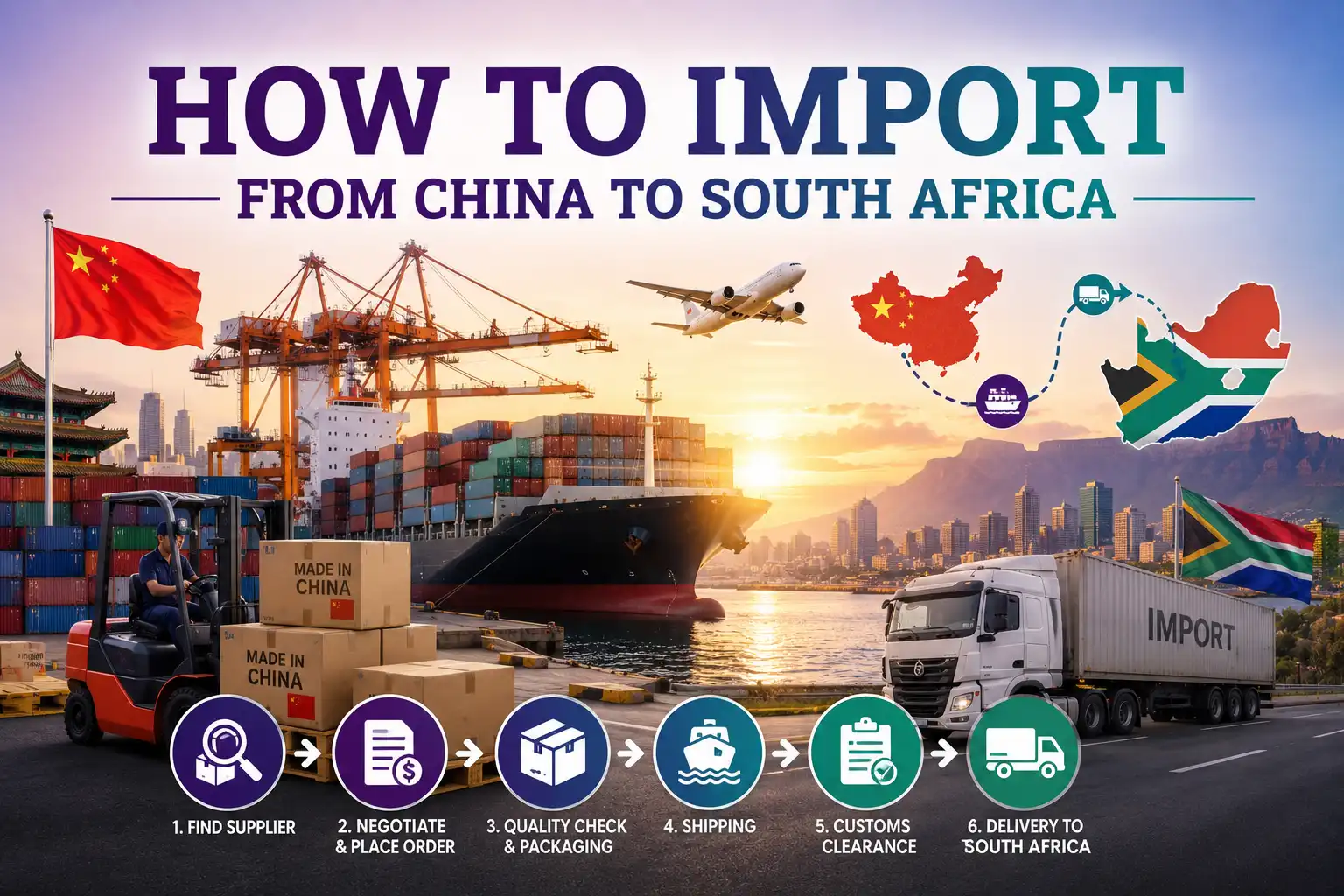
To import from China to South Africa, register with SARS using the DA 185 form, verify your product's duty rate and HS code, find a verified supplier, calculate your full landed cost (FOB price + freight + customs duty + 15% VAT + clearing fees), and clear customs through a registered South African clearing agent. Sea freight to Durban takes 25 to 35 days, and total landed cost typically runs 40 to 80% above the factory price.
South Africa imports over R200 billion worth of goods from China annually — electronics, textiles, solar panels, furniture, and much more. For South African businesses, importing directly from Chinese manufacturers can cut product costs by 30–60%. But only if the process is done correctly.
Get it wrong, and you face SARS penalties, goods held at Durban port, or surprise anti-dumping duties that wipe out your margins overnight.
This guide walks you through every step — from SARS registration and supplier vetting to calculating your total landed cost in ZAR and clearing customs — all updated for 2026.
Step 1: Choose Your Product and Check Compliance Before You Order
Before you contact a single supplier, research your product carefully. Focus on what South African consumers or businesses need that isn’t being manufactured cheaply locally.
High-opportunity categories in 2026 include solar panels and inverters, electronics accessories, construction materials like tiles and fittings, automotive spare parts, and household goods.
Run a compliance check first. Certain product categories require NRCS (National Regulator for Compulsory Specifications) or SABS approval before your goods can legally land in South Africa. This includes electronics, children’s toys, and food contact materials. Skipping this step can lead to customs seizure, even if everything else is in order.
How to Find Your HS Code and Duty Rate
Use the SARS Tariff Search Tool to identify your product’s HS code and applicable duty rate before reaching out to any supplier.
As a rough guide, duty rates range from 0% on industrial machinery to as high as 45% on certain textiles and clothing. Knowing this upfront changes your cost calculations entirely.
Step 2: Register as an Importer with SARS (DA 185 Form)

SARS importer registration is required before any commercial import, whether you are an individual or a registered company.
You’ll complete the DA 185 form (Customs and Excise Client Application) through SARS eFiling. Documents you will need include your CIPC company registration certificate, director ID or passport, proof of business address, and a bank confirmation letter.
If your annual turnover exceeds R1 million, VAT registration is also required. This allows you to claim VAT input on imports, which directly improves your cash flow.
Approval from SARS typically takes 5 to 10 business days.
ITAC Import Permits
Most general goods do not require a separate import permit. However, controlled categories do. These include used or second-hand goods, certain agricultural inputs, textiles in large volumes, and some chemicals.
If your product falls into a controlled category, apply for a permit through ITAC (International Trade Administration Commission) before placing your order. Goods arriving without a required permit will be refused at the port of entry.
Step 3: Find Verified Chinese Suppliers (And Avoid Scams)
There are several platforms to find Chinese suppliers, each with its own strengths.
- Alibaba.com is the largest B2B marketplace. Filter your search for “Verified Supplier” and look for “Trade Assurance” coverage, which protects your payment if the supplier fails to deliver as agreed.
- Made-in-China.com is strong for industrial and hardware products.
- 1688.com offers factory-direct pricing but is a China-domestic platform, so navigating it without a sourcing agent can be difficult.
- The Canton Fair in Guangzhou (held every April and October) is the best way to build direct factory relationships in person.
Sourcing Agent vs. DIY: Which is Right for You?
Use a sourcing agent if: your order value is above $3,000, you need factory audits, you are buying from multiple suppliers at once, or you are new to the China import process.
Go DIY if: your order is a small test shipment ($500 to $1,500), your supplier is Alibaba Gold Verified with Trade Assurance, and your product has no compliance complexity.
Supplier Vetting Checklist
Before placing any order, always do the following:
- Request the supplier’s Business Licence (营业执照) and export licence
- Verify the factory via a live video call showing the production floor
- Order samples before committing to bulk — budget R500 to R2,000 for sample shipping via DHL or FedEx (3 to 5 days delivery)
- Review Alibaba feedback and look for history with South African or African buyers
- Never pay 100% upfront. Standard payment terms are 30% deposit to start production, and 70% paid before or after a pre-shipment inspection
Step 4: Calculate Your Landed Cost Before Placing the Order
This is the step many first-time importers skip — and it is the most costly mistake you can make. The factory price is never your actual cost.
The South Africa Landed Cost Formula (ZAR)
Here is how to calculate what your goods will actually cost you, delivered to your warehouse:
- FOB Value = Supplier factory price + inland China freight to the Chinese port
- Ocean or Air Freight to Durban or Cape Town
- Marine Insurance (roughly 0.3% to 0.5% of cargo value)
- = CIF Value (this is the customs value SARS uses)
- x Customs Duty % (find this via the SARS Tariff Book)
- Anti-Dumping Duty (if applicable to your HS code)
- CIF + Duties = Dutiable Value
- x 15% VAT
- Clearing Agent Fee (typically R2,000 to R6,000)
- Port Handling and Trucking to your warehouse
- = Total Landed Cost (ZAR)
For example, if your FOB price is $5,000 and you are importing ceramic tiles, you could face a 20% customs duty plus active anti-dumping duties. Running the formula in advance could be the difference between a profitable product and a loss.
Anti-Dumping Duty Warning
South Africa maintains active anti-dumping duties on specific Chinese products. Categories currently affected include certain steel products, ceramic tiles, PVC pipes, textiles, and LED lighting.
These duties can add 20% to 150% on top of the standard customs duty rate.
Always check the ITAC anti-dumping register before placing your order. A surprise anti-dumping duty can turn an affordable product into an unprofitable one overnight.
Rand/Yuan Exchange Rate Risk
The ZAR/CNY exchange rate fluctuates significantly. Lock in your cost calculation at the time of ordering, not at the time of payment.
For orders above $5,000, ask your bank about a Forward Exchange Contract (FEC) to fix your rate for 30 to 90 days. This protects your margins if the Rand weakens before your goods arrive.
Step 5: Choose the Right Shipping Method for Your Cargo

Your choice of shipping method affects both your timeline and your total landed cost.
| Method | Transit Time | Best For | Approx. Cost (2026) |
|---|---|---|---|
| Sea FCL (20ft container) | 25 to 35 days | Large orders above 15 CBM | R18,000 to R35,000 |
| Sea LCL (shared container) | 30 to 40 days | Small to medium orders (1 to 14 CBM) | R1,200 to R2,500 per CBM |
| Air Freight | 5 to 7 days | High-value, low-weight goods | R120 to R220 per kg |
| Express Courier (DHL/FedEx) | 3 to 5 days | Samples, small parcels under 50kg | R150 to R350 per kg |
South Africa’s main entry ports are Durban (handling roughly 60% of all containers), Cape Town, and Port Elizabeth (Gqeberha).
Durban Port Congestion: What to Do
Durban port has experienced recurring congestion that can add unexpected delays to your shipment. Here are practical ways to manage this risk:
Book an FCL container over LCL where possible, as full containers are released faster. Use a clearing agent with EDI (Electronic Data Interchange) capability so your documents are pre-submitted before the ship arrives.
For non-urgent shipments, consider routing through Cape Town instead. Always build 5 to 10 extra buffer days into your stock planning when shipping to Durban.
Understanding Incoterms
FOB (Free On Board) is the standard choice for experienced importers. You take control of the freight from the Chinese port onward and typically get better freight rates.
DDP (Delivered Duty Paid) is the safest option for first-time importers. The supplier or their agent handles everything through to your door, and you pay one all-in price, with no surprises at customs.
Suggested Reading: Best Products to Import from China to South Africa in 2026
Step 6: Get Your Import Documentation Right
Customs delays in South Africa are almost always caused by documentation errors. Getting your paperwork right the first time saves you port storage fees and clearance delays.
Required Documents Checklist
- Commercial Invoice (in USD, itemised with HS codes and unit values per item)
- Packing List (carton count, dimensions, and weights)
- Bill of Lading (sea freight) or Airway Bill (air freight)
- Certificate of Origin (Form A for GSP benefit, or a general CO from the Chinese Chamber of Commerce)
- SAD 500 Customs Declaration Form (completed by your South African clearing agent)
- Import Permit (required only for ITAC-controlled products)
- NRCS or SABS compliance certificate (required for regulated products such as electronics, PPE, and toys)
- Marine Insurance Certificate
Important note: Undervaluing your commercial invoice to reduce customs duty is a SARS offence. Penalties can reach 10 times the evaded duty amount, plus interest. SARS uses published reference pricing for common Chinese goods and will spot discrepancies.
Step 7: Clear SARS Customs and Receive Your Goods
Once your shipment arrives at Durban or Cape Town, your clearing agent handles the customs process through the SARS eDuties/RLA system.
Here is how the process flows:
- Clearing agent submits the SAD 500 declaration electronically
- SARS risk engine assigns a channel: Green (automatic release), Orange (document check required), or Red (physical inspection of goods)
- Customs duty and 15% VAT are paid via a deferment account or cash payment
- SARS releases the goods and issues a port release order
- The port or terminal releases your container (port handling charges apply)
- Your transporter delivers goods to your warehouse
Typical clearance timeline is 1 to 3 days on the green channel, or 3 to 7 days if a physical inspection is triggered.
VAT-registered importers should retain the SARS Customs Clearance Certificate (CCA) as proof of import VAT paid. This is the document you use to claim the VAT back on your monthly or bi-monthly VAT return.
The AfCFTA Opportunity for SA Importers
South Africa is a signatory to the African Continental Free Trade Area (AfCFTA) agreement. Goods legally imported and cleared through South Africa can be re-exported into 54 African markets under preferential tariff rates.
Importers who plan for this can build a pan-African distribution business from a single South African entry point, without duplicating the import process in each country.
5 Costly Mistakes South African Importers Make (And How to Avoid Them)
1. Not checking anti-dumping duties before ordering. This can double your landed cost. Always check the ITAC anti-dumping register as the first step in your product research.
2. Skipping NRCS or SABS compliance for regulated products. This leads to customs seizure and a costly release process, if your goods are released at all.
3. Paying 100% upfront to a new supplier. Use 30/70 payment terms as standard. The 30% deposit starts production; the remaining 70% is paid after a pre-shipment inspection confirms quality.
4. Ignoring the Chinese factory calendar. Chinese New Year (January to February) and Golden Week (October) cause 2 to 4 week production shutdowns. Place reorders 10 to 12 weeks in advance to avoid running out of stock.
5. Using the FOB price as your selling price. Always model the full landed cost formula before confirming your profit margins. What looks like a 50% margin at FOB can shrink to 10% after duties, freight, VAT, and clearing fees.
How Change Sourcing Helps South African Importers Source from China

Importing from China involves more moving parts than most people expect. That is exactly where Change Sourcing steps in.
With offices in Yiwu and Guangzhou, Change Sourcing provides end-to-end sourcing for South African importers. The service covers everything from supplier identification and factory audits to quality inspection and logistics coordination.
With over 18 years of experience and more than 1,500 clients served, the team understands the specific compliance, shipping, and cost considerations that affect SA-based businesses.
Whether you are placing your first test order or scaling an established import operation, having a team on the ground in China removes the guesswork and reduces the risk at every stage.
Frequently Asked Questions
Total landed cost depends on your product, order volume, and shipping method. As a general rule, add 40% to 80% on top of the FOB factory price to cover freight, duties, VAT, and clearing fees. High-duty categories like textiles and clothing can see landed costs 90% to 100% above the original FOB price.
You need SARS importer registration completed via the DA 185 form. A separate ITAC import permit is only required for controlled product categories. Most general goods including electronics, furniture, and tools do not require a permit beyond the standard SARS registration.
Sea freight takes 25 to 35 days to Durban or Cape Town from major Chinese ports. Add 5 to 10 days for customs clearance. In total, expect 5 to 7 weeks from factory to your warehouse under normal conditions.
Solar panels and inverters (driven by ongoing load-shedding demand), electronics accessories, construction tiles and sanitary ware, automotive spare parts, and home appliances consistently offer strong margins for SA importers.
The SAD 500 is South Africa’s standard customs declaration form. Your clearing agent submits it electronically to SARS on your behalf when your goods arrive at port. It declares the contents, value, and HS codes of your shipment and triggers the duty and VAT calculation.
Ready to Start Importing from China to South Africa?
Understanding the process is the first step. Executing it correctly is another. If you want a team with on-the-ground presence in China to handle sourcing, quality checks, and logistics on your behalf, get in touch with Change Sourcing for a free consultation.