

"Made in PRC" means "Made in the People's Republic of China." It is legally identical to "Made in China" and refers to the exact same manufacturing location: mainland China. The only difference is the terminology. PRC is the country's official formal name, while "China" is what most people say in everyday life.
You flip a product over, looking for the usual “Made in China” stamp. But instead, you see “Made in PRC.” Naturally, questions follow. Is this the same thing? Is it from a different country? Could it mean something is hidden about the product’s origin?
You are not alone in this confusion. The label trips up everyday shoppers, Amazon sellers, and experienced importers alike.
This guide answers everything. We cover the definition, the legal requirements by country, quality facts backed by research, and what it means specifically for importers and e-commerce sellers. By the end, you will know exactly how to handle this label and why it exists.
What Does “Made in PRC” Mean?
“Made in PRC” stands for “Made in the People’s Republic of China.” PRC is the country’s full official name, the one used in United Nations documents, trade treaties, and government filings. When you see this label on a product, it simply means the item was manufactured in mainland China.
Nothing more, nothing less. The product was made in China. The label just uses the formal name instead of the casual one.
Think of it like the difference between saying “the USA” versus “the United States of America.” Both refer to the same country. One is formal, one is conversational. “PRC” and “China” work the same way.
What Does PRC Stand For?
PRC stands for the People’s Republic of China. The country was officially established under this name on October 1, 1949, when the Communist Party of China proclaimed the new state.
It is the government recognized by the United Nations as the sole legal representative of China.
The PRC governs mainland China, Hong Kong, and Macau. It does not govern Taiwan, which operates as a separate entity under the name Republic of China (ROC). This distinction matters a lot for importers, and we will get to it shortly.
Other Label Variations You Might See
Not every Chinese manufacturer uses the exact same wording. Here are all the label versions you may encounter on products sourced from China, and what each one means:
- “Made in PRC” — Most common alternative to “Made in China.”
- “Product of PRC” — Same meaning. Often used when a product is fully processed and manufactured in China.
- “Made of PRC” — Same country, slightly unusual phrasing. You may see this on items where the raw materials also come from China.
- “Assembled in PRC” — This one is different. It signals the product was assembled in China but may use components made elsewhere. This matters for customs classification in some countries.
- “China, P.R.” — A shorthand version sometimes used on shipping documents and certificates of origin.
For most purposes, all of these refer to the same country. But “Assembled in PRC” can have different legal implications for country-of-origin rules, so watch for that one if you are an importer.
Made in PRC vs. Made in China: Is There Any Difference?
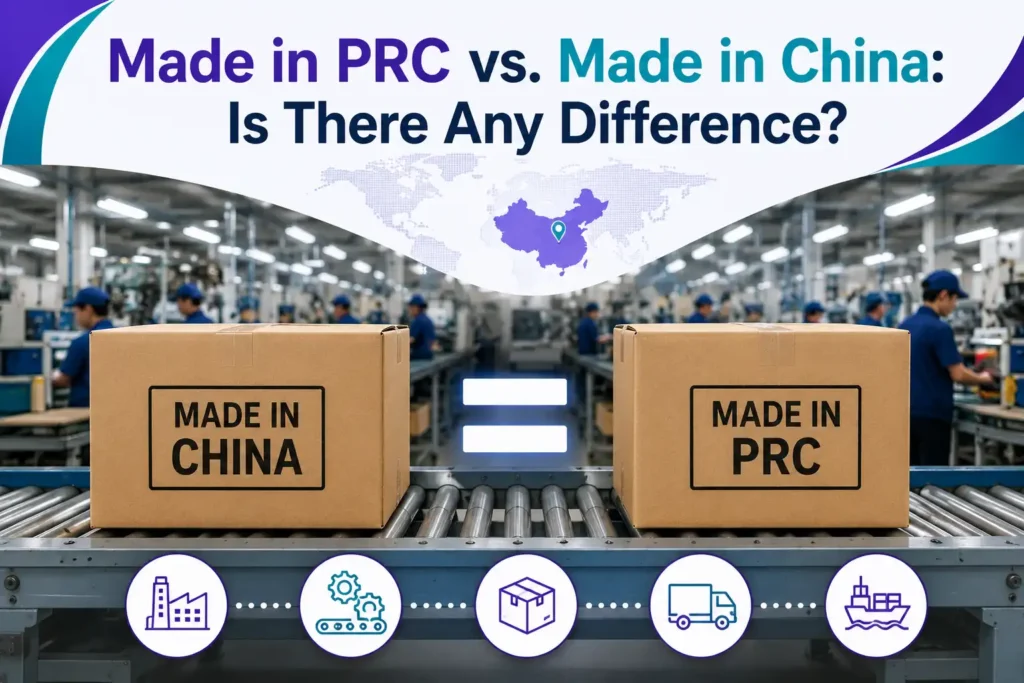
No. There is no difference in geographic origin, quality standards, or legal status between a product labeled “Made in PRC” and one labeled “Made in China.” Both labels point to the same factory floors, the same supply chains, and the same country.
The choice of one label over the other comes down to the manufacturer’s preferences, their target market, or their export documentation practices.
A factory in Guangzhou making the same product for two buyers could ship one box labeled “Made in China” and another labeled “Made in PRC.” The products are identical.
Side-by-Side Comparison
| Category | “Made in China” | “Made in PRC” |
| Country | Mainland China | Mainland China |
| Legal Status | Accepted globally | Accepted in most markets* |
| Quality Impact | None (factory-dependent) | None (factory-dependent) |
| Consumer Familiarity | Universally recognized | Less familiar to consumers |
| Common Use | Consumer packaging worldwide | Export docs, B2B, formal trade |
*US Customs has specific requirements. See Section 6 for details.
Is PRC China or Taiwan? Understanding the Confusion
This is one of the most common mix-ups. Here is the clear answer: “Made in PRC” always refers to mainland China. Never Taiwan.
Taiwan officially calls itself the Republic of China (ROC). Products from Taiwan are labeled “Made in Taiwan” in international trade. This standard exists specifically to avoid confusion with the People’s Republic of China.
Why does the confusion exist? Both governments historically claimed to be the legitimate government of all of China. That political dispute has faded in practical trade terms. Today, the rule is simple:
- PRC = Mainland China (Beijing government)
- ROC / Taiwan = Taiwan (Taipei government)
- A mainland Chinese factory cannot legally label goods “Made in ROC,” and vice versa.
If you are sourcing from both regions, this distinction affects your import duties, trade agreement eligibility, and labeling compliance. Always verify which “China” your supplier is located in before placing a large order.
Why Do Manufacturers Use “Made in PRC” Instead of “Made in China”?

There are five main reasons a manufacturer might choose the PRC label. Each one reflects a different business or compliance reality.
1. Formality: PRC Is the Official Name
International trade documents, Certificates of Origin, and government-to-government trade agreements almost always use “People’s Republic of China” or “PRC.” When a manufacturer aligns their product packaging with their export paperwork, using “PRC” keeps everything consistent.
For a factory exporting to dozens of countries simultaneously, having one unified labeling standard that matches their official documentation reduces errors and simplifies compliance.
2. Perception Management: Avoiding Consumer Bias
Some consumers associate “Made in China” with low quality. That perception is largely outdated, but it persists in certain markets. Using “PRC” is a subtle way to present the same product without triggering that reflex.
A Pew Research Center survey of 24 countries published in November 2023 found that views of Chinese technology products are mixed: many respondents see them as generally well-made, but perceptions still trail behind American products in several markets. In a small number of countries, such as Israel and India, negative views are particularly strong.
Manufacturers aware of these attitudes may use “PRC” precisely because many end consumers do not immediately recognize the abbreviation. It is a branding choice, not a deceptive one, but it is worth understanding.
3. Regulatory Compliance in Specific Destination Markets
Some international trade agreements and bilateral treaties specifically reference the “People’s Republic of China” in their origin rules. A manufacturer exporting under a Free Trade Agreement that uses the PRC designation may label products accordingly to match the agreement’s language.
This is especially common in exports to countries in the Middle East and parts of Africa, where trade documentation standards may differ from Western norms.
4. Export Documentation Alignment
Certificates of Origin, Packing Lists, and Commercial Invoices filed with Chinese customs authorities use the official country name.
Some manufacturers simply replicate that wording on their physical packaging to keep all documents consistent and avoid discrepancies during customs clearance.
5. B2B Branding Strategy for Global Markets
This is a reason most articles overlook. Some Chinese manufacturers specifically use “PRC” when targeting B2B buyers in Europe, the Middle East, and parts of Africa. In these markets, buyers may be more focused on specifications and price than country of origin, making the label a lower-stakes decision.
In B2B contexts, “PRC” can signal a degree of professionalism and formality that some buyers in these regions respond to positively. It positions the manufacturer as trade-literate rather than consumer-market-focused.
A Brief History: Where Did “Made in China” Labels Come From?
Understanding the origin of this label helps explain why it carries any baggage at all, and why manufacturers are now trying to distance themselves from it through the PRC alternative.
The WWII-Era Origins: The First Boycotts
The roots of country-of-origin labeling in China go back to the 1930s and 1940s. During the Second Sino-Japanese War, Chinese civilians began boycotting Japanese-made products as part of a “national salvation” campaign.
Labeling goods by their country of origin became a political act, a way for buyers to support the domestic industry and put economic pressure on Japan.
At that time, China’s own manufacturing capacity was limited. The labels were a statement of intent as much as a practical trade tool.
The 1990s Manufacturing Boom: When the Label Went Global
The “Made in China” label became truly global during the 1990s. US, European, and Asian companies moved large portions of their manufacturing operations to China, driven by dramatically lower production costs for clothing, electronics, and consumer goods.
According to Wikipedia’s entry on Made in China, by the early 21st century, goods labeled “Made in China” were often only partially made in China.
A US-designed iPhone, for example, was assembled in China but contained components from dozens of other countries. The label became shorthand for a global supply chain, not just a single country.
“Made in China 2025”: The Quality Transformation
In 2015, the Chinese government launched “Made in China 2025“, a ten-year national plan to upgrade the manufacturing base by rapidly developing the local high-tech industry.
The goal was to move China from being the world’s factory floor for low-cost goods to becoming a leader in semiconductors, artificial intelligence, aerospace, and advanced robotics.
That transition is well underway. The phrase “Made in China” today encompasses everything from basic household goods to precision medical instruments and electric vehicles. The label’s reputation is changing, whether the country name reads “China” or “PRC.”
Is “Made in PRC” Good Quality? What the Data Actually Says
Quality anxiety is the main reason consumers search for what the PRC label means. They want to know if they’ve been handed something inferior. The answer, backed by actual research, is more nuanced than the stereotype suggests.
European Central Bank Research (2011)
A long-term study published by the European Central Bank in 2011 examined the quality of Chinese exports to EU markets. The findings challenged the common assumption that low cost equals low quality.
The study found that Chinese products were of high quality relative to other developing economies, even at low unit prices. It also identified an unusual characteristic: while products from most countries become more expensive as quality improves, Chinese products maintained affordability even as their quality rose.
The researchers concluded that the quality of Chinese exports was comparable to that of the most technologically advanced economies. That was 2011. Chinese manufacturing has advanced considerably since then.
Pew Research Survey (2023)
The Pew Research Center surveyed respondents across 24 countries in November 2023 on how they view Chinese technology products. The results were mixed but revealing.
In most countries, Chinese technology products were viewed as generally well-made. Negative perceptions were concentrated in a handful of countries. The broader finding was that consumer sentiment, not actual product quality, is often what drives the “Made in China” reputation problem.
The Label Does Not Determine Quality. The Factory Does.
This is the most important point. You will find “Made in PRC” on a $1 plastic toy and on a $1,000 precision medical instrument. The label is the same. The quality is completely different.
What determines the quality is the manufacturer's processes, certifications, and quality controls, not what the stamp on the box says.
A factory with ISO 9001 certification producing automotive parts has nothing in common with a small workshop making novelty items, yet both would carry the same “Made in PRC” label.
The only reliable way to ensure product quality is through proper supplier vetting, sample testing, and pre-shipment inspection.
Is “Made in PRC” Legal? Country-by-Country Requirements
This is where things get practical for importers. The legality of the “PRC” label is not a simple yes or no. It depends entirely on which country you are importing into. Each major market has its own rules.
United States: US Customs and Border Protection (CBP) Requirements
This is the most important jurisdiction to understand, and the one where “PRC” creates the most real-world risk.
The US Customs and Border Protection requires that goods imported into the United States be marked with the English name of the country of origin in a “conspicuous place.”
The CBP's longstanding guidance specifies that the word "China" must appear on both the product and its retail packaging.
Here is the critical problem: a product labeled only “PRC” may cause customs delays or be flagged for re-examination if the CBP officer handling the shipment does not immediately recognize the abbreviation. At busy ports with high inspection volumes, ambiguous labels create friction.
CBP Ruling HQ 560693 established guidance on country-of-origin marking that reinforces the use of the recognizable country name in English.
Products marked with abbreviations or alternative terms that are not immediately recognizable as a country name can be held at customs for re-marking at the importer’s expense.
| US Importer Warning: If you are importing goods into the United States, always specify in your Purchase Order that the country-of-origin label must read “Made in China” or “People’s Republic of China.” Do not leave the label wording to the supplier’s discretion. The cost of a customs hold or re-marking shipment far exceeds the effort of one line in your PO. |
European Union: General Product Safety Regulation (GPSR)
The European Union generally does not mandate country-of-origin marking for most consumer goods. When a country of origin is stated, both “PRC” and “China” are legally acceptable designations under EU customs law.
The EU’s General Product Safety Regulation (GPSR), which came into force in late 2024, focuses primarily on product safety information and traceability rather than origin labeling specifically.
That said, the EU does require accurate origin marking for specific categories, including textiles, footwear, and certain food products. For these categories, the origin must be clearly stated, and using “PRC” is acceptable as long as it is clear and accurate.
United Kingdom: Post-Brexit Requirements
After Brexit, the UK developed its own import regulations separate from the EU. UK Customs generally accepts “PRC” as a country-of-origin designation. However, HMRC guidance recommends that labeling be unambiguous to customs officers.
For high-value shipments or items subject to anti-dumping duties, using the full and recognizable “China” wording is advisable. The UK does not have a specific ruling equivalent to the US CBP requirement, but clarity is always the safer choice.
Australia and Canada: Requirements Summary
Both countries accept “PRC” as a valid country-of-origin designation. The Australian Competition and Consumer Commission (ACCC) oversees country-of-origin claims, and the general standard is that labels must be truthful and not misleading. Since “PRC” is the official name for China, it meets that standard.
In Canada, the Canada Border Services Agency (CBSA) follows similar principles. Both “China” and “PRC” are recognized, though “China” tends to cause less friction in practice.
Summary Table: “Made in PRC” Legality by Country
| Country | “PRC” Accepted? | Preferred Wording | Risk Level |
| United States | Risky | “China” or “Made in China” | High |
| European Union | Yes | “PRC” or “China” both fine | Low |
| United Kingdom | Generally Yes | “China” recommended for clarity | Low-Medium |
| Australia | Yes | “PRC” or “China” both fine | Low |
| Canada | Yes | “China” for simplicity | Low |
“Made in PRC” and Amazon FBA: What Sellers Must Know
If you sell on Amazon, the PRC label question is not just academic. It has direct consequences for your shipments and your account.
Does Amazon Accept “Made in PRC” Labels?
Amazon’s FBA requirements are governed by both Amazon’s own packaging and labeling standards and US Customs regulations for goods entering the country. Because Amazon FBA shipments pass through US customs before reaching fulfillment centers, CBP’s requirements apply.
A product labeled "Made in PRC" entering the United States for Amazon FBA shipment faces the same customs risk as any other US import.
If CBP flags the label as ambiguous, the shipment can be held for re-marking. This means your inventory arrives late, you pay re-marking and storage fees, and your FBA restocking timeline breaks down.
Beyond customs, Amazon’s own Seller Central guidelines for product detail pages and packaging compliance require accurate country-of-origin information. For US-listed products, “China” is the expected entry, not “PRC.”
Best Practice for Amazon FBA Sellers
If you are sourcing products from China for Amazon FBA, specify in your purchase order that the country-of-origin label must read “Made in China.”
This single line in your PO eliminates the risk of customs delays at the port and ensures your products are compliant with both CBP and Amazon standards before they leave the factory.
The time to fix a labeling issue is before the shipment is packed. Correcting it at the port or inside a fulfillment center costs significantly more.
How CHANGE Sourcing Handles “Made in PRC” Label Compliance for Importers
At CHANGE Sourcing, we work with importers across the United States, Europe, the Middle East, and Africa. Label compliance questions like this one come up constantly, especially for first-time importers and Amazon sellers who are navigating Chinese suppliers for the first time.
Our team is based in Yiwu and Guangzhou, which means we are on the ground, working directly with factories before your shipment is ever packed.
Here is what that means for you practically:
Purchase Order Specification
When we manage your sourcing, we include specific label wording requirements directly in the purchase order sent to the factory.
We specify the exact format your destination market requires. For US-bound shipments, that means “Made in China” every time. No ambiguity, no risk.
Pre-Shipment Inspection Includes Label Verification
Our quality inspection teams physically check product packaging labels as part of the standard pre-shipment inspection process.
If a factory has printed “Made in PRC” when your market requires “China,” we catch it before the goods are sealed in a container. Fixing it costs almost nothing at that stage. Fixing it at the port is a different story.
Amazon FBA Prep Service
For sellers using Amazon FBA, our FBA Prep service handles labeling, bundling, and compliance packaging before shipment.
We ensure every unit meets Amazon’s current packaging standards and US Customs requirements. Your goods arrive at the fulfillment center ready to receive, without customs holds or labeling rejection delays.
Whether you are importing for the first time or scaling an existing product line, getting label compliance right from the start saves time, money, and the kind of surprises that derail launch timelines.
Contact our team for a free consultation on your next shipment.
Importer’s Checklist: What to Do if Your Products are Labeled “Made in PRC”
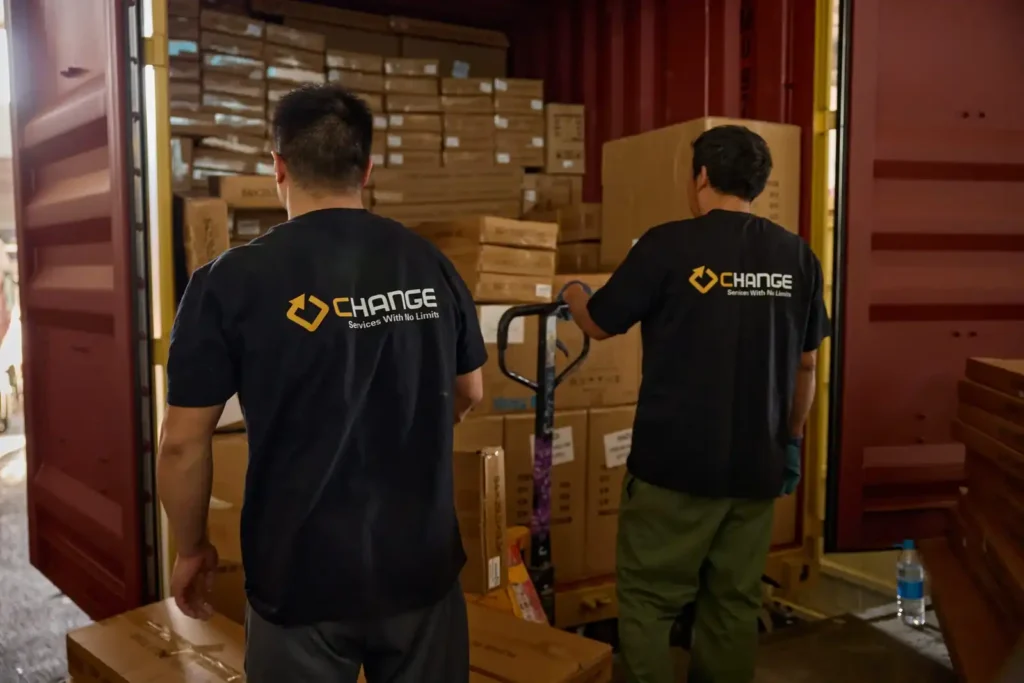
If you have already received goods labeled “Made in PRC” or you are about to place a new order and want to avoid the issue entirely, use this checklist.
Step 1: Verify Your Destination Market’s Requirements
Use the country table in Section 6 as your starting point. If you are importing into the US, “PRC” carries real risk. If you are importing into the EU or Australia, you have more flexibility, but clarity is always preferred.
Step 2: Specify Label Wording in Your Purchase Order
Never leave country-of-origin labeling to the supplier’s default choice. Add a line to your PO: “All product labels and outer cartons must be marked ‘Made in China’ (or the full country name as required by the destination country).” This one step prevents the most common labeling errors.
Step 3: Confirm During Pre-Shipment Inspection
Schedule a pre-shipment inspection and include label verification as a checklist item. Your inspector should photograph the country-of-origin marking on both the product itself and the outer carton.
If you receive products from Alibaba suppliers or other platforms without an agent, hire a third-party inspection firm to do this check.
Step 4: Consult a Licensed Customs Broker
For high-value or high-volume shipments, especially those entering the United States, consult a licensed US Customs Broker before your labels are printed at scale. Regulations can change, and a licensed broker gives you current, jurisdiction-specific guidance that no blog can fully substitute.
Frequently Asked Questions
Yes. Both labels mean the product was manufactured in mainland China. PRC stands for People’s Republic of China, which is the official formal name of the country. There is no difference in geographic origin or legal status between the two.
It depends on how it is marked. US Customs requires the word “China” to appear in English on imported goods. A label that reads only “PRC” without spelling out “China” can cause customs delays or trigger a re-marking requirement. For US imports, always use “Made in China” or “People’s Republic of China.”
No. The label tells you the product’s country of origin, not its quality level. Quality depends entirely on the specific manufacturer, their processes, and their certifications. Research from the European Central Bank found that Chinese exports are comparable in quality to products from the most advanced economies, even at lower prices.
“Made in PRC” refers to mainland China (governed from Beijing). “Made in Taiwan” refers to Taiwan, which officially calls itself the Republic of China (ROC). These are two different governments, territories, and manufacturing ecosystems. Never assume a PRC product is from Taiwan or vice versa.
Yes, absolutely. This is a standard request and any professional supplier will accommodate it. Include your label wording requirement in your purchase order from the start. Do not wait until a sample or bulk order arrives with the wrong wording.
Final Takeaway
“Made in PRC” is not a mystery. It is not a trick and it is not a sign of inferior quality. It is simply the formal, official name of the same country you know as China, applied to a product label instead of the casual name you are used to seeing.
For everyday consumers, the label means nothing different from “Made in China.” For importers and Amazon sellers, the label requires attention, particularly when shipping into the United States, where “China” must appear explicitly on the packaging to satisfy US Customs requirements.
The practical rule is this: if you are ordering from China, specify in your purchase order that all labels must read “Made in China.” That single instruction covers the compliance gap and prevents the kind of customs delays that can disrupt your entire supply chain timeline.
If you need help getting your China sourcing, labeling, and pre-shipment inspection right before products ever leave the factory, CHANGE Sourcing’s team in Yiwu and Guangzhou is available for a free consultation.