

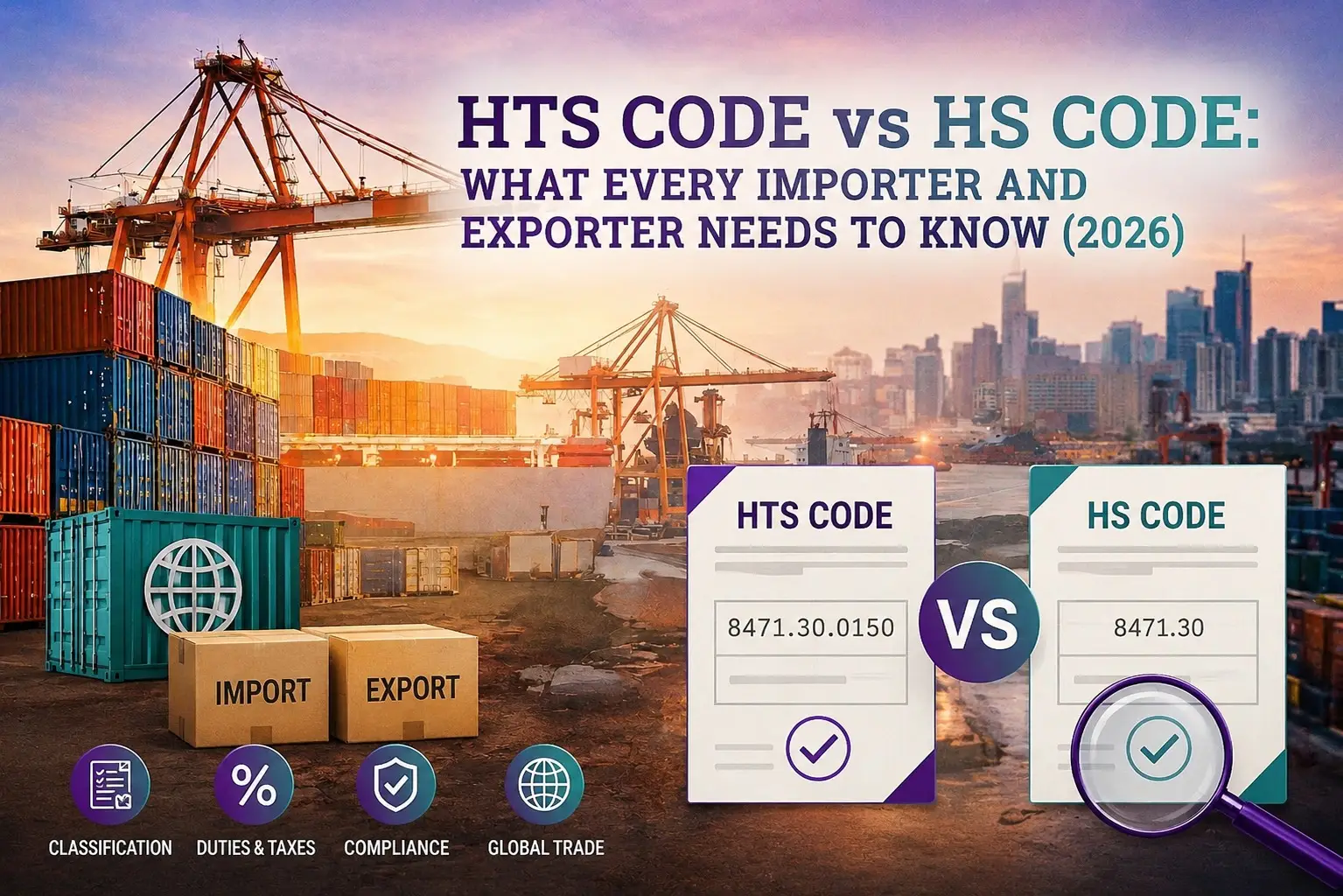
An HS code is a 6-digit international product classification used by 200+ countries, created by the World Customs Organization. An HTS code is a 10-digit US-specific extension of that HS code, required for all US imports. They share the same first 6 digits, but submitting an HS code alone on a US customs form is incomplete and can trigger fines, delays, or costly reclassification.
Most importers treat “HS code” and “HTS code” as the same thing. It is an easy mistake; they look almost identical, and nobody really explains the difference until something goes wrong. But something does go wrong. Shipments get held. Duties get miscalculated. Penalties arrive.
This guide breaks down the HTS code vs HS code difference in simple terms.
What is an HS Code?
An HS code (Harmonized System code) is a 6-digit international code used to classify products for customs purposes across 200+ countries and territories. Additionally, the World Customs Organization (WCO) develops and maintains the system, updating it every 5 years to reflect changes in global trade.
The 6 digits follow a consistent structure:
- First 2 digits = Chapter (broad category, e.g., 09 = coffee, tea, spices)
- Next 2 digits = Heading (specific product group)
- Last 2 digits = Subheading (most detailed global level)
Example: Green tea carries the HS code 0902.10, the same classification whether you are shipping to the US, UK, Germany, or Japan.
Because of this, HS codes act as the universal language of global trade. Moreover, businesses and customs authorities use them worldwide for export documentation, rules of origin, trade statistics, and customs declarations.
HS Code Lookup: Where to Start
First, the fastest free way to find your HS code is to use a dedicated lookup tool. Then, enter your product name or description, and the tool will suggest the correct 6-digit classification.
A reliable and simple tool for this is the SendCloud HS Code Finder. It works well for common product categories and gives you a starting point you can then verify with your destination country’s customs authority.
What is an HTS Code?
HTS code (Harmonized Tariff Schedule code) is a 10-digit US-specific code required for every product imported into the United States. It is managed by the US International Trade Commission (USITC) and enforced by US Customs and Border Protection (CBP).
Put simply, the first 6 digits match the HS code, while the additional 4 digits define:
- The exact import duty rate
- Any quota restrictions or trade remedies
- Statistical tracking for US trade data
Example: That same green tea becomes 0902.10.1000 under the HTSUS. Those last 4 digits decide how much you pay at the US border.
Unlike HS codes, which only change every 5 years, HTS codes can be revised multiple times within a single year, especially when trade policy shifts quickly.
HTS Code Lookup: Finding the Full 10-Digit US Code
After you identify your 6-digit HS code, you should then find the US-specific 10-digit HTS code. This step matters because duty rates and trade remedy flags are applied at the HTS level.
Use Flexport’s HTS Code Lookup tool to search by product category and navigate to the correct subheading. For the most official version, always cross-check with hts.usitc.gov before submitting your entry.
HTS Code vs HS Code: Key Differences at a Glance
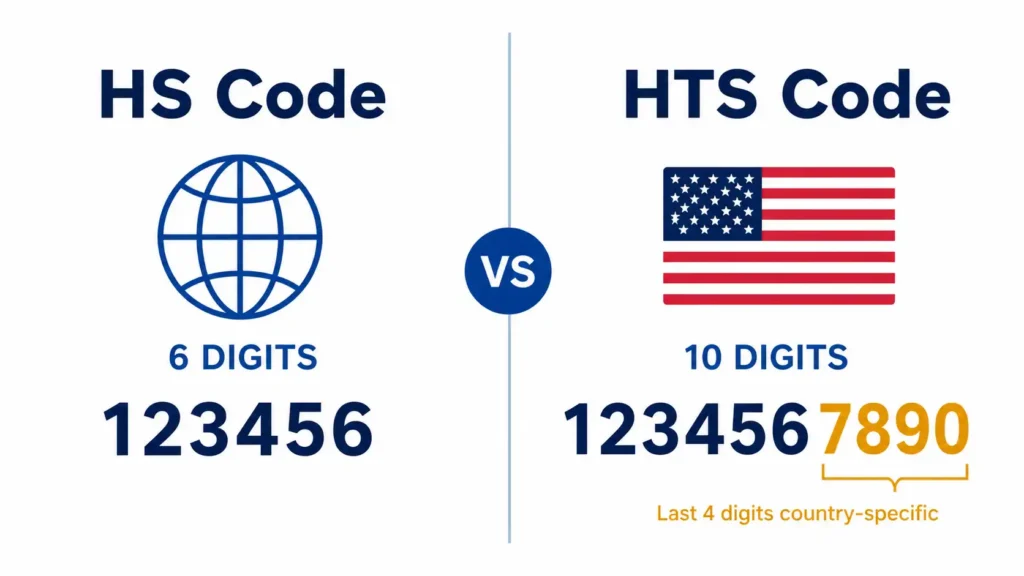
The rule that matters most: every HTS code contains an HS code inside it, but an HS code alone is never sufficient for a US customs entry.
| Feature | HS Code | HTS Code |
| Number of digits | 6 | 10 |
| Governing body | WCO | USITC / CBP |
| Used by | 200+ countries | United States only |
| Purpose | Universal product identification | US import duties + statistics |
| Update frequency | Every 5 years | Multiple times per year |
| Required for US imports? | No, not alone | Yes |
| Required for exports? | Yes | No |
Real HS Code and HTS Code Examples by Product
However, knowing the structure is only the first step. Knowing the actual code for the product you are shipping is also what helps you avoid problems at customs.
To make this easier, the table below covers the most commonly searched product categories, based on real trade classification data. Use this as a starting point, then verify your specific variant using the lookup tools listed below the table.
| Product | HS Code (6 digits) | HTS Code – US Import (10 digits) | Notes |
| Aluminum structures and parts | 7610.90 | 7610.90.0080 | Frames, bridges, panels |
| Aluminum machined parts | 7616.99 | 7616.99.5190 | CNC and milled parts |
| Steel structures and parts | 7308.90 | 7308.90.9590 | Fabricated structural steel |
| Auto parts (general) | 8708.99 | 8708.99.8180 | Miscellaneous vehicle parts |
| Metal articles (general) | 8302.42 | Builders’ hardware, fittings | Builders hardware, fittings |
| Mirrors (glass) | 7009.92 | 7009.92.1000 | Framed glass mirrors |
| Lithium-ion batteries | 8507.60 | 8507.60.0020 | For portable electronics |
| Printed circuit board assembly | 8534.00 | 8534.00.0020 | Bare PCBs |
| Clothing (men’s woven cotton) | 6203.42 | 6203.42.4011 | Trousers and breeches |
| Stainless steel parts | 7326.90 | 7326.90.8688 | General stainless articles |
| Books (printed) | 4901.99 | 4901.99.0092 | Non-educational printed books |
| Stickers (paper, self-adhesive) | 4821.10 | 4821.10.2000 | Printed paper labels |
| Repair and return goods | 9802.00 | 9802.00.4000 | US goods returned after repair |
Important: HTS codes can also vary depending on material composition, packaging, end use, and country of origin. The codes above are starting references. Always verify the exact 10-digit code for your specific product before filing.
For HS code lookup, use the SendCloud HS Code Finder. For HTS code lookup, use Flexport's HTS Lookup Tool or also the official USITC HTS Search.
The Third Code Nobody Tells You About: Schedule B
Most articles explain HTS vs HS and stop there. But if you are exporting from the United States, there is a third code you cannot ignore.
A Schedule B code is a 10-digit export classification code administered by the US Census Bureau. It is required for Electronic Export Information (EEI) filing through AESDirect, generally for any shipment valued over $2,500.
Many buyers confuse Schedule B, HS, and HTS codes because they look similar. A Schedule B code shares the same first 6 digits as the HS code, but its last 4 digits can differ from the HTS code used for imports.
Using your HTS code on an export filing is one of the most common and also costly compliance mistakes in US trade.
| Code | Used for | Managed by |
| HS | Global product classification | WCO |
| HTS (HTSUS) | US imports | USITC / CBP |
| Schedule B | US exports | US Census Bureau |
Which Code Do You Actually Need?
The answer also depends on your role in the shipment. Whether you are the importer, the exporter, or an online seller, each situation calls for a different code.
- If you are importing into the US: Use the full 10-digit HTS code on every CBP entry. Find it free at hts.usitc.gov.
- If you are exporting from the US: Use the Schedule B code for your AES filing. Do not use your HTS code here, as the last 4 digits are often different, and the filing will be incorrect.
- If you are shipping between two non-US countries: The 6-digit HS code is your foundation. Each destination country applies its own extended digits, so always confirm the local version before submitting documents.
- If you are an e-commerce seller on Amazon, Shopify, or eBay importing products from overseas, you need the HTS code. Platforms increasingly ask for it during compliance setup. Guessing or leaving it blank creates customs problems that come back months later.
If you are sourcing products from China and want your classifications verified before your shipment moves, the team at Change Sourcing has helped over 1,500 importers get this right. Reach out before your goods leave the factory.
Suggested Reading: Customs Process When Buying from China: Detailed Guide (2026)
What Happens If You Use the Wrong Code?
Getting the HTS code classification wrong is not just a paperwork inconvenience. It also carries real financial and legal consequences.
- Wrong duty rate: As a result, underpaying can trigger back-duties, interest, and penalties from CBP for negligent misclassification. On the other hand, overpaying means you lose money you will rarely recover.
- Shipment holds: In addition, CBP may flag goods for reclassification, which can delay delivery by days or weeks. Consequently, this can disrupt your entire supply chain.
In 2017, Sterling Footwear was handed a $1.6 million penalty with an additional $20 million in fines looming, for misclassifying shoes under the wrong tariff code. Not fraud. Not deliberate evasion. One wrong digit in the classification.
Moreover, Section 301 tariffs on Chinese goods currently apply average effective duty rates of around 52% on many categories. Therefore, a single wrong HTS subheading on a full container can mean tens of thousands of dollars in unexpected duties. As a result, classification accuracy in 2026 has never mattered more.
You might also like to read: How to Do Quality Control When Buying from China?
Change Sourcing Insight: When a Wrong Code Costs More Than the Product Itself
After 10+ years in sourcing and supporting over 1,500 clients, we have noticed a pattern that people rarely discuss openly.
Most misclassification problems do not start at customs. They create the problem weeks earlier when they rush to place orders, and no one in the chain takes responsibility for the code. The supplier gives a rough HS number. The freight forwarder uses it as-is. And by the time CBP flags it, the goods are already at port.
For example, we have worked with buyers importing electronics from Shenzhen who assumed their supplier’s 6-digit HS code was enough for US customs. However, that assumption led to problems because customs required a more specific code. The HTS extension added a Section 301 surcharge they had never budgeted for, and also the landed cost jumped 30% overnight.
The fix is very simple. It just has to happen before the shipment moves. When we onboard a new client at Change Sourcing, one of the first things our Yiwu and Guangzhou teams verify is whether the product classification is correct for the destination country, because we have seen too many times what happens when it is not.
If your goods are coming from China and you are not 100% certain your HTS code is right, do not wait for customs to tell you. Speak to our team at Change Sourcing for FREE before your next shipment.
FAQs
No. An HS code is a 6-digit international classification used in 200+ countries, maintained by the WCO. An HTS code is a 10-digit US-specific code for imports managed by the USITC. They share the first 6 digits, but the HTS adds 4 more that determine US duty rates.
An HS code is always 6 digits. An HTS code is 10 digits. The first 6 digits of both are identical. The final 4 digits of the HTS code are added by the US for duty calculation and trade statistics.
No. CBP requires the full 10-digit HTS code on all US import entries. A 6-digit HS code alone results in an incomplete filing and will likely cause a customs hold.
HTSUS stands for Harmonized Tariff Schedule of the United States. It is the official name for the full HTS code system in the US, published by the USITC. When people say “HTS code” and “HTSUS code,” they are referring to the same thing.
No. A Schedule B code is a 10-digit code used specifically for US exports, managed by the Census Bureau. The first 6 digits match the HS code, but the last 4 digits are different from the HTS. Using an HTS code on an export filing is a common and costly error.
Go tohts.usitc.gov and search by product description or HS number. For US exports, use theCensus Bureau’s Schedule B Search Engine. Navigate from chapter to heading to subheading until you reach the full 10-digit code.
CBP can assess penalties up to 4 times the unpaid duties for negligent misclassification. Fraud carries higher penalties and potential criminal liability. The Sterling Footwear case resulted in a $1.6 million penalty for a one-digit misclassification error.
Suggested Reading: Incoming Quality Control: The Importer’s Must-Know Guide 2026
Final Takeaway
The difference between HTS code vs HS code comes down to two things: depth and geography. HS codes are the 6-digit global foundation. HTS codes are the 10-digit US version required for every import. And if you are exporting from the US, Schedule B is the third code that most guides leave out entirely.
In 2026, with Section 301 tariffs still in effect and CBP enforcement tightening, getting classification right is not optional. It is the difference between a smooth shipment and a five-figure penalty.