

You found a supplier on Alibaba. The photos look professional, replies come within minutes, and the price beats everything else you’ve seen. You’re ready to wire the deposit.
Then silence.
This scenario plays out thousands of times a year. China has over 6 million manufacturing enterprises and registered approximately 27.37 million new business entities in 2024—roughly 24,000 new companies every single day.
Legitimate factories and sophisticated fraudsters operate in the same space, on the same platforms, with the same badge systems.
Knowing how to check China supplier legitimacy before sending money is the most important step in any sourcing process.
This guide covers the free government checks, the paid verification tools, the 2025 scam tactics that nobody in your industry is talking about yet, and a consolidated red flag checklist you can use on every new supplier.
Step 1: Verify the Business License and USCC
Every legally registered company in China holds a government-issued business license. This document is the foundation of all other verification, and your first request from any new supplier should be a clear copy of it.
What to Look for on the License
A valid Chinese business license contains six critical fields:
- Unified Social Credit Code (USCC): an 18-digit identifier unique to every registered company in China. This number never changes and can’t be duplicated.
- Registered Chinese company name: the only legally binding version of the company’s name. English names have no legal status under Chinese company law.
- Business scope: the activities the company is legally licensed to conduct. If manufacturing isn’t listed, they cannot legally manufacture.
- Legal representative: the person officially responsible for the company
- Registered address: where the company is officially located
- Registration date and validity period
How to Verify It in the Government Database
Once you have the USCC and the Chinese company name, you can verify them yourself for free.
Go to the National Enterprise Credit Information Publicity System (NECIPS)—China’s official government business registry operated by the State Administration for Market Regulation (SAMR).
Enter the Chinese company name or 18-digit USCC in the search field.
Check four things: Is the company’s status listed as active (rather than dissolved, revoked, or abnormal)? Does the registered address match what the supplier tells you? Is the business scope consistent with manufacturing your product category? Does the legal representative’s’s name match the person you’re communicating with?
For non-Chinese readers, Qichacha is a widely used third-party aggregator that pulls NECIPS data into a more navigable format. The USCC status and registration details are easy to read numerically, even without Chinese literacy.
The English Name Problem Every Importer Needs to Know
Chinese company law requires all registered names to be in Chinese. A company can call itself anything in English, and that name is neither unique nor legally binding.
A supplier might present themselves as “Shenzhen Global Trade Co.” in English while being registered under a completely different Chinese entity. This is one of the most common entry points for supplier fraud.
Always verify the Chinese legal name against the USCC—never rely on the English name alone.
Step 2: Run the Social Insurance Check (The Ghost Factory Test)
This is the most underused verification method in the entire industry, and it eliminates a significant portion of fraudulent suppliers before you spend another minute on them.
Why Social Insurance Records Matter
In China, employers are legally required to pay social insurance contributions for all formally employed workers. These records are tracked by the government and are one of the few data points that directly reflect a company’s real operational size—not just what they claim on a platform profile.
A verification report showing 0 or 2 social insurance enrollees for a company claiming to employ 300 people is a near-certain indicator of a ghost factory or shell company.
These are entities that hold a real license but have no actual production capacity.
How to Access the Data
You can’t pull social insurance data directly from the NECIPS homepage. Request it through a paid company verification report—Qichacha Pro offers this, as do China-based due diligence firms that produce English-language reports.
Expect to pay $30–$100 for a basic report. Compare that to the cost of discovering the problem after a wire transfer, and it’s an easy decision.
If the report shows a claimed manufacturing workforce but near-zero social insurance coverage, walk away. If it shows enrollment numbers that roughly match the company’s stated size and production scale, that’s a meaningful positive signal.
Step 3: Determine Whether You’re Dealing with a Factory or a Trading Company
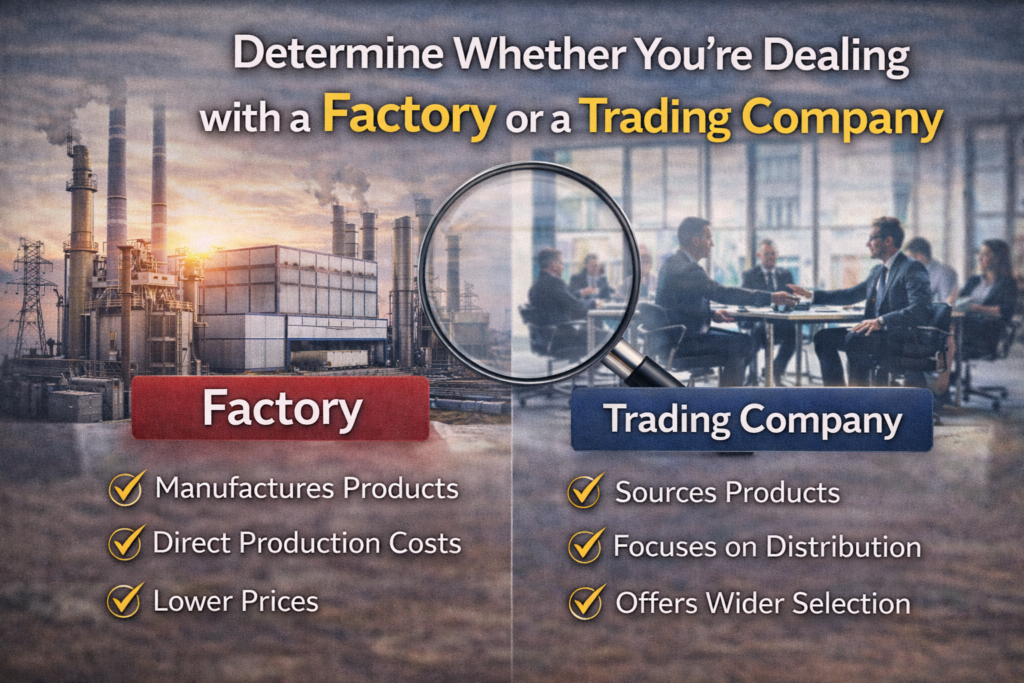
Many suppliers on Alibaba and Made-in-China present themselves as direct manufacturers when they’re actually trading companies (intermediaries who source from actual factories and add a margin)
Trading companies aren’t automatically bad, but you need to know which one you’re dealing with.
Check the Business Scope on the USCC Listing
Pull up the company’s NECIPS registration and look at the registered business scope.
A genuine manufacturer’s scope will include terms containing “生产” (shēngchǎn—manufacturing or production). A trading company’s scope will list “贸易” (màoyì—trade) or “批发” (pīfā—wholesale).
Some companies are legitimately both—larger enterprises often manufacture and trade—but if manufacturing isn’t listed at all, they cannot legally be your factory.
Check the Export License Category
Regulated goods require export licenses from MOFCOM (China’s Ministry of Commerce). Ask your supplier for a copy of their export license and look at the category.
A Manufacturing Enterprise Export License confirms that the holder is a producer. A Trading Company Export License confirms they are a reseller.
Suppliers who can’t produce either document for regulated goods are a red flag regardless of platform badges.
Ask Technical Production Questions
A real manufacturer knows their production tolerances, lead times, material specs, and machine capacity from memory or can verify them within minutes.
A trading company will frequently say, “Let me check with our factory,” when you ask about specific manufacturing parameters. That’s not always disqualifying, but combined with other signals, it matters.
Step 4: Verify Certifications (Don’t Just Accept the PDF)
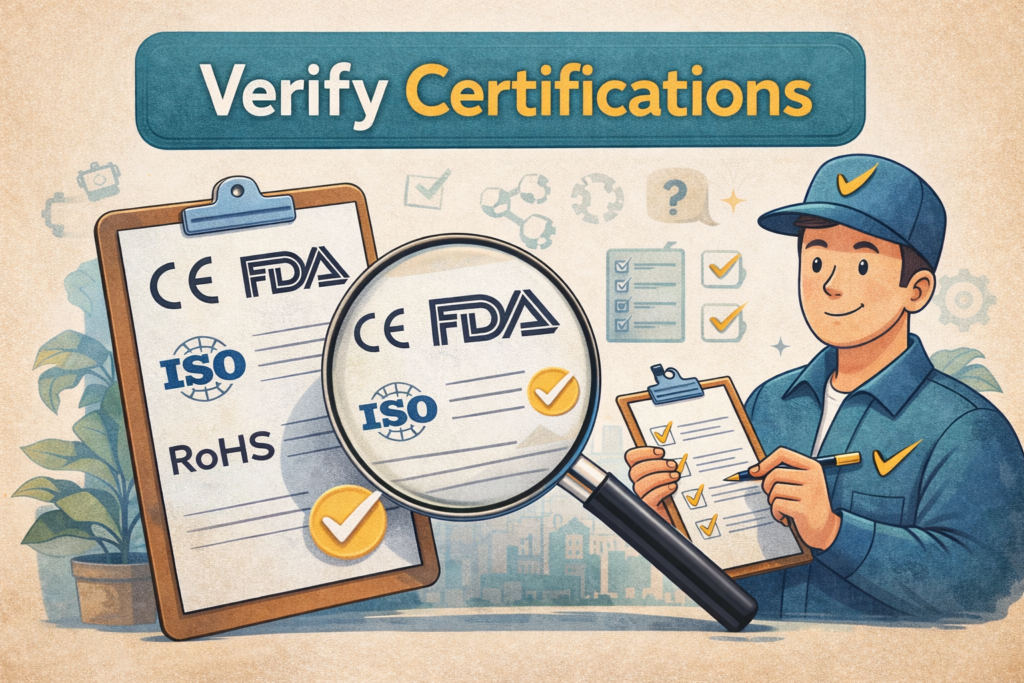
Counterfeit certificates are one of the most common fraud mechanisms in China sourcing.
A supplier sending you a PDF of an ISO 9001 or CE certificate proves nothing on its own—these are trivially easy to clone from real companies or generate from templates.
How to Verify a Certificate Is Real
Every legitimate certification from an accredited body carries a certificate number and an issuing organization. Cross-check that number directly:
- SGS – SGS Certified Client Directory
- TÜV SÜD – Certipedia
- Intertek – Intertek Certificate Search
- Bureau Veritas – Bureau Veritas Directory
If the certificate number doesn’t appear in the issuing body’s database, it’s not real.
Common Certifications by Product Category
| Product Category | Key Certifications to Request |
| Consumer electronics | CE, RoHS, FCC |
| Food, supplements | FDA registration, GMP, HACCP |
| Children’s products | EN 71 (EU), ASTM F963 (US), CPSC |
| Wood and furniture | FSC, CARB |
| Quality management | ISO 9001 |
| Environmental standards | ISO 14001 |
| Ethical labor practices | BSCI, Sedex |
Watch for template-style certificates with inconsistent fonts, missing issuer contact details, or a company name on the certificate that doesn’t exactly match the USCC-registered Chinese legal name.
Any of these is a forgery indicator.
Step 5: Run a Factory Audit Before You Commit
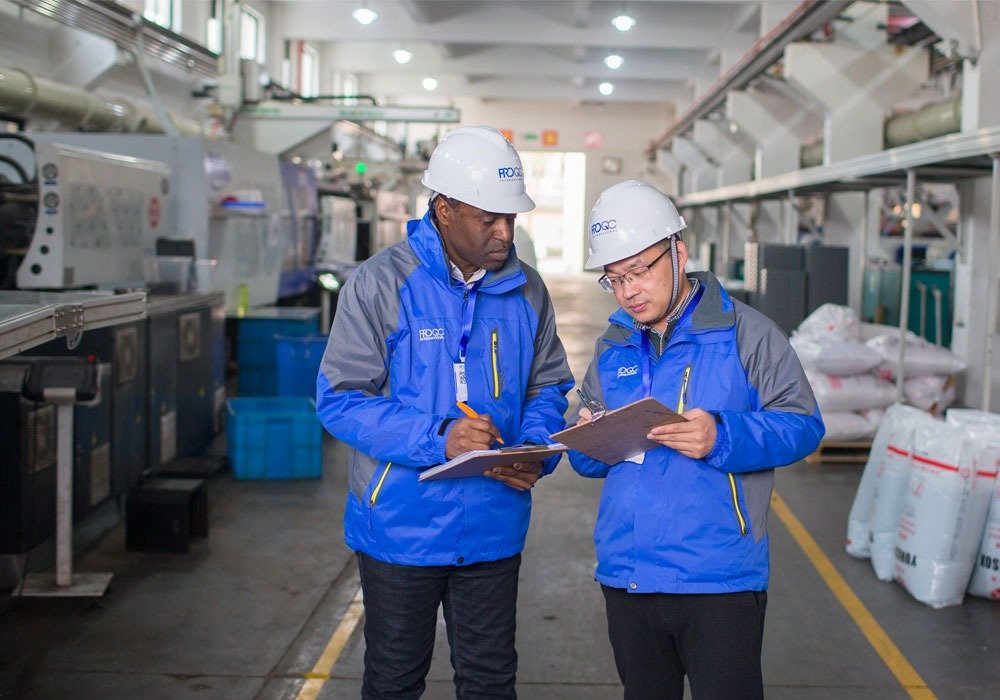
A factory audit is the most reliable way to confirm that a supplier’s claimed capacity, quality systems, and ethical practices are real.
According to QIMA’s Q3 2024 Barometer, 59% of audited factories in China passed compliance reviews, which means 41% didn’t. Auditing is not paranoia; it’s standard practice.
Types of Factory Audits
There are three distinct audit categories, and they serve different purposes:
| Audit Type | What It Confirms | What It Covers |
| Basic Factory Audit | Company registration and physical existence | License, location, headcount |
| Quality System Audit | Production and QC processes | Equipment, inspection, traceability |
| Social Compliance Audit | Ethical and labor conditions | Safety, wages, working environment |
Basic audits typically cost $250–$400 and deliver a detailed report with photos within 48 hours of the site visit. Quality and social compliance audits run higher depending on the scope.
Audit Providers Worth Knowing
Third-party audit firms with established China networks include QIMA, SGS, Intertek, and Bureau Veritas.
If you’re working with a sourcing partner, they can often coordinate on-site audits through their local teams, which is one of the genuine advantages of using an experienced intermediary.
For example, CHANGE Commerce offers end-to-end sourcing services that include supplier verification and factory audits as part of their process, so you’re not coordinating these checks in isolation.
Step 6: Watch for 2025 Scam Tactics That Didn’t Exist Three Years Ago
This is where most competitor guides stop. They cover verification basics but miss the methods that are actually catching buyers off guard right now.
AI-Generated Factory Video Tours
Fraudulent suppliers increasingly use AI deepfake tools to simulate live factory tours that appear completely convincing on a video call.
Pre-recorded footage of real factories—or AI-generated production environments—can be streamed as though it’s a live walkthrough.
To test for this, ask the supplier to perform a specific real-time action during the call.
Have them hold up a piece of paper with your company name and today’s date written on it, show a specific corner of the building you point to, or walk the camera to the company signboard at the entrance.
A real factory can do this instantly. A fake feed cannot.
Stolen Business License Identity
Scammers acquire or clone the USCC of a legitimate, active company and present those credentials as their own.
The license check passes, but you’re communicating with a completely different entity operating from a different address.
After verifying the USCC in NECIPS, always cross-check the registered address against Google Maps or Baidu Maps street view.
Request a short video call where they show the building exterior and company signage on camera and confirm it matches the registered address on the license.
Business Email Compromise (BEC) Before Payment
Business Email Compromise is one of the most costly fraud types in international trade. According to the FBI’s Internet Crime Report, BEC caused $2.9 billion in losses to US businesses in 2023 alone.
The mechanics: a scammer intercepts or spoofs your legitimate supplier’s email chain and sends you updated bank details—just before you’re about to make a payment.
The format looks identical to previous emails. The new account belongs to them.
Protect yourself with one rule: call your supplier on their verified landline to confirm bank details before every payment, especially if the account information has changed. Never confirm new banking details by replying to the email.
AI-Generated Product Listing Images
Suppliers increasingly use AI image generation tools to create product photos that look photographed but were never manufactured.
Order a physical sample before any production commitment—every time, with every new supplier.
Step 7: Read the Platform Signals Accurately
Platform badges carry real information, but only when you know what they actually represent.
What Alibaba’s Trust Signals Actually Mean
Gold Supplier status on Alibaba means the supplier paid for a premium membership tier. It signals they’re invested in the platform—not that they were independently verified for legitimacy or quality. Treat it as one positive signal among many.
Trade Assurance means orders placed through Alibaba’s escrow system have some buyer protection—refund rights if delivery fails or quality is significantly misrepresented. It provides recourse, but only for qualifying orders placed within the Trade Assurance system.
The Verified Supplier badge means the supplier was independently audited by a third party, such as SGS. This is meaningfully more trustworthy than Gold Supplier status alone and is worth looking for specifically.
Transaction volume and years of operation are often more useful than any badge. A supplier with 7+ years on the platform and consistent order volume is statistically far less likely to be a ghost factory than a new listing with no history.
Reverse Image Search the Factory Photos
Take any factory photo from a supplier’s listing and run it through Google Images or TinEye. If the same image appears on multiple unrelated supplier pages, stock image sites, or completely different company profiles, you’re looking at fabricated content.
This takes 30 seconds and catches a surprising number of fraudulent listings.
Step 8: Structure Your Payment to Limit Exposure
Payment terms are both a verification signal and a loss-limiting tool. How a supplier responds to your payment structure request tells you a lot about how legitimate they are.
The Safe Payment Structure
The industry-standard split for China imports is a 30% deposit upfront and a 70% balance after pre-shipment inspection approval.
This means the bulk of your payment is contingent on seeing the actual goods pass inspection—not just on the supplier’s promise.
Suppliers who demand 50% or 100% upfront with no milestone conditions attached are a red flag. Legitimate manufacturers understand buyer protection terms. They use them with their own suppliers.
Payment Methods and What They Mean for Your Protection
T/T (Telegraphic Transfer/Wire Transfer) is the most common method in China trade. It offers limited buyer protection. Use it within the 30/70 structure and never for full payment upfront.
Alibaba Trade Assurance provides some recourse for qualifying orders made through the platform—useful for smaller orders where the protection is relevant.
Letter of Credit (LC) is a bank-guaranteed payment conditional on the supplier meeting specific shipment document requirements. Complex to arrange but worth it for orders above $20,000.
Always ensure the bank account name matches the USCC-registered Chinese legal name of the company exactly.
Payments to personal accounts, unrelated third parties, or accounts in a different company’s name are a serious red flag, regardless of any explanation offered.
Red Flags: The Complete Checklist
Run every new supplier through this before you engage further. Working with a reliable sourcing partner like CHANGE Commerce means these checks are built into the process from the start – but if you’re sourcing independently, this list is your safety net.
🚩 Cannot or will not provide an 18-digit Unified Social Credit Code
🚩 NECIPS shows the company status as dissolved, revoked, suspended, or abnormal
🚩 The company name on their invoice doesn’t match the USCC-registered Chinese legal name
🚩 Social insurance records show near-zero enrollment despite the claimed large workforce
🚩 Registered address maps to a residential building, virtual office, or vacant lot
🚩 Factory photos appear on multiple unrelated supplier listings or stock image databases
🚩 Hesitates or deflects during a live video call when asked to perform a simple real-time action
🚩 Cannot verify certifications through the issuing body’s official search tool
🚩 The certificate company name doesn’t exactly match the USCC-registered legal name
🚩 Refuses a factory audit or pre-shipment inspection without a clear reason
🚩 Only contactable via a personal mobile number—no company domain email or verified landline
🚩 Demands full payment upfront with no inspection milestone
🚩 Requests payment to a personal account or a third-party entity
🚩 Sends updated bank details by email without proactive phone confirmation
🚩 Price is more than 15% below the median market rate for comparable product specs
🚩 Applies urgency or time pressure when you request any verification step
What to Do If You’ve Already Been Scammed
Most guides stop at prevention. Here’s what to do if you’re past that point.
Immediate Actions Within 72 Hours
Contact your bank immediately—within 24 to 72 hours of discovering the fraud.
International wire transfers can sometimes be recalled if the fraud is reported quickly enough and the receiving bank hasn’t yet released the funds. Every hour matters.
Document everything right now: every email, every WeChat message, every payment receipt, every screenshot of the product listing, and every certificate they sent. This is your evidence file for all subsequent steps.
Escalation Steps
File a complaint with the SAMR (State Administration for Market Regulation) if the company is registered in China. They maintain oversight of registered businesses and can act on fraudulent operators.
Contact the platform where you found the supplier—Alibaba, Made-in-China, or Global Sources. All have fraud reporting teams. Provide your documentation and the supplier’s listing details.
For losses above $10,000, engage a China-based attorney or international trade law firm.
Legal action in China requires local legal representation and Chinese-language documentation—both of which require preparation. Don’t wait to start looking for representation.
Final Thoughts
Verification isn’t overhead. It’s the actual cost of operating in a market where 24,000 new companies register every day, and sophisticated fraud is the norm, not the exception.
The two non-negotiables before any order: verify the USCC through NECIPS before the first deposit, and run a pre-shipment inspection before the final payment clears. Everything else in this guide adds layers on top of those two pillars.
For orders above $5,000, budget for a third-party factory audit—typically $250–$400. It’s a fraction of what you stand to lose and the only way to confirm with confidence that your supplier is who they say they are.
Knowing how to check China supplier’s legitimacy correctly, and doing it consistently, is what separates importers who scale sustainably from those who absorb expensive lessons on their first or second order.
Frequently Asked Questions
1) How do I check if a Chinese supplier is legitimate?
Start with the USCC verification. Ask for the supplier’s 18-digit Unified Social Credit Code, then check it against the National Enterprise Credit Information Publicity System (NECIPS). Confirm the company is active, the business scope includes manufacturing, and the registered address is verifiable. Then cross-check with a social insurance report and a factory audit before committing any significant funds.
2) What is the Unified Social Credit Code, and why does it matter?
The Unified Social Credit Code (USCC) is an 18-digit government-assigned identifier unique to every registered company in China. It’s the only stable, legally binding identifier—unlike English names, which have no legal status. Verifying a supplier’s USCC in the NECIPS database is the single most important step in confirming a Chinese company’s legitimacy.
3) What’s the difference between a Gold Supplier and a Verified Supplier on Alibaba?
A Gold Supplier pays for a premium Alibaba membership – it indicates platform investment, not independent verification. A verified supplier has been audited by a third-party body such as SGS. The Verified Supplier badge carries significantly more weight when evaluating legitimacy.
4) How can I tell if my Chinese supplier is a real factory or a trading company?
Check the business scope in their NECIPS registration. Genuine manufacturers list “生产” (production/manufacturing) in their scope. Trading companies list “贸易” (trade) or “批发” (wholesale). You can also request their MOFCOM export license—a Manufacturing Enterprise Export License confirms they are a producer.
5) Can I trust certificates like ISO 9001 or CE from Chinese suppliers?
Not without verification. Certificate copies are easy to forge. Cross-check every certificate number directly in the issuing body’s public database—SGS, TÜV SÜD (Certipedia), Intertek, or Bureau Veritas. If the number doesn’t appear in their system, the certificate is not genuine.
6) What should I do immediately if I’ve been scammed by a Chinese supplier?
Contact your bank within 24–72 hours to attempt a wire recall. Document everything immediately—emails, payment records, certificates, and listing screenshots. Report to the platform where you found the supplier and file a complaint with SAMR. For significant losses, engage a China-based attorney as soon as possible. Time is your most critical resource at this stage.