

Quick Answer: To source products from China cheaply, use platforms like 1688.com or Alibaba, negotiate directly with manufacturers, calculate your true landed cost (product + shipping + tariffs), and verify suppliers before placing any bulk order. This guide walks you through every step.
China is still the world’s largest manufacturing hub—and for most importers, it remains the most cost-effective place to source products. Yes, tariffs have changed the math. But the fundamentals of cheap sourcing from China are stronger than ever if you know how to work the system.
The problem? Most guides online give you a surface-level overview and leave out the parts that actually save you money. Things like how to negotiate prices, where to find suppliers cheaper than Alibaba, how to calculate real costs before you order, and how to protect yourself from scams.
This guide covers all of it. No filler. No fluff. Just a clear, step-by-step process to help you source products from China at the lowest possible cost—even in today’s tariff environment.
Step 1: Define Your Product and Calculate Your Real Budget
Most sourcing mistakes happen before you even contact a supplier. People jump to platforms, browse products, and start comparing prices without knowing exactly what they want or what they can afford to pay. That backwards approach costs money.
Get two things locked in first: a clear product brief and a realistic landed cost target. Everything after that becomes much easier.
Start With the Product, Not the Platform
Before you open Alibaba or talk to a single supplier, you need to be specific about what you want. Vague searches get vague results—and expensive mistakes.
Write down the exact product name, the material and dimensions, the quantity you want to start with, and the maximum price you can pay per unit to stay profitable. This is your sourcing brief, and every supplier conversation should start with it.
Understand Your Landed Cost—Not Just the Unit Price
This is the mistake every first-time importer makes. They see a unit price of $2.50 and get excited. But that number means almost nothing on its own.
Your landed cost is what you actually pay to get the product in your hand, ready to sell. Here is how to calculate it:
Landed Cost Formula:
Unit Price + International Freight + Import Tariff + Customs Broker Fee + Local Delivery + Quality Inspection = Landed Cost Per Unit
For example, a product priced at $3.00 FOB might cost you $4.80–$5.50 per unit once you add sea freight, a 30%+ effective tariff on Chinese goods, customs fees, and inspection. Know this before you negotiate—not after.
Step 2: Choose the Right Sourcing Platform
Where you source matters as much as who you source from. Different platforms attract different types of suppliers—and charge very different price points. Picking the wrong one means you either overpay or deal with buyers you can’t trust.
Here’s how the main platforms compare, and when to use each one.
Not All Platforms Are Created Equal
Most people go straight to Alibaba. That’s fine—but it’s not always the cheapest option. Here’s a side-by-side look at the four main platforms so you can pick the right one for your situation.
| Platform | Best For | Price Level | Buyer Protection | Min. Order (MOQ) |
| Alibaba | Beginners, B2B exports | Medium | Trade Assurance | Usually 50–500 units |
| 1688.com | Lowest prices, bulk | Lowest (domestic) | Limited for foreigners | Often 1–10 units |
| Global Sources | Electronics, verified suppliers | Medium–High | Verified suppliers | Higher MOQ typical |
| Made in China | Industrial, niche products | Competitive | Moderate | Flexible |
Why 1688.com Deserves Your Attention
1688.com is Alibaba’s domestic Chinese B2B platform—built for Chinese buyers, not international ones. Because suppliers aren’t trying to impress foreign buyers, prices are typically 30–60% lower than the same products on Alibaba’s export site.
The catch: the site is in Chinese. You’ll need to use Google Translate or pair with a sourcing agent to navigate it. But if you want the closest-to-factory price possible without visiting China, this is your best tool.
A good workaround is to find a product on Alibaba, search the same model or factory name on 1688.com, and use the price gap as leverage in your Alibaba negotiations.
Step 3: Find and Verify Suppliers Before You Send a Dollar
Finding a cheap supplier is easy. Finding a cheap, reliable supplier is the hard part. China has millions of manufacturers, and a small percentage are bad actors who will take your deposit and disappear or ship goods that don’t match your samples.
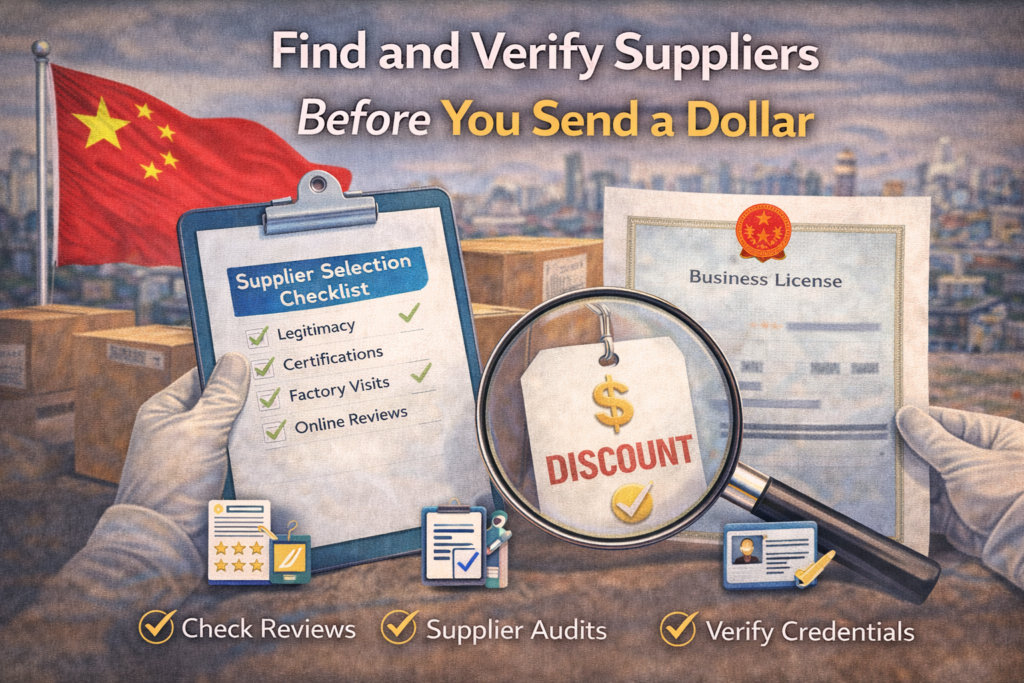
The steps below show you exactly how to identify the right suppliers and verify them before committing any money.
How to Search for Suppliers the Right Way
On Alibaba, filter by “Verified Supplier” and look for factories with Trade Assurance enabled. These two filters alone remove most bad actors from your results.
Contact at least 5–8 suppliers for every product. Send each of them your sourcing brief (from Step 1). Gauge response time, clarity, and whether they ask smart questions about your specs. Good suppliers ask questions. Bad ones just send you a price list.
Red Flags to Watch Out For
Not every supplier on Alibaba or 1688.com is who they claim to be. Some are trading companies masquerading as factories. Others are outright fraudulent. The good news is that most bad actors show the same warning signs—you just need to know what to look for.
If you spot any of the following during your supplier search, walk away and move to the next one. No deal is worth the risk of losing your entire order budget.
How to Verify a Supplier
Ask for their business license number. Run it through China’s National Enterprise Credit Information Publicity System—a free government database. This confirms the company is legally registered and shows its registered address.
For orders over $3,000, it’s worth hiring a third-party inspection company (like QIMA or Intertek) to do a factory audit before you commit. It costs $200–$400 and can save you from a $10,000 mistake.
Step 4: Negotiate the Cheapest Price—With Tactics That Work

Negotiation is where you actually make your sourcing cheap. The listed price on Alibaba is never the final price—it’s a starting point. Suppliers build margin into their quotes, especially for international buyers who don’t push back.
Use these four tactics, and you’ll consistently pay less than importers who just accept the first number they’re given.
What You Can Realistically Negotiate
Most importers accept the first quoted price. That’s a mistake. Chinese suppliers quote with a margin built in—especially for international buyers. You can typically negotiate 10–25% off the initial quote if you approach it correctly.
Negotiation Tactics That Actually Move the Price
Use the 1688.com Price as Your Anchor
Find the same or similar product on 1688.com. Screenshot the price. Then go back to your Alibaba supplier and say, “I found this product from a domestic supplier at $X. Can you match that for an export order of 500 units?” You’ll be surprised how often they can.
Negotiate Timing, Not Just Price
Suppliers are most flexible right before the Chinese New Year (January/February) and immediately after the Canton Fair season (May and October). These are the periods when factories have quiet order books and are more willing to negotiate.
Increase the Order Size in Phases
Tell the supplier, “If this first order goes well, we plan to scale to 2,000 units in the next quarter.” Many suppliers will reduce the unit price now in exchange for a commitment to future volume. Get this in writing.
Ask for Better Payment Terms, Not Just Lower Price
If they won’t move on price, ask for better payment terms instead—for example, a 30% deposit with 70% paid on delivery confirmation rather than 30/70 before shipment. That’s meaningful protection that has a real dollar value.
Step 5: Understand Tariffs—The Number That Changes Everything
Tariffs are the single biggest blind spot for new importers sourcing from China in 2026. They can turn a profitable deal into a losing one if you don’t factor them in before you order.
This section breaks down what you’re actually dealing with and—more importantly—how to work around it without leaving China.
The Tariff Reality in 2026
This is the section most sourcing guides ignore. If you’re importing from China into the United States, tariffs are now a major line item in your cost structure—and you must plan for them before you place any order.
According to the Penn Wharton Budget Model, China faces the highest effective tariff rate of any major trading partner — reaching 37.1% as of late 2025. Some categories go much higher.
Meanwhile, PIIE data shows average US tariffs on Chinese exports now stand at 47.5% and cover 100% of all goods. These are not small numbers.
How to Reduce Your Tariff Burden Without Leaving China
Know Your HS Code and Tariff Rate Before You Order
Every product has an HS (Harmonized System) code that determines its tariff rate. Look up your product’s code on the USITC Tariff Database before contacting suppliers. Some similar products have very different tariff rates—a small tweak to a product’s classification can save you 10–15 percentage points.
Use the Tariff to Negotiate Lower Factory Prices
Be transparent with your supplier. Say: “The tariff on this product is 30%. That makes our landed cost $X. For us to make this work, we need your FOB price to be $Y.” Many factories will adjust their pricing to keep the business, especially if you’re offering consistent volume.
Source Low-Tariff Categories Where Possible
Some product categories carry lower tariffs than others. Food packaging, certain textiles, and some consumer goods fall in the 7.5–15% range. Electronics and industrial goods tend to be higher. Do this research in the planning stage—not after your shipment is at the port.
Step 6: Ship Smart and Keep Freight Costs Low
Shipping is often the second-largest cost after the product itself—and most first-time importers overpay for it simply because they don’t know their options. The right shipping decision depends on your product size, weight, urgency, and budget.
Here’s what you need to know to move goods from China to your door without bleeding money on freight.
Sea vs. Air: The Core Decision
For most importers, sea freight is the only affordable option for bulk goods. Air freight can cost 6–10 times more per kilogram. Use air only for small, urgent, or high-value-per-weight shipments.
Sea freight from China to the US West Coast typically runs $800–$1,500 for a 20-foot container (FCL). For smaller shipments, LCL (Less than Container Load) lets you share space and pay only for your portion—usually priced per cubic meter (CBM).
Use a Freight Forwarder
Don’t try to manage international shipping yourself for your first few orders. A freight forwarder handles customs clearance, documentation, and routing. They often negotiate better shipping rates than you can as a small importer.
Get quotes from at least three forwarders. Ask them to quote DDP (Delivered Duty Paid) so you can compare total costs apples-to-apples, including tariffs, duties, and delivery.
Understand FOB vs. CIF vs. DDP
- FOB (Free on Board): Supplier delivers to the port. You handle everything from there.
- CIF (Cost, Insurance, Freight): Supplier covers shipping and insurance to your destination port. You handle customs.
- DDP (Delivered Duty Paid): Supplier handles everything, including tariffs. Easiest, but usually most expensive.
For beginners, DDP from a trusted supplier removes most of the complexity. As volume grows and you know the process, switching to FOB typically saves 5–10% on logistics.
Step 7: Quality Control—Don’t Let ‘Cheap’ Become Costly

The word ‘cheap’ in sourcing should refer to price—not quality. The two are not the same thing, and the best importers know how to get low prices without accepting low standards.
Skip quality control, and you’re gambling with your entire order. These two steps protect you every time.
Always Order a Sample First
Never skip samples. Ask for 1–3 samples before committing to any bulk order. Yes, you’ll pay $50–$200 for them. That’s a fraction of the cost of receiving 500 defective units.
Test the sample hard. Does it meet your specs? How does it compare to what the supplier showed in their photos? If there’s a gap, raise it—and get written confirmation that the bulk production will match the approved sample.
Pre-Shipment Inspection for Orders Over $2,000
Hire a third-party inspection company to check your goods before they leave China. Inspectors visit the factory, test units against your specs, and send you a report with photos. Common providers include QIMA, Intertek, and Bureau Veritas.
Costs typically range from $200–$400 per inspection day. That fee is cheap compared to the cost of dealing with defective stock after it’s already in your warehouse.
If you’re working with a sourcing partner—like CHANGE Commerce, which manages supplier relationships and quality checks on behalf of importers—this step can be handled as part of their service. That removes the back-and-forth of coordinating inspections yourself.
Step 8: Pay Safely and Protect Your Money
How you pay is just as important as what you pay. International wire transfers to a new supplier carry real risk—if something goes wrong, recovering your money is extremely difficult.
Use the right payment method for each situation, and you significantly reduce the chance of losing money to a bad actor.
Payment Methods Ranked by Safety
- Letter of Credit (LC): Safest for large orders. A bank guarantees payment only when conditions are met.
- Alibaba Trade Assurance: Funds held in escrow. Released when you confirm the order received.
- PayPal (Goods & Services): Good for small sample orders. Offers dispute protection.
- T/T Wire Transfer (Partial): Standard for established relationships. Pay a 30% deposit and 70% before shipment.
- Western Union / Full Upfront Wire: Avoid. No protection if the supplier disappears.
For your first order with a new supplier, always use Trade Assurance or PayPal regardless of what they request. Build trust before you move to wire transfers.
When to Use a Sourcing Agent (And When to Skip It)

Not every importer needs a sourcing agent. But for some businesses, using one is the single best way to save time, avoid costly mistakes, and access factories that don’t list on English-language platforms.
Here’s how to decide which side of that line you fall on.
What a Sourcing Agent Does
A sourcing agent is a person or company based in China who acts on your behalf. They find suppliers, negotiate prices, visit factories, inspect goods, and manage logistics. For many importers, especially beginners, this removes most of the headache.
Services like CHANGE Commerce go further—managing the entire supply chain from supplier vetting to delivery, making them a good fit for businesses that want to source from China without building an in-house team for it.
When You Need One
A sourcing agent makes sense when the complexity of your supply chain exceeds what you can manage remotely. If you’re dealing with multiple suppliers, language barriers, or large order values, the agent’s fee more than pays for itself in time saved and mistakes avoided.
These are the situations where hiring a sourcing agent is the smarter move:
When You Can Go Direct
Going direct to a supplier works well when your order is straightforward—one product, one factory, and enough time to manage back-and-forth communication yourself. For early-stage importers testing a product idea, it also keeps costs lean.
Bonus: 5 Common China Sourcing Scams and How to Avoid Them
The vast majority of Chinese suppliers are legitimate businesses. But scams do exist—and they tend to target first-time importers who don’t know what warning signs to look for.
Knowing these five patterns will protect you from the most common traps.
- The Bait-and-Switch: The supplier shows high-quality samples and ships inferior bulk goods. Fix: Third-party pre-shipment inspection.
- The Trading Company Disguise: They claim to be a factory but are a middleman adding margin. Fix: Ask for factory photos, business license, and production videos.
- The Disappearing Deposit: The supplier takes your 30–50% deposit and goes quiet. Fix: Only use Trade Assurance or escrow for new suppliers.
- The MOQ Manipulation: Quoted a low MOQ to get your business, then the “minimum” goes up after samples. Fix: Get MOQ in writing before ordering samples.
- The Fake Certification: The supplier claims CE, RoHS, or FDA certification but can’t provide documents. Fix: Always request actual certificates and verify the issuing body.
Frequently Asked Questions

These are the questions importers most commonly ask when they’re starting out sourcing from China. Short, direct answers below.
1) Is it still worth sourcing from China with high tariffs?
Yes—for most product categories, China still offers the lowest factory prices in the world. The key is doing the landed cost math before you order, not after. Factor in tariffs at the planning stage, negotiate your FOB price accordingly, and China remains competitive for most importers.
2) How much money do I need to start sourcing from China?
You can start as low as $500–$1,000 for a small sample order. For a meaningful first bulk order, budget $2,000–$5,000, including product cost, shipping, and tariffs. The more important number is your landed cost per unit—that tells you if the deal makes sense.
3) What is the minimum order quantity (MOQ) when buying from China?
MOQ varies widely by supplier and product. On Alibaba, MOQs typically range from 50 to 500 units. On 1688.com, you can sometimes order as few as 1–10 units. For private label or custom products, MOQs are usually higher—200 to 1,000 units minimum.
4) How long does shipping from China take?
Sea freight from China to the US West Coast takes 18–30 days. The East Coast adds another 7–10 days. Air freight is 5–8 days but significantly more expensive. Factor lead time into your inventory planning—especially around Chinese New Year when factories close for 2–4 weeks.
5) Do I need a customs broker to import from China?
For shipments over $2,500, you are legally required to file a customs entry with US Customs and Border Protection. A licensed customs broker handles this. Their fee typically runs $150–$300 per shipment and is well worth it to avoid delays, fines, or seized goods.
Final Thoughts
Sourcing products from China cheaply is about more than finding a low unit price. It’s about understanding your real costs, choosing the right suppliers, negotiating with data, and protecting yourself at every step.
The importers who succeed are the ones who treat this as a process, not a one-off transaction. Get your landed cost right. Use 1688.com to anchor your negotiations. Verify before you buy. And build tariffs into your model from day one—not as a surprise at the port.
Follow the steps in this guide, and you’ll be ahead of most first-time importers before you even place your first order.
Note: Tariff rates and trade policies change frequently. Always verify current rates using the
USITC HTS database or CBP.gov before placing orders.