

Shipping from China looks simple on paper. Then the invoice arrives — and it’s $800 more than you expected. Fuel surcharges. Terminal handling fees. Customs exam charges. If you don’t understand the full cost picture upfront, every order is a guessing game. This guide breaks it all down — specifically for US sellers, not freight agents.
Whether you’re running an Amazon FBA business, a Shopify store, or importing wholesale goods, your shipping decisions directly affect what lands in your pocket. A product that looks profitable in your supplier quote can turn into a loss once freight, duties, and fees are factored in.
This guide covers every layer of China shipping costs—methods, rates, tariffs, hidden fees, seasonal timing, and how to calculate your true landed cost. By the end, you’ll have a clear framework to make smarter shipping decisions in 2026.
What Actually Determines Your China Shipping Cost?
Before you look at a single rate chart, you need to understand the variables that drive the final number.
Most sellers only focus on the base freight rate—and then get blindsided by everything else.
Shipping Method
This is the biggest variable. Sea freight, air freight, and express courier each have completely different price structures. The cheapest option per kilogram is almost never the cheapest option for your specific shipment when you factor in time, minimum charges, and risk.
Weight vs. Volume (Chargeable Weight)
HOW CARRIERS ACTUALLY CHARGE YOU
Carriers don’t always charge by actual weight. They charge based on the higher of actual weight and volumetric weight.
Volumetric weight is calculated as: Length × Width × Height (cm) ÷ 5,000 for air freight, or ÷ 1,000 for express.
A box of light, bulky goods—like foam packaging or stuffed toys—will almost always be charged at volumetric weight. Knowing this upfront saves you from nasty surprises on the invoice.
Your Incoterms
EXW (Ex Works) means you handle everything from the factory door.
FOB (Free on Board) means your supplier delivers to the port, and you take over from there.
DDP (Delivered Duty Paid) means the freight forwarder handles everything, including customs and delivery.
For most US sellers, FOB is the most common and practical starting point. DDP is worth considering for Amazon FBA shipments — more on that later.
Seasonal Demand
Freight rates are not fixed. They respond to supply and demand. The Freightos Baltic Index tracks real-time container rates, and the data consistently shows spikes in Q3–Q4 as retailers stock up for the US holiday season.
Chinese New Year also creates a sharp demand surge before the factory shutdown period each January–February.
Origin and Destination
Shipping from Shanghai or Ningbo to Los Angeles is cheaper than shipping from Guangzhou to New York via the East Coast. The longer the route and the more congested the destination port, the higher the rate.
West Coast ports (LA/Long Beach) offer the fastest transit times for goods coming from eastern China.
Shipping Methods Compared: Cost, Speed & Best Use
There are three main ways to move goods from China to the US. Each one suits a different situation.
Picking the wrong method for your shipment type is one of the most common (and costly) mistakes new sellers make.
| Method | Avg. Cost (2025) | Transit Time | Best For | Min. Shipment |
| Sea Freight – FCL | $2,000–$5,500 / container | 20–35 days (West Coast) 35–45 days (East Coast) | Large orders, bulk inventory | Fills most of a 20′ or 40′ container |
| Sea Freight – LCL | $150–$280 / CBM | 25–40 days | Medium shipments (1–15 CBM) | ~1 CBM minimum |
| Air Freight | $3–$7 / kg | 5–10 days | Restocks, high-value goods | 45 kg typical minimum |
| Express Courier (DHL/FedEx/UPS) | $6–$14 / kg | 3–7 days | Samples, small urgent parcels | No minimum |
Rates based on Freightos & Flexport market data, Q1 2026. Actual rates vary by carrier, route, and season.
Sea Freight: FCL vs. LCL
FCL — FULL CONTAINER LOAD
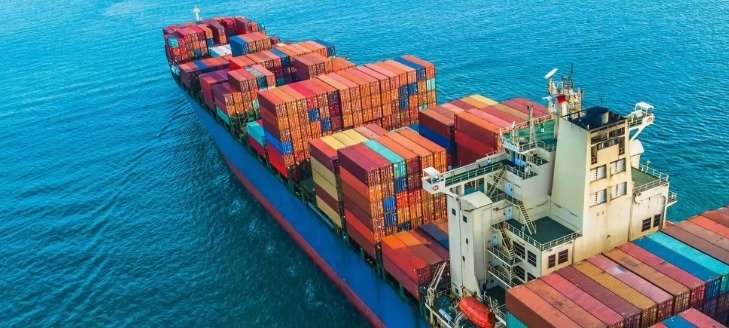
FCL means you’re renting an entire container—either a 20-foot (roughly 25–28 CBM usable space) or a 40-foot (50–55 CBM). You get exclusive use of that container, which means faster loading and lower risk of damage. FCL makes economic sense when your cargo fills at least 60–70% of a container.
For established FBA sellers shipping large seasonal inventory, FCL is almost always the most cost-effective option per unit. A 40-foot container from Shanghai to LA currently runs between $2,500 and $5,500, depending on the season, according to Freightos rate data.
LCL — LESS THAN CONTAINER LOAD
LCL consolidates your cargo with shipments from other businesses into one shared container. You only pay for the space you use—measured in cubic meters (CBM).
This is ideal for sellers with 1–15 CBM of goods who don’t yet move enough volume for a full container.
The downside: LCL adds handling time at the consolidation warehouse, which often adds 5–7 days to transit. You also share container space with other shippers, which slightly increases the risk of delays or damage if another shipper’s goods have a problem.
Air Freight
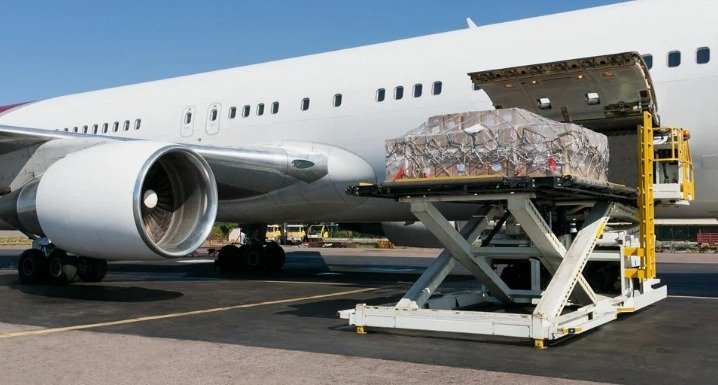
Air freight is expensive, but it’s the right tool in specific situations. When you’re launching a new product and need inventory fast, when your sea freight shipment is delayed, and you need to avoid a stockout, or when you’re shipping high-value goods where the cost of capital tied up in transit matters, air freight pays for itself.
Current air freight rates from major Chinese hubs (Shanghai, Guangzhou, and Shenzhen) to US airports run $3–$7 per kg, with Q4 peak surcharges pushing rates toward the top of that range.
Budget approximately $4.50–$5.50/kg as a working average for planning purposes.
Express Courier (DHL, FedEx, UPS)
Express is door-to-door, fast, and simple—but the cost per kilogram is the highest of all three methods. Use it for samples, product prototypes, or shipments under 30 kg where speed is critical.
For anything above 150–200 kg, air freight will almost always be cheaper.
| 💡 PRO TIP FOR SELLERS |
| The crossover point between express and air freight is typically around 50–100 kg. Above that weight, booking through a freight forwarder for air freight will save you 30–50% compared to booking DHL or FedEx directly. |
Real Cost Breakdown: What You’re Actually Paying
The freight rate is just the starting point. Every shipment carries a layer of additional charges that most sellers don’t account for until the final invoice arrives. Here’s a transparent breakdown.
Sea Freight: West Coast vs. East Coast
The destination port matters more than most sellers realize. West Coast ports (Los Angeles, Long Beach, and Seattle) are faster and cheaper for China routes. It would roughly cost you $800–$1,200 less per container compared to East Coast ports (New York and Savannah) because the route through the Panama Canal adds distance and transit time.
If your Amazon fulfillment center is in a Midwest or East Coast state, you’ll need to weigh the savings on freight against the added cost of domestic trucking from the West Coast. In many cases, the West Coast still wins on total landed cost.
Common Additional Fees — What to Watch For
| Fee Type | Typical Cost | Notes |
| Fuel Surcharge (BAF) | $200–$500 / container | Fluctuates monthly with oil prices |
| Terminal Handling Charge (THC) | $150–$350 / container | Charged at both the origin and destination ports |
| Customs Brokerage | $150–$350 / shipment | Required for US customs clearance |
| ISF Filing Fee | $25–$75 | Mandatory for all ocean freight imports |
| Chassis Fee (Trucking) | $25–$50 / day | Applies to container pickup at the port |
| Port Congestion Surcharge | $100–$500 | Applied during high-demand periods |
| Customs Exam Fee | $300–$1,200 | Only if CBP selects your shipment for inspection |
| Amazon FBA Prep / Labeling | $0.20–$0.50 / unit | If done at a 3PL before delivery |
| ⚠️ IMPORTANT |
| Always ask your freight forwarder for an “all-in” quote that lists every charge explicitly. A quote that shows only the freight rate and omits THC, fuel surcharge, and customs fees can understate your true cost by 30–50%. |
Tariffs & Import Duties: What US Sellers Must Know in 2026
This is the section that most shipping guides skip—and it’s the one that hits US sellers the hardest. Tariffs can add 7.5% to 145% on top of your product cost, depending on what you’re importing. Getting this wrong doesn’t just eat your margins — it can make a product completely unviable.
The Current Tariff Landscape
SECTION 301 TARIFFS
Section 301 tariffs have been in place since 2018 and apply to a broad range of goods imported from China. Depending on the product category, these tariffs range from 7.5% to 25% of the customs value. You can check whether your product is subject to Section 301 tariffs using your HS code on the US International Trade Commission HTS database.
IEEPA TARIFFS (2025)
In early 2025, the US imposed additional tariffs on Chinese goods under the International Emergency Economic Powers Act (IEEPA). After a 90-day negotiation truce in May 2025, the effective combined tariff rate on most Chinese goods currently sits at around 30% — but this is subject to change as trade negotiations continue.
According to Reuters reporting on the US-China trade truce, sellers should treat current rates as temporary and build tariff uncertainty into their product pricing models.
The De Minimis Rule Change — A Big Deal for Small Sellers
WHAT CHANGED IN MAY 2025
Previously, packages from China valued under $800 could enter the US duty-free under the de minimis exemption. This rule was eliminated for Chinese-origin goods in May 2025.
Every shipment from China now faces tariff assessment, regardless of value.
This change hit small-volume FBA sellers hard. Test orders of 50–100 units—previously shipped via express duty-free—now carry full tariff liability. If you’ve been relying on the de minimis threshold to keep your test shipment costs low, you need to factor duties into your product validation economics.
More details on the current rules are available directly from US Customs and Border Protection.
How to Find Your Duty Rate
Every product has an HS (Harmonized System) code — a 10-digit number that tells customs what you’re importing. Your duty rate is tied to this code.
Here’s a simple process:
Step 1: Ask your Chinese supplier for the HS code they use on export declarations.
Step 2: Search that code on hts.usitc.gov to find the general duty rate plus any Section 301 or IEEPA additions.
Step 3: Add the total tariff percentage to your landed cost calculation (see the next section).
| KEY TARIFF RATES BY PRODUCT CATEGORY (ESTIMATES, 2025) |
| Electronics & tech accessories: 20–30% combined |
| Apparel & textiles: 25–37% |
| Furniture & home goods: 25–35% |
| Toys & sporting goods: 7.5–25% |
| Industrial parts & machinery: 25% base + IEEPA additions |
| Always verify the exact rate for your specific HS code before making pricing decisions. |
Your Landed Cost Formula: Know Your True Profit Per Unit
Freight rate + product cost is not your real cost. Your landed cost is the total amount you spend to get one unit from a Chinese factory into your hands—or into an Amazon warehouse. Until you know this number, you can’t make a reliable pricing decision.
The Landed Cost Formula
Landed Cost Per Unit = Product Cost + Freight Cost + Import Duties + Customs Brokerage + FBA Prep + Domestic Trucking
Let’s run a real example so this isn’t abstract.
📦 Example: 500 Units of a Home Goods Product via Sea Freight (LCL)
| Product cost (500 units × $8) | $4,000 |
| Sea freight – LCL (1.5 CBM × $200/CBM) | $300 |
| Origin charges (THC + export docs) | $180 |
| Customs brokerage + ISF filing | $250 |
| Import duty (25% on $4,000 product value) | $1,000 |
| FBA labeling prep at 3PL ($0.30 × 500 units) | $150 |
| Domestic trucking to the FBA warehouse | $150 |
| TOTAL LANDED COST | $6,030 |
| LANDED COST PER UNIT | $12.06 |
In this example, the product cost alone was $8/unit. By the time it’s in the FBA warehouse, the real cost is $12.06/unit — a 51% increase over the factory price. If you priced this product based on an $8 cost assumption, your margin model is broken.
A practical rule: if your landed cost exceeds 40% of your target retail price, the product unit economics are under serious pressure. Factor this into your product selection, not after.
| 💡 SELLER TIP |
| Working with a sourcing company that handles supplier negotiations, quality control, and freight coordination in one place can meaningfully reduce your landed cost. Companies like CHANGE Sourcing provide end-to-end support—from factory sourcing through to consolidated shipping—helping US sellers reduce total import costs without managing five separate vendors. |
Seasonal Shipping Strategy: When You Ship Saves You Money
One of the most overlooked levers for US sellers is timing. Freight rates are not flat — they spike predictably every year. Booking at the wrong time can cost you 30–50% more than the same shipment booked two months earlier.
The Two Biggest Rate Spikes to Avoid
CHINESE NEW YEAR (JANUARY–FEBRUARY)

Chinese factories typically close for 2–4 weeks around Chinese New Year. In the weeks before the shutdown, there’s a rush to complete orders and fill containers. Rates spike, space gets tight, and rollover delays become common. Book and ship at least 6 weeks before the Chinese New Year.
Q3–Q4 PEAK SEASON (AUGUST–OCTOBER)
US retailers and Amazon sellers flood the market with inventory orders ahead of the holiday season. Freightos data consistently shows container rates from China to the US West Coast surging 30–60% between August and October compared to the prior spring. If you’re shipping holiday inventory, book space by July at the latest.
Seasonal Shipping Calendar
| Month | Rate Level | Strategy |
| January–February | 🔴 HIGH RISK | CNY rush + factory closures. Avoid if possible. |
| March–May | 🟢 BEST VALUE | Post-CNY recovery. Rates at yearly lows. |
| June–July | 🟡 RISING RATES | Rates climbing. Book early for Q4 inventory. |
| August–October | 🔴 PEAK SEASON | Holiday rush. Highest rates of the year. |
| November | 🟢 GOOD WINDOW | Post-peak drop. Good for restocking planning. |
| December | 🟡 WATCH CNY | Start CNY pre-booking. Don’t wait. |
DDP vs. DAP for Amazon FBA Sellers
This topic trips up a lot of new FBA sellers — and it’s important enough to cover clearly. When you ship to an Amazon FBA warehouse, Amazon will not act as the Importer of Record (IOR). That’s a firm policy.
What This Means in Practice
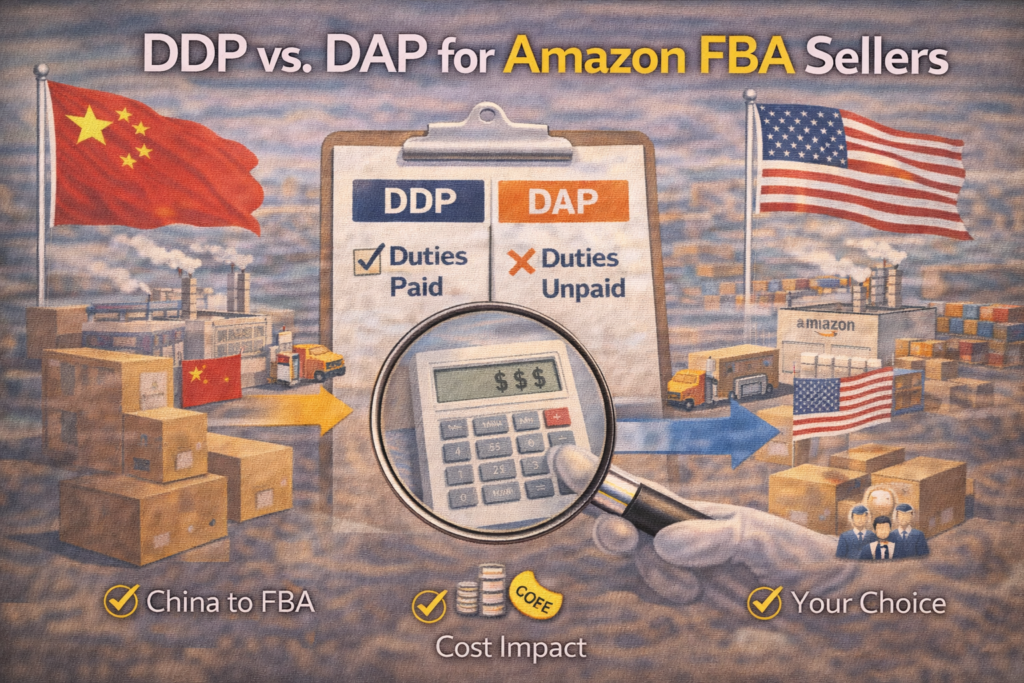
As an FBA seller, you are always the US importer on record. This means you are legally responsible for paying import duties, complying with customs regulations, and ensuring the shipment enters the country correctly.
Amazon simply receives the goods after customs clearance — they are not involved in the import process.
DDP — DELIVERED DUTY PAID
Under DDP terms, your freight forwarder handles the entire import process — freight, customs clearance, duty payment, and delivery to the FBA warehouse.
You receive one all-in invoice. DDP is the recommended option for most FBA sellers, especially those new to importing, because it eliminates complexity and keeps compliance risk on the forwarder’s side.
DAP — DELIVERED AT PLACE
Under DAP, the forwarder delivers the shipment to a US port or address, but you are responsible for customs clearance. This requires you to have a licensed customs broker, understand your HS code, and file the entry yourself or through a separate broker.
It’s more complex and only makes sense if you have in-house customs expertise or a strong broker relationship that saves you money.
| ⚠️ FBA SELLERS: WATCH THIS |
| Some forwarders quote DDP pricing but quietly exclude duties—meaning you still face a surprise bill when the shipment clears customs. Always confirm in writing: “Does your DDP price include import duties and all applicable taxes?” Get the answer in writing before booking. |
How to Choose a Freight Forwarder (Without Getting Burned)
Most sellers pick a forwarder based on who has the lowest quote. That’s understandable — but the cheapest quote often doesn’t stay the cheapest by the time the shipment arrives.
Here’s what actually separates a reliable forwarder from a costly one.
5 Questions to Ask Before You Book
1. IS YOUR QUOTE TRULY ALL-IN?
Ask them to list every charge: freight, origin THC, destination THC, fuel surcharge, customs brokerage, ISF filing, and delivery. A legitimate forwarder will itemize everything without hesitation.
2. DO YOU OFFER DDP TO AMAZON FBA WAREHOUSES?
Not all forwarders are experienced with FBA requirements — Amazon has specific labeling rules, booking procedures, and delivery window requirements. Confirm they’ve done it before.
3. WHAT’S YOUR POLICY IF MY SHIPMENT IS ROLLED?
Rolling means your cargo gets bumped off a scheduled sailing to a later one. It happens. Ask how they handle it — do they notify you immediately, and do they rebook at no extra charge?
4. DO YOU HAVE A CUSTOMS BROKER IN-HOUSE OR OUTSOURCED?
In-house customs brokerage is faster and less prone to communication gaps. An outsourced broker adds a layer that can slow down clearance during busy periods.
5. CAN YOU PROVIDE REFERENCES FROM US E-COMMERCE SELLERS?
A forwarder with real FBA or DTC seller clients will happily share references. If they can’t, treat that as a red flag.
Red Flags to Walk Away From
Vague quotes with no itemization. If they can’t tell you exactly what you’re paying for, they’re leaving room to add charges later.
No track record with Amazon FBA. FBA shipping has unique requirements. A forwarder who says “it’s just like any delivery” hasn’t done it.
No response within 24 hours. Freight timelines are tight. A slow-communicating forwarder will cost you more than money—they’ll cost you inventory planning delays.
When you’re still building supplier relationships in China, it also helps to have a sourcing partner who can coordinate logistics alongside product procurement. CHANGE Sourcing works directly with US sellers to manage everything from factory selection and price negotiation to quality inspection and shipment coordination — reducing the number of vendors you have to manage while keeping costs transparent.
Key Takeaways: 3 Decisions That Define Your Shipping Cost
After everything in this guide, it comes down to three strategic decisions that every US seller needs to make clearly:
1. Pick the right method for your shipment size and timeline. Sea LCL for medium shipments (1–15 CBM), FCL for large orders, air for restocks and launches, and express only for small urgent parcels. Don’t use air freight because it feels safer—use it only when the math supports it.
2. Calculate landed cost before you validate a product. The factory price is not your cost. Add freight, duties, customs, prep, and trucking. If landed cost exceeds 40% of the target retail price, revisit the product or the sourcing.
3. Time your shipments around known rate spikes. Book Q4 inventory by July. Finish CNY shipments 6 weeks before the holiday. Ship in March–May for the best value windows of the year.
These three decisions — method, cost structure, and timing — give you more control over your import margins than almost any other factor in your business.
Frequently Asked Questions

A 20-foot container (FCL) from China to the US West Coast currently runs $2,000–$3,500. A 40-foot container runs $2,500–$5,500. East Coast routes via the Panama Canal cost $800–$1,500 more. Rates fluctuate significantly by season — Q4 peak season and pre-Chinese New Year periods push rates to the high end of these ranges.
Sea freight FCL has the lowest cost per unit for large shipments. LCL is the most economical for smaller shipments (under 15 CBM). Air freight and express are significantly more expensive per kilogram but justified for time-sensitive or small, high-value shipments. The “cheapest” option always depends on your cargo size and timeline.
Transit time from major Chinese ports (Shanghai, Ningbo, Shenzhen) to US West Coast ports (LA/Long Beach) is typically 16–22 days on the vessel. Add 3–7 days for port handling, customs clearance, and final delivery, bringing the real door-to-door total to 22–35 days. East Coast routes add another 10–14 days.
Tariffs don’t affect freight rates directly — but they’re a major component of your landed cost. Most Chinese goods currently face a combined tariff rate of 25–35% under Section 301 and IEEPA provisions. The de minimis exemption for Chinese goods was also eliminated in May 2025, meaning even small test shipments now face duty assessment. Always factor in tariffs when calculating your landed cost per unit.
DDP (Delivered Duty Paid) means your freight forwarder handles all freight, customs clearance, duty payment, and delivery to the destination — including an Amazon FBA warehouse. It matters for FBA sellers because Amazon will not act as the US Importer of Record. You must ensure customs is cleared and duties are paid before the shipment arrives at Amazon. DDP simplifies this by putting that responsibility on your forwarder.
Chargeable weight is the higher of your cargo’s actual weight or its volumetric weight. Volumetric weight is calculated as: Length × Width × Height (cm) ÷ 5,000. If your cargo is light but bulky — like foam goods, pillows, or lightweight packaging — you’ll almost always pay based on volumetric weight, not actual weight. Always calculate both before booking air freight so the final invoice doesn’t surprise you.