

Your shipment from China is on its way. Then it sits at the port for two weeks, fees start stacking up, and nobody can tell you why.
For most first-time importers, that’s not a horror story—it’s a rite of passage. The customs process when buying from China trips up small business owners, Amazon FBA sellers, and experienced traders alike, often because the rules are more complex than a supplier’s quoted price ever suggests.
This guide walks you through every stage: what customs clearance actually involves, the documents you need, how duties are calculated, and the critical 2025 rule changes that have completely altered how low-value China shipments are handled in the US. No filler. Just what you need to know before your next order ships.
What Actually Happens at Customs When Your Shipment Arrives
Customs clearance isn’t a single event. It’s a sequence of reviews, filings, and payments that must occur in the right order before your goods can be released.
Here’s the core flow, regardless of whether you’re shipping by sea or air:
1. Arrival Notice
When your cargo reaches the destination port or airport, the carrier sends an arrival notice to your freight forwarder or customs broker. This kicks off the clearance clock.
2. Entry Filing
You (or your broker) submit a formal customs entry to the relevant authority — in the US, that’s US Customs and Border Protection (CBP). This includes your commercial invoice, packing list, and other required documents.
3. Review and Assessment
Customs officers review the declared goods, verify the product classification under the correct HS code (more on that below), and assess the applicable duties.
4. Duties and Taxes Payment
You pay what’s owed—import duties, any applicable VAT or GST depending on your country, plus any surcharges. Goods don’t move until this is settled.
5. Cargo Release
Once cleared, the shipment is released for final delivery to your warehouse or address.
The process is largely the same whether your goods come by sea or air. What differs is the timeline. Ocean freight typically gives you more lead time to prepare documents; air freight moves faster and has less room for error.
Documents You Need to Clear Customs
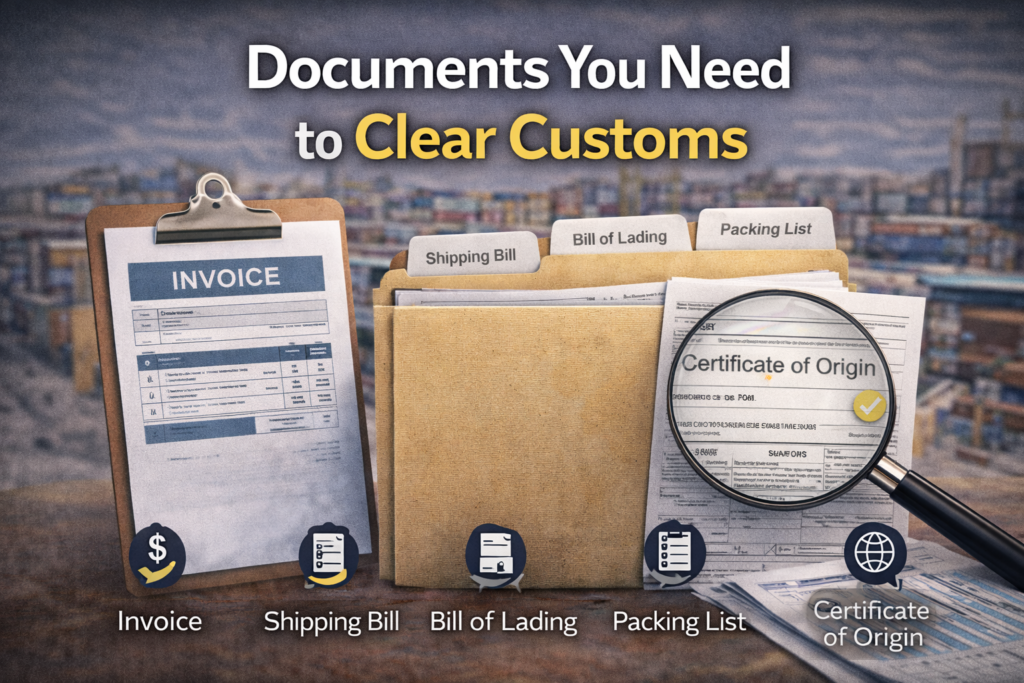
Missing or incorrect paperwork is the leading cause of customs delays. Get these ready before your shipment even leaves China.
Commercial Invoice
This is the most important document in your entire customs filing. It declares the buyer, seller, product descriptions, unit prices, and total value. Customs authorities use it directly to calculate your import duties. Any inaccuracy here—wrong value, vague description, mismatched totals—can trigger a hold or an audit.
Packing List
The packing list details the quantity, weight, and dimensions of every item in the shipment. It must match the commercial invoice exactly. A discrepancy between the two is one of the fastest ways to get your shipment flagged for physical inspection.
Bill of Lading (B/L) or Air Waybill (AWB)
This is your proof that the shipment exists and is in transit. For sea freight, you’ll receive a Bill of Lading from the shipping line. For air freight, it’s an Air Waybill. You need this document to legally take possession of your goods at the destination.
Customs Entry Form
In the US, this is CBP Form 7501 (Entry Summary), which your customs broker typically files electronically through the Automated Broker Interface (ABI). Other countries have equivalent declarations.
Certificate of Origin
Not always required, but it matters. If a trade agreement grants your goods a reduced duty rate, you’ll need this to qualify. For Chinese-origin goods entering the US, it can also determine which tariff rates apply.
Import Permits or Licenses
Certain product categories require pre-approval before they can enter the country. This includes food and beverages, cosmetics, electronics with radio frequency components, medical devices, and children’s products. Check with the relevant agency before you place your order—not after your container arrives.
Quick Rule: Every document must agree with every other document. A different product description on your invoice versus your packing list is enough to trigger inspection, even if everything else is perfect.
Who Actually Pays Customs—FOB, CIF, or DDP?
This is one of the most common points of confusion when buying from Chinese suppliers, and it’s rarely explained clearly.
Your Incoterm (the shipping term in your contract) determines where the supplier’s responsibility ends, and yours begins.
FOB (Free on Board)
Your supplier loads the goods onto the vessel at the Chinese port. From that point on, freight, insurance, customs clearance at your destination, and import duties are entirely your responsibility. This is the most common term used when buying from China—and the one that catches most buyers off guard when the duty bill arrives.
CIF (Cost, Insurance, Freight)
Your supplier covers shipping and insurance to your destination port. But customs clearance and import duties at the destination are still your problem.
DDP (Delivered Duty Paid)
The supplier handles everything—freight, insurance, customs, and duties—right to your door. You pay a higher unit cost, but there are no surprise fees on arrival. This is popular for smaller orders or first-time buyers who want simplicity over cost.
If your supplier quotes FOB and you haven’t budgeted for destination customs costs, you’re going to get a nasty surprise. Always clarify which Incoterm applies and factor in the full landed cost before placing an order.
How China’s Import Duties Are Calculated
Your duty bill has several layers. Here’s how they stack.
Base Import Duty Rate
Every product has an HS code—a Harmonized System classification number that customs authorities worldwide use to identify goods. In the US, it’s 10 digits long. Your base duty rate is determined by this code. Approximate ranges by category:
- Consumer electronics: 0–7.5%
- Textiles and apparel: 10–25%
- Plastic goods: 3–6%
- Furniture: 0–6%
- Steel and aluminum: varies + additional tariffs may apply
You can look up rates directly on the USITC Harmonized Tariff Schedule. For the UK, use the HMRC Trade Tariff. For the EU, use TARIC.
Section 301 Tariffs (US—still active)
On top of the base duty, most goods from China are subject to Section 301 tariffs imposed by the US Trade Representative. These range from 7.5% to 25%, depending on the product category, and they apply in addition to the base rate.
Your Landed Cost Formula
To avoid sticker shock, calculate this before you order:
Product Cost + Freight + Base Duty + Section 301 Tariff + Broker Fee = Total Landed Cost
Skipping this step is how importers end up with margins they can’t sustain.
The 2025 Tariff Changes Every China Buyer Needs to Know
This section is what most competitor guides skip entirely—and it’s the most important update in years for anyone sourcing from China.
The $800 De Minimis Exemption for China Is Gone
Previously, any shipment valued under $800 entering the US qualified for de minimis treatment: no duties, no formal entry required. This was heavily used by e-commerce sellers, dropshippers, and importers testing new products with small orders.
As of May 2, 2025, the de minimis exemption was eliminated for all goods of Chinese origin under Executive Order 14256. Every shipment from China—regardless of declared value—is now subject to full customs duties and standard entry procedures.
This was later extended further: Executive Order 14324 suspended de minimis for all countries globally, effective August 29, 2025.
What this means for you: Ordering a $50 sample batch from a Guangdong supplier? You’re filing customs now. Testing a new product line with a small trial order? Budget for duties. The old workaround is closed.
IEEPA Tariffs (New in 2025) Additional tariffs were imposed under the International Emergency Economic Powers Act (IEEPA) earlier in 2025. Following a temporary US-China trade agreement in May 2025, a 10% baseline IEEPA tariff currently applies to most Chinese imports (reduced from the initial 125% rate). This stacks on top of base duties and Section 301 tariffs.
Important: The tariff situation with China continues to evolve rapidly. Always verify current rates with CBP.gov or a licensed customs broker before finalizing your cost projections.
Do You Need a Customs Broker?
Technically, you can handle your own customs filing for small informal entries in the US (shipments under $2,500). Practically, it’s rarely worth doing yourself once you’re running a real import operation.
A licensed customs broker is authorized by CBP to act on your behalf. They file your entry documents, classify your goods under the correct HS code, calculate your duties, coordinate with CBP if your shipment gets flagged, and pay duties through their account. You reimburse them.
Broker fees for standard shipments typically run $75–$300 per entry. Many freight forwarders bundle brokerage services—but ask explicitly, because it’s not always included.
You should definitely use a broker if:
- Your shipment is valued at $2,500 or more (formal entry required in the US)
- Your products fall under FDA, USDA, EPA, or CPSC oversight
- You’re importing goods subject to anti-dumping or countervailing duties
- It’s your first time clearing this product category
The cost of a broker is almost always less than the cost of a customs hold, a reclassification penalty, or a failed inspection.
The US Customs Process for China Imports: Specifics
If you’re shipping into the United States, here’s what the process looks like step by step.
The Regulating Authority
CBP All imports entering the US are processed by US Customs and Border Protection, a division of the Department of Homeland Security. CBP enforces import rules, collects duties, and coordinates with partner agencies.
ISF Filing—Don’t Miss This Deadline
For ocean freight from China, you or your broker must file an Importer Security Filing (ISF-10) at least 24 hours before the vessel departs the Chinese port. This is not optional. CBP can issue penalties of $5,000 per violation for late, missing, or inaccurate ISF filings.
Formal vs. Informal Entry
- Informal entry: Shipments under $2,500 for most goods. Lower documentation requirements; no customs bond needed.
- Formal entry: Shipments valued at $2,500 or more. Requires a full customs entry, payment of duties, and a customs bond.
Customs Bond
A customs bond is a financial guarantee that duties and fees will be paid. It’s required for all formal entries and all ocean freight shipments regardless of value. You have two options:
- Single-entry bond: Covers one shipment. Costs approximately 0.5–1% of the shipment’s value.
- Continuous bond: Covers all entries for 12 months. Typically $300–$600 per year—a better deal if you import more than a few times annually.
Partner Government Agencies
Depending on what you’re importing, CBP will coordinate with other agencies before releasing your goods:
- FDA—food, beverages, cosmetics, supplements, medical devices
- EPA—vehicles, engines, certain chemicals
- USDA/APHIS—agricultural products, plants, animal products
- CPSC—children’s toys and products
A hold from one of these agencies can add two to six weeks to your clearance timeline. The only way to avoid it is to confirm compliance requirements before your shipment leaves China.
Mistakes That Get China Shipments Held at Customs

These are the most common errors—and most of them are avoidable.
1. Undervaluing Goods on the Invoice
Declaring a lower value to reduce your duty bill isn’t clever—it’s customs fraud. CBP cross-references declared values against transaction databases and market pricing. If they find a discrepancy, the consequences include penalties, seizure of goods, and potential bans on future imports.
2. Misclassifying the HS Code
Your Chinese supplier may assign an HS code on export documents that doesn’t match what the product actually is. Sometimes this is an error; sometimes it’s intentional. Either way, you’re responsible for the correct classification on import. Wrong HS code means wrong duty rate, which means an underpayment and the associated penalties.
3. Invoice and Packing List Mismatches
If the commercial invoice says 500 units and the packing list says 480, expect a flag. Customs officers are looking for consistency. A mismatch between any two documents will slow your clearance at a minimum.
4. Late or Missing ISF Filing (US Ocean Freight)
There are no grace periods and no common-sense exceptions. File late, file wrong, or forget to file—the $5,000 penalty stands. This is a non-negotiable deadline.
5. Skipping Product Compliance Checks
Many importers discover their goods need FDA registration or CPSC testing only after the shipment arrives. That discovery will cost you—storage fees accumulate daily while you sort it out. Research compliance requirements before the order is placed.
6. Assuming De Minimis Still Applies
As covered above, the $800 exemption no longer protects China-origin shipments. If your import model relied on splitting orders or sending frequent low-value test batches under the threshold, you need to recalculate your landed costs.
How Long Does the Customs Process Actually Take?
Here’s a realistic timeline for China imports clearing US customs:
| Scenario | Expected Timeframe |
| Clean paperwork, no inspection | 1–3 business days |
| Flagged for document review | 3–7 business days |
| Physical examination of cargo | An additional 5–10 business days |
| Partner agencies hold (FDA, USDA, etc.) | 2–6 weeks (in some cases longer) |
The factors most likely to extend your clearance time are incomplete or mismatched documents, incorrect HS codes, goods that match import watchlist criteria, or products requiring partner agency sign-off.
The single most effective thing you can do to speed up clearance is to have every document accurate and ready before your shipment departs China.
Suggested: How to Order Samples from China: A Complete Guide
Final Thoughts
The customs process when buying from China is more layered than most suppliers let on when quoting you a price. The actual cost of importing isn’t just the invoice value—it’s duties, tariffs, broker fees, bonds, and potential inspection delays all added together.
Three things matter most:
First, get your documents right before the shipment leaves. Errors in the commercial invoice or packing list are the easiest problem to prevent and the most expensive to fix at the port.
Second, understand what you owe. Base duty rates, Section 301 tariffs, and 2025 IEEPA surcharges can stack quickly. Run your landed cost calculation using the USITC Harmonized Tariff Schedule before you confirm your order.
Third, work with a licensed customs broker for any commercial shipment. The fee is small relative to what a preventable customs hold costs in storage, penalties, and lost time.
If you have specific questions about clearing a product category or calculating your duty exposure, CBP’s import resources and the USTR Section 301 tariff list are the most authoritative sources to check every shipment before.
Frequently Asked Questions

1- Does the $800 de minimis exemption still apply to China imports?
No. As of May 2, 2025, goods of Chinese origin are no longer eligible for de minimis treatment in the US. All shipments, regardless of value, are subject to applicable duties and standard customs procedures. (Source: Federal Register, EO 14256)
2- What is an ISF filing, and who is responsible for it?
An Importer Security Filing (ISF-10) is a pre-departure data submission required by CBP for all ocean freight entering the US. It must be filed at least 24 hours before the vessel leaves the port in China. Your customs broker can handle this on your behalf.
3- Can I clear customs myself without a broker?
For informal entries under $2,500, yes—but it’s rarely advisable. For formal entries and regulated goods, using a CBP-licensed customs broker is strongly recommended.
4- What’s the difference between a single-entry bond and a continuous bond?
A single-entry bond covers one shipment. A continuous bond covers all your entries for 12 months and typically costs $300–$600 per year, more economical if you import regularly.
5- What happens if customs holds my shipment?
Your goods remain at the port or customs facility. Storage and demurrage fees begin accruing, and you’ll need to resolve the issue—either correcting documents, paying outstanding duties, or demonstrating compliance—before goods are released. This is why proactive document preparation matters.
6- How do I find the correct HS code for my product?
Start with the USITC Harmonized Tariff Schedule for the US. For the UK, use the HMRC Trade Tariff. If you’re uncertain, a licensed customs broker can classify your goods correctly—and it’s worth paying for that certainty.
Last reviewed: February 2026. Tariff regulations are subject to change. Verify current rates and rules with CBP or a licensed customs broker before importing.
Suggested Readings: