

Every year, thousands of B2B businesses lose money on defective bulk orders because they skipped one crucial step: ordering samples first.
A UK-based electronics retailer once placed a $45,000 order for phone accessories from a highly rated Chinese supplier, only to receive products with misaligned logos and packaging that tore during basic handling. The entire shipment was unsellable, and the supplier refused returns because “bulk orders are final.” This nightmare scenario happens more often than you’d think, yet it’s completely preventable.
The solution is straightforward: always order product samples from Chinese suppliers before committing to bulk purchases, and follow a systematic evaluation process to verify quality, customization accuracy, and supplier reliability.
Why Ordering Samples from China Is Non-Negotiable for B2B Buyers
Before committing thousands of dollars to bulk production, you need tangible proof that your supplier can deliver what they promise.
Samples serve as your insurance policy against quality failures, customization errors, and unreliable partnerships that can devastate your business reputation and bottom line.
Quality Assurance: What Photos Can’t Tell You
Product photos and videos are marketing tools designed to impress, not inform. A supplier’s image might show flawless surfaces under professional lighting, but a physical sample reveals what your customers will actually receive.
When you hold a product sample in your hands, you can assess material thickness, stitching quality, paint adhesion, and structural integrity in ways that digital media simply cannot convey.
Consider how a fitness equipment company tested resistance bands from three different Guangzhou suppliers. The photos looked identical across all three quotes, but the physical samples told completely different stories. Supplier A’s bands had a chemical smell that lingered for days, indicating low-grade rubber that would likely trigger customer complaints.
Supplier B’s bands felt appropriate but snapped after just 50 stretches during stress testing. Supplier C’s samples passed both smell and durability tests, ultimately winning the contract. Without hands-on testing, this buyer would have had a one-in-three chance of choosing correctly—terrible odds when your business reputation is at stake.
Practical testing protocol: Use your samples exactly as your end customers will. If you’re sourcing kitchen tools, cook with them. For outdoor products, expose them to water and temperature changes. For electronics, run continuous operation tests for 24-48 hours. Drop test your packaging from waist height at least five times. These simple actions reveal manufacturing shortcuts that cost you customers later.
Customization Verification: Protecting Your Brand Identity
Customization miscommunication causes some of the most expensive sourcing mistakes in B2B commerce. A Canadian cosmetics brand once approved design files for custom soap packaging, only to receive 10,000 boxes with their logo printed 3 mm off-center—a small shift that made every box look unprofessional. The color they specified as “rose gold” (Pantone 14-1323) arrived as orange-bronze because the factory used a similar but cheaper ink formulation.
When you order a customized sample, you’re conducting a dress rehearsal for your bulk production. This sample shows you whether the supplier can execute your brand guidelines accurately or whether they’ll take creative liberties that damage your market positioning.
You can verify that your logo placement matches your specifications down to the millimeter, that text remains legible at the actual product size, and that color matching meets your Pantone or CMYK standards.
Real-world example: A German automotive parts distributor requested samples of branded toolkits from a Shenzhen manufacturer. The digital mock-up showed clean debossing on the leather case, but the physical sample revealed shallow, barely visible branding because the factory’s debossing equipment was designed for softer materials. Catching this issue at the sample stage allowed them to switch to a different supplier with proper tooling, saving them from receiving 5,000 unusable cases three months later.
Building Supplier Trust Through Observable Behavior
A supplier’s sample handling process reveals their operational culture more honestly than any certification or trade show presentation.
When a factory ships your sample on time, packages it carefully to prevent damage, includes all requested documentation, and follows up proactively, these actions demonstrate the organizational discipline that predicts successful bulk production.
Conversely, warning signs during the sample phase almost always intensify during production. If a supplier takes three weeks to ship a sample they promised in five days, missed communications become the norm rather than the exception. And, if they argue about minor customization requests during sampling, they’ll resist quality improvements during bulk production. If they pressure you to skip the sample and go straight to production “to save time,” they’re prioritizing their convenience over your risk management.
Case study: An Australian home goods importer worked with two Ningbo suppliers simultaneously, both offering similar products at comparable prices. Supplier X delivered samples in eight days as promised, with detailed packing lists and proactive shipping updates.
Supplier Y’s sample arrived three weeks late with no explanation and damaged packaging. The importer chose Supplier X for a trial order of 2,000 units, which arrived on schedule with zero defects. Industry contacts later revealed that Supplier Y had a reputation for production delays and quality inconsistencies—issues that were visible from the very first sample interaction.
Market Testing and Marketing Preparation
Physical samples enable revenue-generating activities before your bulk inventory arrives, significantly reducing your time-to-market and financial risk.
You can create authentic product photography and video content that showcases actual merchandise rather than supplier stock images. You can send samples to industry reviewers, trade publications, or beta customers to generate early buzz and gather feedback that shapes your final product specifications.
A US-based pet supplies company used samples from a Dongguan manufacturer to create social media content three months before their bulk order shipped.
The videos generated 50,000 views and 1,200 pre-orders, which not only validated their product concept but also provided working capital to fund the bulk purchase.
They also discovered through customer feedback that their original packaging design was confusing, allowing them to request modifications before production began.
Step-by-Step Process for Ordering Samples from China
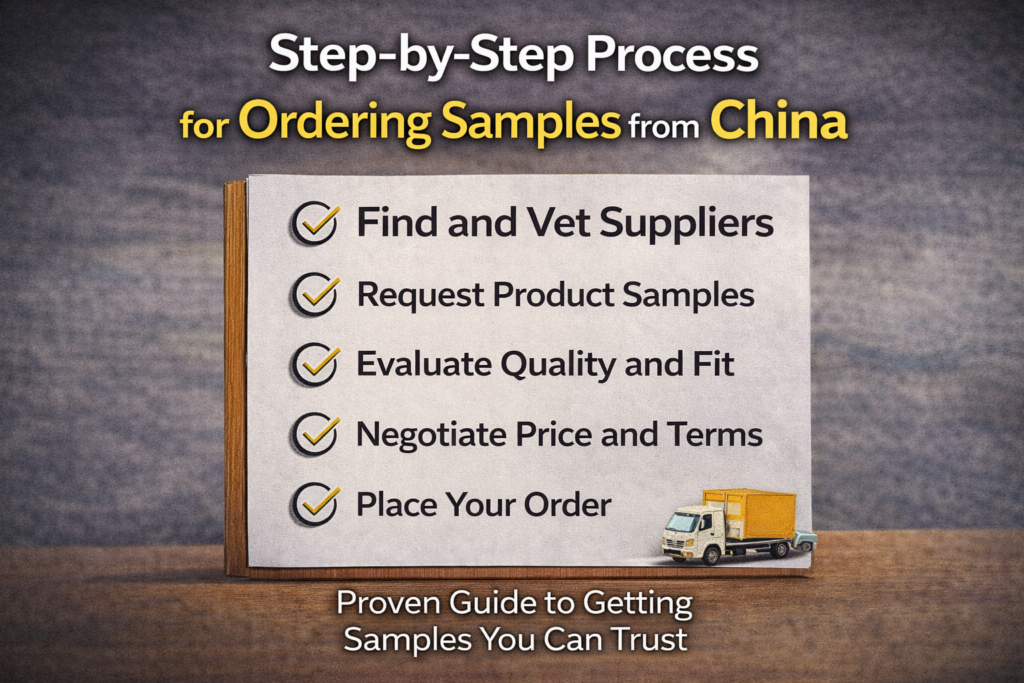
Successful sample ordering requires a structured approach that minimizes miscommunication and maximizes the value of your evaluation.
Follow these six steps to transform supplier conversations into actionable decisions backed by physical proof rather than promises.
Step 1: Define Your Product Requirements with Precision
Vague specifications guarantee disappointing results. Instead of requesting “high-quality stainless steel water bottles,” provide detailed specifications: “500 ml capacity, 304 food-grade stainless steel, double-wall vacuum insulation maintaining temperature for 12+ hours, powder-coated exterior in matte black (RAL 9005), leak-proof screw cap with silicone O-ring, dimensions not exceeding 70 mm diameter × 245 mm height, weight between 280 and 320 g.” “
Create a specification document that includes exact measurements with tolerances (e.g., “25 cm ± 0.5 cm”), material grades with international standards (e.g., “ABS plastic, UL94 V-0 flame rating”), color references using industry systems (Pantone, RAL, or CMYK values), surface finish descriptions (e.g., “brushed aluminum, 180-grit finish”), and functional performance requirements (e.g., “withstands drops from 1.5 meters onto concrete”).
Include visual references: Attach photos of similar products, technical drawings showing dimensions and assembly, material swatches if available, and packaging examples that demonstrate your quality expectations.
A New Zealand outdoor gear company reduced its back-and-forth communication with suppliers by 60% simply by creating a two-page specification sheet with annotated photos showing exactly what they wanted.
Step 2: Find and Vet Suppliers Using Multiple Verification Methods
Start with established B2B platforms: Alibaba, Global Sources, and Made-in-China offer supplier verification systems, transaction histories, and buyer reviews.
Look for “Gold Supplier” status (typically requiring 3+ years of platform membership and business license verification), response rates above 85%, and detailed company profiles showing factory photos and certifications.
However, platform presence alone doesn’t guarantee reliability. Conduct deeper verification:
- Check business registration: Request the supplier’s business license and verify it through China’s National Enterprise Credit Information Publicity System (gsxt.gov.cn). This free government database confirms legal business status, registration date, and registered capital.
- Verify factory ownership: Some “manufacturers” are actually trading companies that outsource production. Ask directly: “Do you own the factory, or do you source from other facilities?” Request factory photos showing production lines, quality control areas, and warehouse facilities. A genuine manufacturer can usually provide these within hours.
- Assess communication quality: Strong suppliers respond to initial inquiries within 24 hours with specific answers to your questions. They address your requirements point-by-point rather than sending generic product catalogs. They volunteer information about production capacity, lead times, and customization limitations without evasion.
- Request a video call: A 15-minute video tour of their facility reveals more than dozens of email exchanges. You can observe factory organization, equipment condition, and staff professionalism. One US importer discovered during a video call that a “factory” was actually a small trading office with three employees—a major red flag they would have missed through email alone.
Working with sourcing partners: Companies like CHANGE Commerce specialize in connecting B2B buyers with verified Chinese manufacturers, conducting factory audits, managing quality control, and streamlining the entire procurement process.
This approach works particularly well for businesses ordering samples from multiple product categories simultaneously or those new to international sourcing who need expert guidance through supplier verification, negotiation, and logistics.
Step 3: Request Samples with Clear Specifications and Timelines

Optimization of procurement or purchasing product order for online shopping and service solution.Management for business growth.not ai generated
Craft a concise, professional sample request that includes:
Your sample request email template: “Hello [Supplier Name],
We are interested in ordering a sample of [specific product name] to evaluate for a potential bulk order of [estimated quantity] units.
Product specifications: [Paste or attach your detailed requirements]
Sample requirements:
- Quantity: [1-3 units]
- Customization: [Yes/No—if yes, specify logo placement, colors, and text.]
- Delivery address: [Complete address with contact phone]
Please provide:
- Sample unit price (including customization if applicable)
- Sample production time
- Shipping cost and estimated delivery time via express courier
- Sample refund policy for future bulk orders
- Formal quotation including all costs
We appreciate your prompt response and look forward to working together.”
What to expect in their response: Professional suppliers typically reply within 24-48 hours with a detailed quotation breaking down sample costs ($15-150 depending on product complexity), customization fees ($20-200 for logo printing or minor modifications), express shipping costs ($25-60 via DHL, FedEx, or UPS), and total production time (3-10 days for stock samples, 7-21 days for customized samples).
Step 4: Arrange Payment and Shipping Securely
Payment methods ranked by buyer protection:
- Platform escrow (Alibaba Trade Assurance, etc.): Highest protection—payment releases only after you confirm receipt and quality. Ideal for first-time transactions.
- PayPal Business transactions: Good buyer protection and dispute resolution, though some Chinese suppliers charge 3-5% fees to cover PayPal’s transaction costs.
- Credit card payments: Offer chargeback protection, but not all suppliers accept cards due to processing fees.
- Wire transfer (T/T): Common for established supplier relationships but offers minimal buyer protection. Only use after building trust through successful sample orders.
Critical payment verification: Before transferring money, confirm the bank account name matches the company name on their business license exactly.
A British retailer once sent a sample payment to an account under an individual’s name rather than the company name—a common scam where fraudsters impersonate legitimate suppliers. The money disappeared, and the “supplier” stopped responding immediately.
Shipping strategy: Always request express courier service (DHL, FedEx, UPS) for samples rather than slower postal or sea freight options. The $30-50 premium for express shipping pays for itself by reducing your evaluation timeline from 4-6 weeks to 7-12 days.
Insist on door-to-door service with tracking numbers, and ask the supplier to declare a low value ($20-50) to minimize customs duties on samples, which is standard practice.
Step 5: Inspect and Evaluate Systematically
Create a standardized evaluation checklist that you use for every sample:
Physical inspection:
- Package condition: Any crushing, water damage, or poor protection during shipping?
- Product appearance: Clean surfaces, consistent colors, proper alignment of all elements?
- Dimensions and weight: Do they match specifications within acceptable tolerances?
- Material quality: Appropriate thickness, texture, flexibility, or rigidity?
- Assembly and construction: Secure joints, clean welds, tight stitching, no gaps or misalignment?
- Finish quality: Smooth edges, even coating, no scratches, bubbles, or rough spots?
Functional testing:
- Does it perform its intended function correctly?
- Stress test beyond normal use (bend, twist, pull, compress within reason)
- Durability simulation (repeated use over several days)
- Safety testing (sharp edges, pinch points, electrical safety, chemical smell)
Documentation review:
- Compare the received item against your original specifications point-by-point
- Photograph any discrepancies with measurements for reference
- Note both problems AND positive surprises
Provide structured feedback: “Thank you for the sample received on [date]. Overall impression: [positive/needs improvement]. Specific observations:
- ✓ Material quality meets requirements—[specific detail]
- ✗ Logo placement 5 mm too far right—see attached photo
- ✓ Packaging strength appropriate
- ✗ Product weight 340g vs. specified 280-320g range
Please advise if adjustments can be made before bulk production.”
This fact-based approach maintains professionalism while clearly communicating your standards. Good suppliers appreciate specific feedback because it helps them meet your expectations.
Their response to this feedback—whether they’re defensive, dismissive, or collaboratively problem-solving—tells you everything about long-term partnership viability.
Step 6: Compare Multiple Suppliers Objectively
If you’ve ordered samples from 2-3 suppliers (recommended for important products), create a comparison matrix:
| Criteria | Supplier A | Supplier B | Supplier C | Weight |
| Sample quality | 8/10 | 9/10 | 7/10 | 30% |
| Customization accuracy | 9/10 | 7/10 | 8/10 | 25% |
| Communication responsiveness | 9/10 | 6/10 | 8/10 | 20% |
| Price competitiveness | 7/10 | 8/10 | 9/10 | 15% |
| Delivery punctuality | 8/10 | 9/10 | 6/10 | 10% |
| Weighted Score | 8.2 | 7.8 | 7.7 |
This quantitative approach prevents emotional decision-making or over-weighting a single factor like price.
A Singapore electronics distributor discovered that their lowest-priced supplier scored poorly on communication and delivery—issues that would have cost them far more than the 8% price savings during actual production.
Expert Tips for Successful Sample Orders

Smart sample ordering habits separate successful importers from those who struggle with quality issues and supplier problems.
These practical tips help you extract maximum value from every sample while protecting your budget and timeline.
1- Request Production Samples, not Showroom Samples
Some suppliers maintain a set of perfect “golden samples” for customer evaluation that don’t represent actual production quality. Specify: “Please send a sample from current production, not a special showroom sample.”
2- Document Everything in Writing
Verbal agreements mean nothing in international trade disputes. After any phone or video call, send an email summarizing what was discussed and agreed upon: “Thank you for our call today. To confirm, we agreed that…”
3- Factor in Total Landed Costs
A sample quoted at $35 might actually cost you $85 after customization fees ($20), shipping ($25), and your time processing the order (valued conservatively). Calculate this fully before comparing multiple suppliers.
4- Understand Customization Limitations
Factories have minimum order quantities (MOQs) for custom molds, special colors, or unique packaging. A supplier might send you a sample with your logo applied manually, but bulk production might require a $500 mold and a 1,000-unit MOQ.
Ask explicitly: “Will this exact customization method be used in bulk production, and what are the associated MOQs and tooling costs?”
5- Request Supplier-Paid Samples for Large Commitments
If you’re planning a $50,000+ initial order, many suppliers will provide samples free of charge (you pay shipping only) because the potential business justifies the investment.
Don’t hesitate to negotiate this, especially if you’re evaluating their capabilities against competitors.
You might also like to read: How to Do Quality Control When Buying from China?
Common Pitfalls to Avoid
Even experienced importers make preventable mistakes during the sample ordering process. Recognizing these common pitfalls helps you maintain quality standards and avoid costly errors that undermine your sourcing success.
1- Rushing the Evaluation
Spending 15 minutes examining a sample you’ll potentially order 5,000 units of is poor risk management. Dedicate several hours over multiple days to thorough testing and reflection.
2- Ignoring Small Defects
That tiny scratch or slight color variation in your sample will appear in 30-40% of your bulk order. If it bothers you now, it will definitely bother your customers later.
3- Forgetting to Test Packaging
Many buyers focus entirely on the product and discover during a bulk shipment that the packaging splits open, fails to protect the contents, or looks unprofessional on the shelf. Test packaging strength and visual appeal just as carefully as the product itself.
4- Skipping Samples for “Simple” Products
Even basic items like t-shirts or phone cases have quality variations. Material weight, print quality, sizing accuracy, and stitching durability all vary significantly between suppliers.
Moving Forward: From Samples to Successful Partnerships
Ordering samples from China transforms international sourcing from a gamble into a manageable business process. The small investment—typically $50-200 per sample—protects you from catastrophic losses when bulk orders fail to meet expectations.
By following this systematic approach, you build supplier relationships based on verified quality, clear communication, and mutual accountability rather than hope and risk.
Frequently Asked Questions

1- How long does it take to receive samples from China?
Express courier delivery typically takes 5-8 business days from shipment to your door. However, the total timeline includes sample production time: stock samples ship within 2-3 days, while customized samples requiring logo printing take 7-15 days to produce before shipping begins.
2- Can I negotiate sample prices with suppliers?
Yes, particularly when ordering multiple samples or committing to bulk orders. Many suppliers offer 20-30% sample discounts for serious buyers or refund sample costs entirely when you place production orders exceeding certain thresholds, often $3,000-5,000 minimum.
3- Should I order samples from multiple suppliers?
Absolutely, especially for critical products. Comparing 2-3 suppliers simultaneously provides quality benchmarks, reveals pricing variations, and ensures you don’t settle for mediocre service. The extra investment (usually $150-400 total) is insignificant compared to choosing poorly.
4- Do suppliers refund sample costs after bulk orders?
Many suppliers refund sample fees (though usually not shipping costs) when you place bulk orders, but policies vary significantly. Some require minimum order quantities ($5,000+), while others refund proportionally. Always get refund terms in writing before paying for samples.
5- What if the sample quality doesn’t meet expectations?
Provide detailed, photo-documented feedback explaining specific deficiencies and ask whether improvements are possible. Professional suppliers typically offer revision rounds for customized samples. If they respond defensively or produce another poor-quality sample, move on immediately to alternative suppliers.